
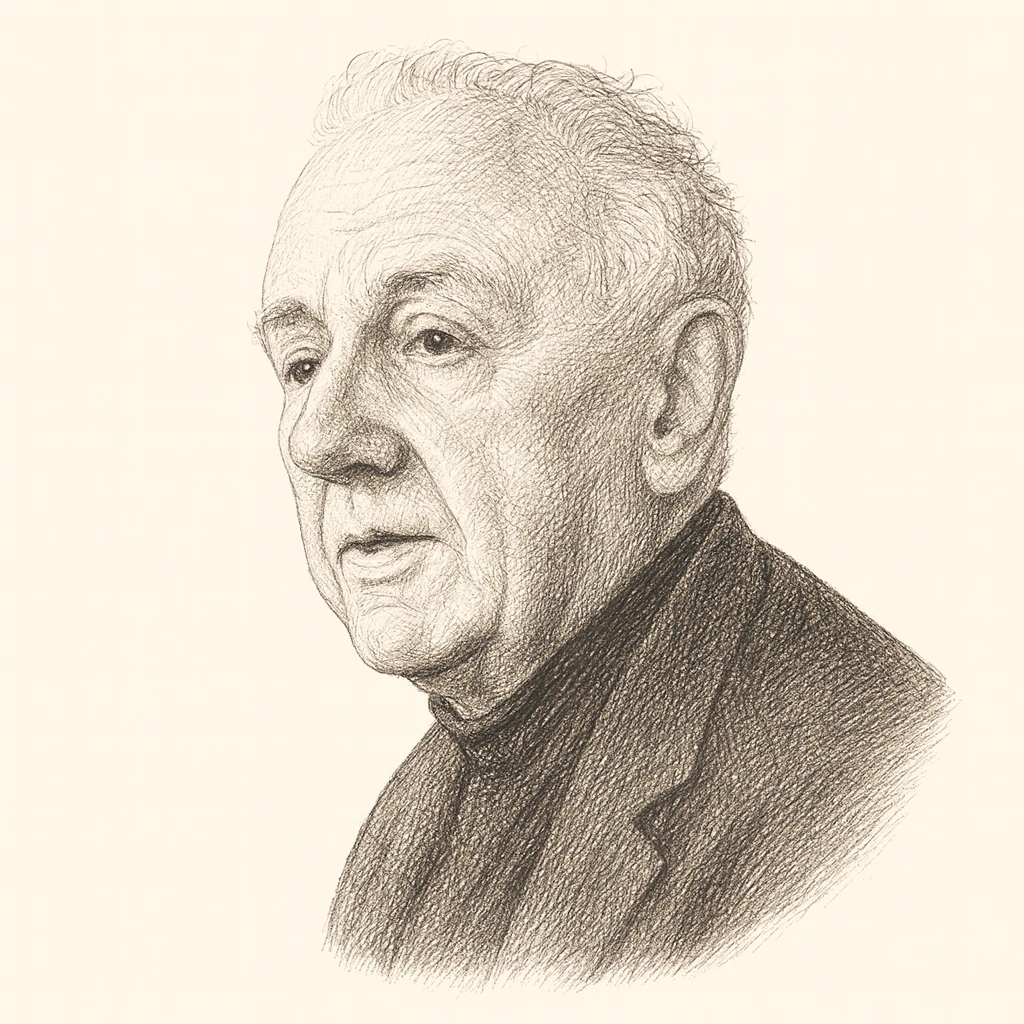
Alasdair MacIntyre was the most influential Aristotelian philosopher of his era, a Scottish-born thinker whose long and intellectually restless career culminated in a powerful revival of virtue ethics and communitarian critique of liberal modernity that has shaped moral and political philosophy for more than four decades. His 1981 book After Virtue is one of the small number of recent philosophical works that can fairly be described as having reoriented an entire subfield. Published at a moment when analytical moral philosophy had largely abandoned serious engagement with the history of ethics, After Virtue argued that contemporary moral discourse had become incoherent fragments of older traditions, and that any genuine recovery of rational moral argument required returning to the Aristotelian tradition of virtue ethics that modernity had mistakenly abandoned.
MacIntyre was born in 1929 in Glasgow, Scotland, raised speaking both English and Scottish Gaelic, and educated at Manchester University and Oxford. His early intellectual life was shaped by an unusual combination of Marxism and Christianity. He was a committed Marxist in his twenties, writing for Marxist journals and engaged with the British New Left, while also maintaining serious engagement with Catholic moral and theological tradition. This combination of Marxist social analysis and Christian ethical seriousness shaped his entire subsequent career, even as his specific commitments shifted repeatedly. He moved through different positions over several decades — secular Aristotelian, sympathetic observer of Christian tradition, and eventually committed Thomist Catholic — with each transition reflecting his intellectual restlessness and his conviction that contemporary moral philosophy had to engage with the actual traditions from which moral thinking arose rather than pretending to reason about ethics from some imaginary neutral standpoint.
MacIntyre spent most of his academic career in the United States, teaching at Brandeis, Boston University, Vanderbilt, Notre Dame, and Duke. His breakthrough came in 1981 with After Virtue, which opened with a famous thought experiment. Imagine, MacIntyre asked, that civilization had been destroyed by a catastrophe that eliminated the institutional and social frameworks in which science had been practiced, leaving behind only fragments of scientific texts — half-remembered formulas, isolated experiments, bits of theoretical vocabulary — that survivors tried to piece together without understanding the original contexts that had given them meaning. The result would be a pseudo-science that used scientific vocabulary without actually being science. MacIntyre's argument was that this was precisely the state of contemporary moral discourse. We still used moral vocabulary — rights, obligations, justice, virtue — but we had lost the traditions within which that vocabulary had originally made sense, and our moral arguments were consequently interminable and unresolvable.
What MacIntyre proposed as a remedy was a recovery of the Aristotelian framework of virtue ethics, in which moral life was understood as the cultivation of character traits that enabled human beings to flourish according to their specific nature and their specific social roles. This framework, MacIntyre argued, had been gradually dismantled by the Enlightenment project of grounding morality in abstract universal principles that could be justified to any rational agent regardless of their particular tradition or community. The Enlightenment project had failed, in MacIntyre's view, because no such universal grounding was possible — every moral framework depends on particular narratives, particular traditions, and particular communities that shape what rationality itself means within them. The choice modernity faced was not between Aristotelian particularism and Enlightenment universalism but between rival traditions whose claims could only be evaluated from within. And contemporary liberalism, MacIntyre argued, was itself just one tradition among others, no more grounded in universal reason than any of the traditions it claimed to transcend.
MacIntyre developed this framework across a series of major books that extended the argument of After Virtue. Whose Justice? Which Rationality? (1988) examined several rival traditions of moral reasoning — Aristotelian, Augustinian, Scottish Enlightenment, liberal — and argued that each had internal standards of rationality that made sense within their own frameworks but that could not be evaluated from some neutral external standpoint. Three Rival Versions of Moral Inquiry (1990) extended the analysis to contemporary academic debates. Dependent Rational Animals (1999) developed the anthropological foundations of his virtue ethics, emphasizing how human beings develop through networks of dependence and care that liberal individualism had systematically underestimated. His later work continued to develop Thomist Aristotelian themes in ways that integrated his mature Catholic commitments.
MacIntyre's political implications were complicated. He was a fierce critic of contemporary liberalism, capitalism, and what he called the "bureaucratic individualism" that dominated modern Western life. He saw the modern nation-state and modern market economy as incapable of sustaining the kinds of communities in which genuine virtue could be cultivated. His positive political vision involved small-scale local communities — parishes, cooperatives, intellectual traditions — in which people could participate in shared practices that shaped their characters through shared work directed at goods internal to those practices. This communitarian vision put him at odds with both liberal individualism and socialist state centralization, and his political writing cannot be easily assimilated to standard left-right categories.
MacIntyre died in May 2025 at ninety-six, having continued to write and teach well into his nineties. His influence on contemporary moral and political philosophy remains enormous, and the revival of virtue ethics he helped launch has become one of the most productive areas of contemporary ethical theory. Whether one accepts his specific conclusions or not, his argument that contemporary moral discourse cannot be understood without attention to the historical traditions from which it arose has shaped how serious philosophers approach the history of ethics.
Alasdair MacIntyre is associated with Traditionalist. See the archetype