
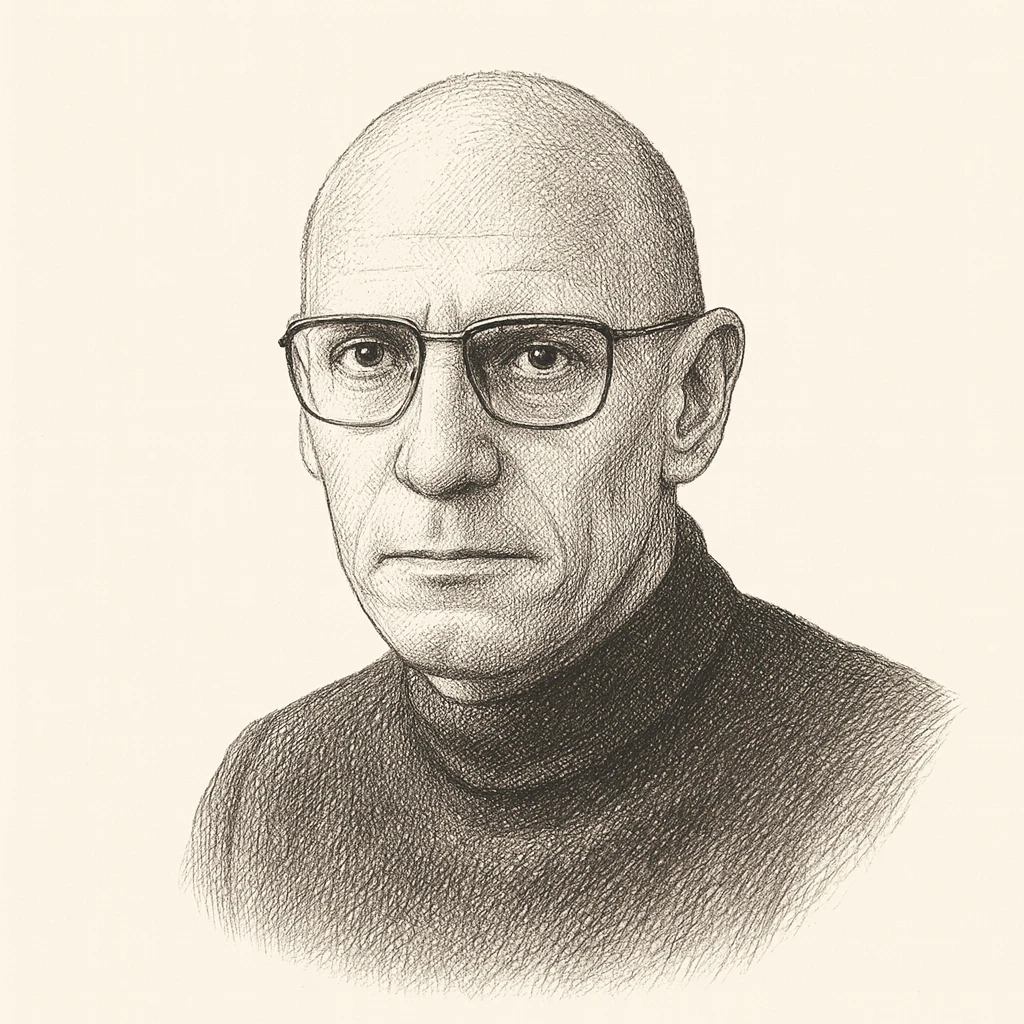
Michel Foucault is arguably the most influential political theorist of the late 20th century outside the Anglo-American analytical tradition, a French philosopher and historian whose work across prisons, psychiatry, sexuality, and the history of knowledge transformed how a generation of scholars thought about power and political authority. His analyses have shaped contemporary critical theory, sociology, history, literary criticism, cultural studies, gender studies, and even parts of libertarian and anti-state thought in ways that cross ideological lines in unpredictable ways. He died in 1984 at the height of his influence, and the debate about what his work actually meant and what political projects it supports has only intensified in the decades since.
Foucault was born in 1926 in Poitiers, France, into a comfortable provincial middle-class family whose expectations he spent his youth systematically rejecting. He was gay in a France that was still largely hostile to homosexuality, depressive to the point of attempting suicide in his twenties, politically radical in various shifting directions, and academically brilliant in ways that both opened doors and made him enemies. He studied philosophy and psychology at the elite École Normale Supérieure in Paris under the Marxist philosopher Louis Althusser, worked briefly in psychiatric hospitals that gave him firsthand experience of institutional power over the mentally ill, taught at universities in Sweden, Poland, and Tunisia, and eventually became one of the dominant figures in French intellectual life from the late 1960s until his death.
His first major book, Madness and Civilization (1961), established the pattern that would run through his entire career. The book was a history of how Western societies had come to define and treat madness from the Renaissance through the 19th century, and its central argument was that the apparently humane treatment of the mentally ill in modern psychiatric institutions was not straightforwardly progress. The old medieval treatment of madness had been harsh but had kept the mad visible within ordinary society. The modern confinement of the mad in asylums had removed them from sight and subjected them to new forms of disciplinary power that Foucault argued were more thoroughly controlling than anything the medieval world had managed. What looked like enlightened progress was actually, Foucault argued, a transformation in the techniques of power rather than an improvement in its moral quality.
This analytical pattern — showing how apparent progress involved the intensification rather than the reduction of power — became Foucault's signature. Discipline and Punish (1975), his most widely read book, traced the shift from premodern public spectacles of punishment (torture, execution, the display of suffering bodies) to modern prison discipline (surveillance, routine, the production of docile and productive subjects). The change was usually presented as a humanitarian improvement: torture was cruel, prison was more civilized. Foucault argued that this missed what was actually happening. The new forms of punishment were not kinder; they were more effective, producing individuals who disciplined themselves internally rather than simply suffering external pain. The Panopticon — Jeremy Bentham's design for a prison in which every cell could potentially be observed at any time from a central tower — became Foucault's symbol of modern power: power that worked through constant visibility and self-monitoring rather than through direct force.
Foucault's later work, particularly the multi-volume History of Sexuality (1976-1984), developed the framework of what he called "biopolitics" — the way modern power takes life itself as its object of management, producing and regulating populations, bodies, health, and reproduction in ways that classical political theory had never examined. Where earlier political theory had focused on sovereign power (the king's right to command, punish, and kill), Foucault argued that modern power had become something subtler and more pervasive. It operated through countless small disciplinary mechanisms embedded in schools, hospitals, factories, armies, and family life. It produced the categories through which people understood themselves — as sexual subjects of particular types, as workers, as patients, as citizens — and thus shaped the very desires and identities that people then experienced as naturally their own.
Foucault's political standpoint was hard to pin down, and this is part of what made his work so influential across ideological lines. He was associated with the left, participated in prison reform and immigrant rights activism, and his analysis of disciplinary power was widely read as a critique of capitalism and the state. But he also rejected Marxist orthodoxy, resisted the temptation to present his work as straightforward political advocacy, and in his final years became increasingly interested in classical and early Christian "techniques of the self" — the practices through which people shaped their own lives in accordance with their own values. This late interest has led some contemporary readers to treat Foucault as a theorist of individual freedom against all forms of collective power, while others treat him as a critical theorist whose analyses are best applied in explicitly leftist political directions. Both readings find support in his work.
Foucault died in 1984 at fifty-seven, the first famous French intellectual to die of AIDS-related complications at a moment when the disease was still poorly understood and heavily stigmatized. His death was initially reported evasively, in keeping with the prevailing norms about homosexuality and AIDS in early 1980s France. The full disclosure came later, and his life and work have since become central to gay and queer political thought in ways that extend his influence even further into contemporary political conversation.
Michel Foucault is associated with Progressive Activist. See the archetype