
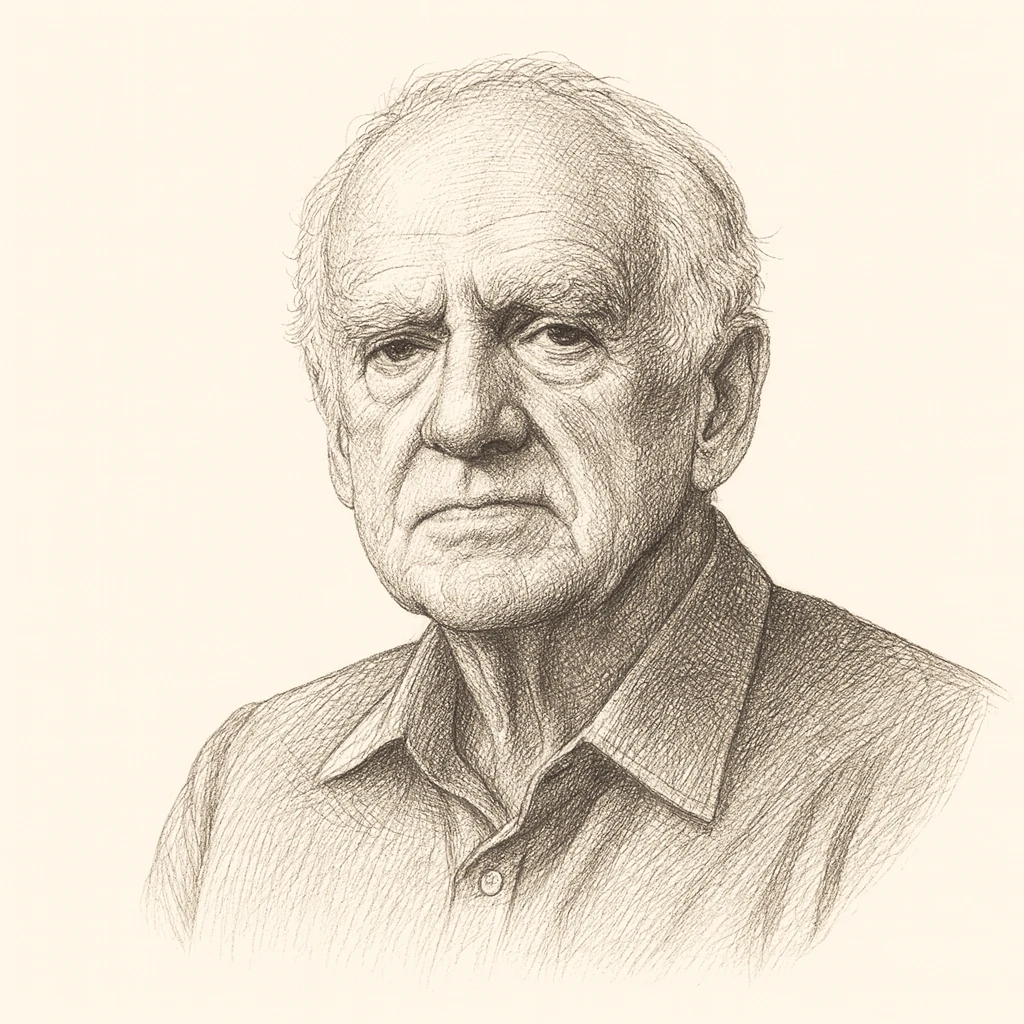
Charles Taylor is one of the most important living political philosophers and the foremost contemporary theorist of the relationship between modern identity, moral frameworks, and political community. His work has shaped debates about multiculturalism, secularism, religious pluralism, the nature of the self, and the distinctive challenges of living in a modern Western civilization that has lost its traditional sources of meaning without replacing them with anything equally coherent. He has spent his career moving between Canadian and British academic institutions and between contemporary Anglo-American analytical philosophy and the continental tradition of Hegel, hermeneutics, and phenomenology, which has allowed him to bring unusual combinations of argument and perspective to contemporary political debates.
Taylor was born in 1931 in Montreal, in the English-speaking minority of a predominantly French-speaking province, and his bilingual and bicultural upbringing shaped his lifelong interest in how political communities hold together across deep differences of language, religion, and cultural identity. He studied at McGill and at Oxford, where he completed his doctorate under Isaiah Berlin and began developing the distinctive philosophical voice that would mark his career. He taught at Oxford and then at McGill, where he spent most of his career, and has also been actively involved in Canadian politics, running unsuccessfully for parliament as a member of the democratic socialist New Democratic Party in the 1960s and serving on several commissions dealing with Quebec's relationship to the rest of Canada. This combination of rigorous academic philosophy with sustained political engagement has shaped his work throughout his career.
Taylor's first major philosophical contribution came in his massive study Hegel (1975), a nearly six-hundred-page intellectual biography and philosophical interpretation that helped restore Hegel to a central place in contemporary Anglo-American political philosophy. For most of the 20th century, Hegel had been dismissed by analytical philosophers as obscure, speculative, and politically reactionary. Taylor's book argued that Hegel was actually the most important source for contemporary thinking about the relationship between individual identity and social community, and that Hegel's account of how selves are constituted through recognition from others and through participation in shared forms of life provided essential resources for contemporary political philosophy that purely Kantian or Lockean frameworks lacked. The book marked Taylor as one of the most serious contemporary readers of the continental tradition and established themes that would run through all of his subsequent work.
Taylor's most influential book was Sources of the Self (1989), a nearly six-hundred-page study of the historical development of modern Western identity from the ancient Greeks through the 20th century. The central argument was that contemporary Western people's sense of themselves as bearers of deep inner feeling, moral significance, and distinctive individuality was not a natural feature of human life but the product of specific historical developments that could be traced through Augustine, Montaigne, Descartes, the Reformation, the Enlightenment, and Romanticism. Understanding this history mattered politically because contemporary debates about moral and political questions were almost always conducted in terms of concepts whose historical origins were invisible to the participants, which meant that participants often talked past each other without recognizing that they were drawing on incompatible philosophical inheritances. Sources of the Self was an attempt to make the deep structure of modern moral frameworks visible so that contemporary political debate could be conducted with more self-awareness about what was actually at stake in various positions.
The book also made a substantive philosophical argument about the self. Contemporary liberal political philosophy, Taylor argued, had inherited a thin conception of personhood from the Enlightenment that treated selves as autonomous rational agents making choices based on their preferences. But actual human selves were not like this. They were constituted by their attachments, commitments, and identifications with communities, traditions, and moral frameworks that gave their lives meaning and that could not be meaningfully chosen from some abstracted standpoint of pure rational autonomy. This was a communitarian argument that ran in parallel with the work of Alasdair MacIntyre and Michael Sandel, and Sources of the Self became one of the foundational texts of contemporary communitarian political philosophy.
Taylor's most politically consequential work has been on multiculturalism. His essay "The Politics of Recognition" (1992) argued that modern identity requires recognition from others, and that policies aimed at correcting the historical misrecognition of minority groups and cultures should be understood not as special favors but as responses to a fundamental dimension of what it means to live a fully human life in a modern society. The argument shaped Canadian debates about French-English relations and indigenous peoples, influenced discussions of multiculturalism across North America and Europe, and provided a theoretical framework for thinking about cultural rights and democratic accommodation that moved beyond both pure individualist liberalism and crude collectivism.
His later book A Secular Age (2007) was his most ambitious work, a nearly nine-hundred-page study of how Western societies shifted from a condition in which religious belief was the default assumption to a condition in which religious belief is one option among many and often an increasingly embattled one. Taylor rejected the standard "subtraction story" that treated secularization as simply the removal of religious beliefs from a pre-existing natural rational framework. Instead he argued that the secular age had required positive construction of new self-understandings, new frameworks of meaning, and new social imaginaries that were themselves as much achievements as the religious frameworks they replaced. The book was enormously influential in religious studies, philosophy of religion, and contemporary political debates about the role of religion in public life, and it established Taylor as one of the most important contemporary interpreters of the distinctive situation of Western civilization in the early 21st century.
Taylor continues to write and teach into his nineties, and his influence on contemporary political philosophy remains substantial. His distinctive combination of historical depth, philosophical rigor, and practical political engagement has made him one of the few living philosophers whose work is read seriously across multiple academic disciplines and political positions. He is widely regarded as a communitarian, but his communitarianism is more philosophically sophisticated than most caricatures suggest, and his willingness to draw on continental sources that most Anglo-American philosophers have dismissed has given his work distinctive resources for addressing contemporary questions about identity, community, and the moral foundations of political life.
Charles Taylor is associated with Traditionalist. See the archetype