
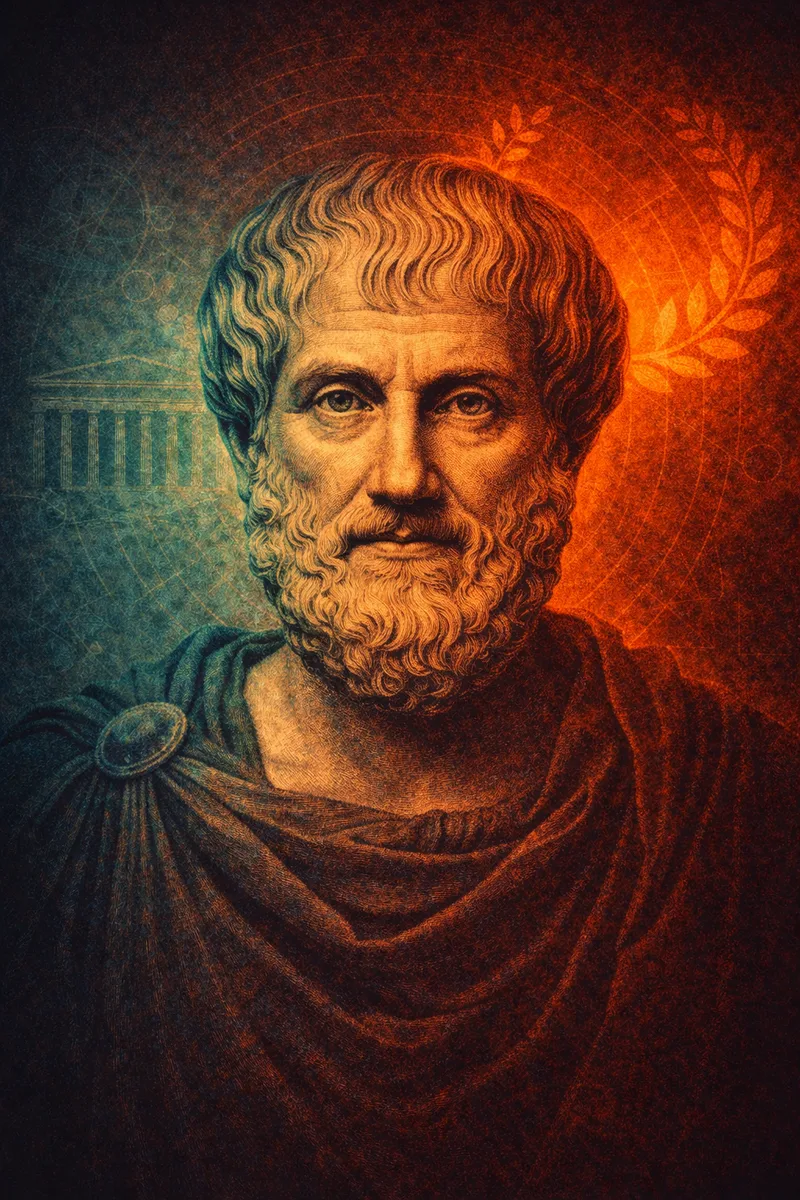
Aristotle was born in 384 BC in Stagira, a small town in northern Greece, the son of a physician to the king of Macedon. He moved to Athens at seventeen to study at Plato's Academy and stayed for twenty years, until Plato's death. Then he left, traveled, tutored a young prince named Alexander (who would later conquer most of the known world), and eventually returned to Athens to found his own school, the Lyceum. When anti-Macedonian feeling turned dangerous after Alexander's death, Aristotle fled the city, reportedly saying he refused to let Athens "sin twice against philosophy," a reference to the execution of Socrates. He died in exile a year later, in 322 BC.
What Aristotle gave to political thought was a different way of doing philosophy. Plato had built his political theory on a vision of eternal Forms accessible only through abstract contemplation. Aristotle thought this was backwards. Real political wisdom, he argued, comes from observing how human beings actually live, what they actually want, what kinds of cities and constitutions actually work, and what kinds of habits and institutions actually produce good lives. His Politics is the first work of political science in something like the modern sense, built on comparative analysis of dozens of actual Greek city-states, asking empirical questions about what makes them stable, what causes them to fail, and what forms of government produce the best results.
The single most important argument in the Politics is the claim that human beings are by nature political animals. Aristotle didn't mean we like politics; he meant that we can only become fully human by living together in political communities, deliberating about the common good, and developing the virtues that political life requires. The isolated individual making rational choices about whether to enter society, the figure later social contract theorists would imagine, was alien to Aristotle. For him, you don't choose to enter the polis; you become a person by being part of one. Outside the polis, Aristotle famously wrote, you are either a beast or a god, and most of us are neither.
Aristotle's ethics is the necessary companion to his politics. The Nicomachean Ethics asks what it means to live well as a human being and answers in terms of eudaimonia, usually translated as "flourishing" or "happiness," though both words miss the original sense, which is closer to "the kind of life a complete human being would lead." Eudaimonia comes from cultivating the virtues — courage, justice, temperance, practical wisdom — and these virtues can only be developed in the right kind of community. So ethics depends on politics, politics depends on ethics, and both depend on a particular vision of human nature. The whole structure stands or falls together.
Aristotle's influence on Western thought is hard to overstate. For most of the next two thousand years he was simply known as "the Philosopher," and when medieval scholars said "the Philosopher said," they meant Aristotle and everyone knew it. His framework shaped Christian theology through Aquinas, Islamic philosophy through Averroes and Avicenna, and almost every subsequent attempt to ground politics in human nature rather than in abstract principles. Modern liberal political theory, which generally doesn't take human nature seriously as a foundation for politics, is in many ways a sustained departure from the Aristotelian tradition. Conservative and communitarian political thinkers who want to bring nature, virtue, and community back into political theory are usually working with Aristotelian materials, whether they say so or not.
Aristotle is associated with Traditionalist. See the archetype