
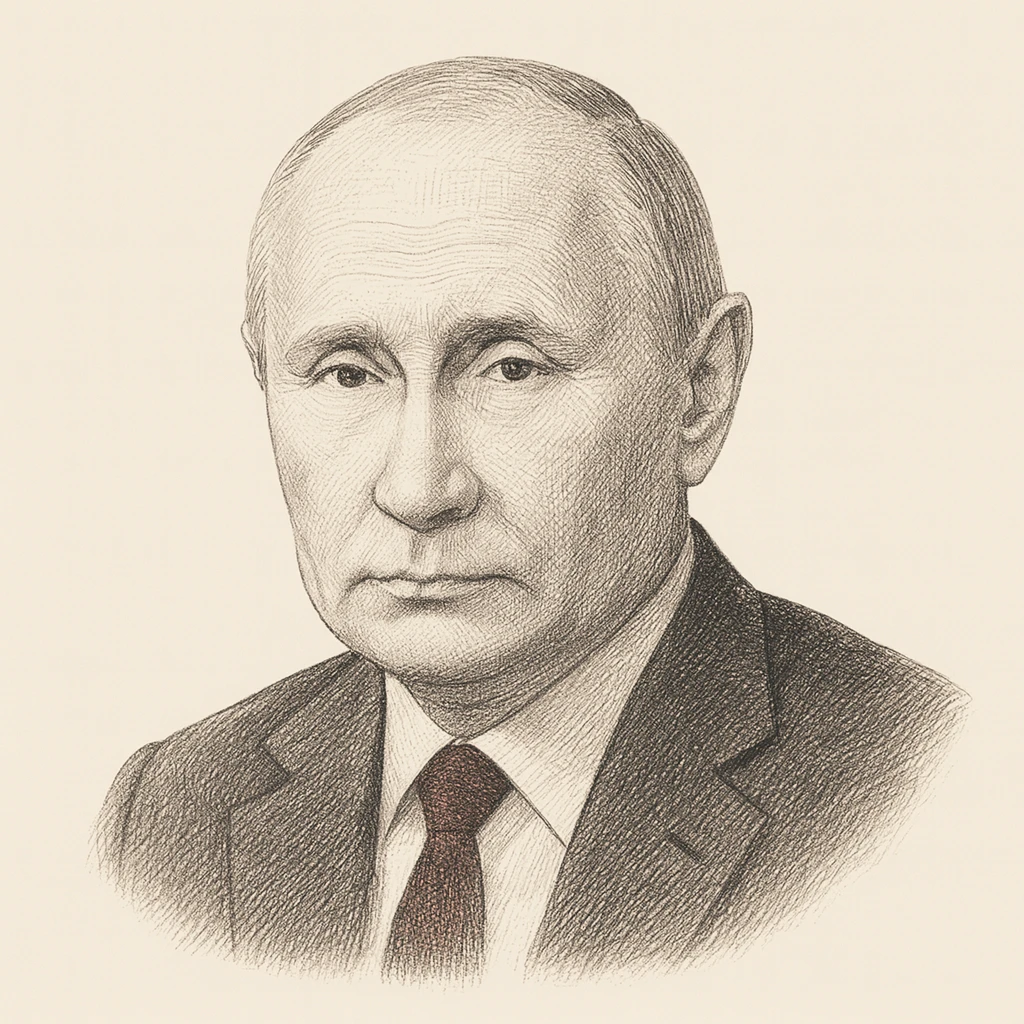
Vladimir Putin, who rose from the Soviet security services to become Russia's dominant political figure at the turn of the twenty-first century, is associated less with a systematic doctrine than with a governing philosophy built around the primacy of the state. Coming to power after the chaotic 1990s, he framed his project as the restoration of order, national dignity, and central authority following what he portrayed as the humiliation and disintegration that accompanied the collapse of the Soviet Union. His political thought treats a strong state not as a threat to the nation but as its precondition — the guarantor of stability against internal fragmentation and external pressure.
At the center of Putin's outlook is an insistence on sovereignty, understood as the right of a great power to determine its own path free from external interference, particularly from the United States and Western institutions. Over time this hardened into an explicitly civilizational argument: the claim that Russia constitutes a distinct civilization with its own values — often invoking Orthodoxy, tradition, family, and historical continuity — set against a West depicted as decadent, universalist, and imperial in its liberalism. This sovereignty-civilizationalism has made him a reference point for nationalist and traditionalist movements far beyond Russia, who read in him a model of unapologetic cultural and geopolitical self-assertion.
Domestically, his system is frequently described as "managed democracy" or a hybrid regime: elections and constitutional forms are retained, but competition is constrained, media and courts are subordinated to executive power, and opposition is marginalized. His record includes the suppression of dissent, the jailing and death of opponents, and armed interventions abroad, among them the full-scale invasion of Ukraine, which the UN General Assembly in March 2022 deplored "in the strongest terms" as aggression by the Russian Federation.
Whatever one's judgment, Putin's significance as a political thinker-in-practice lies in demonstrating a durable alternative to the post-Cold War liberal consensus. He articulates a vision in which national strength, cultural conservatism, and centralized authority are presented as answers to the disorder of liberal modernity, and he has made that argument attractive to a global audience skeptical of Western universalism.
Vladimir Putin is associated with Reactionary Strongman. See the archetype