
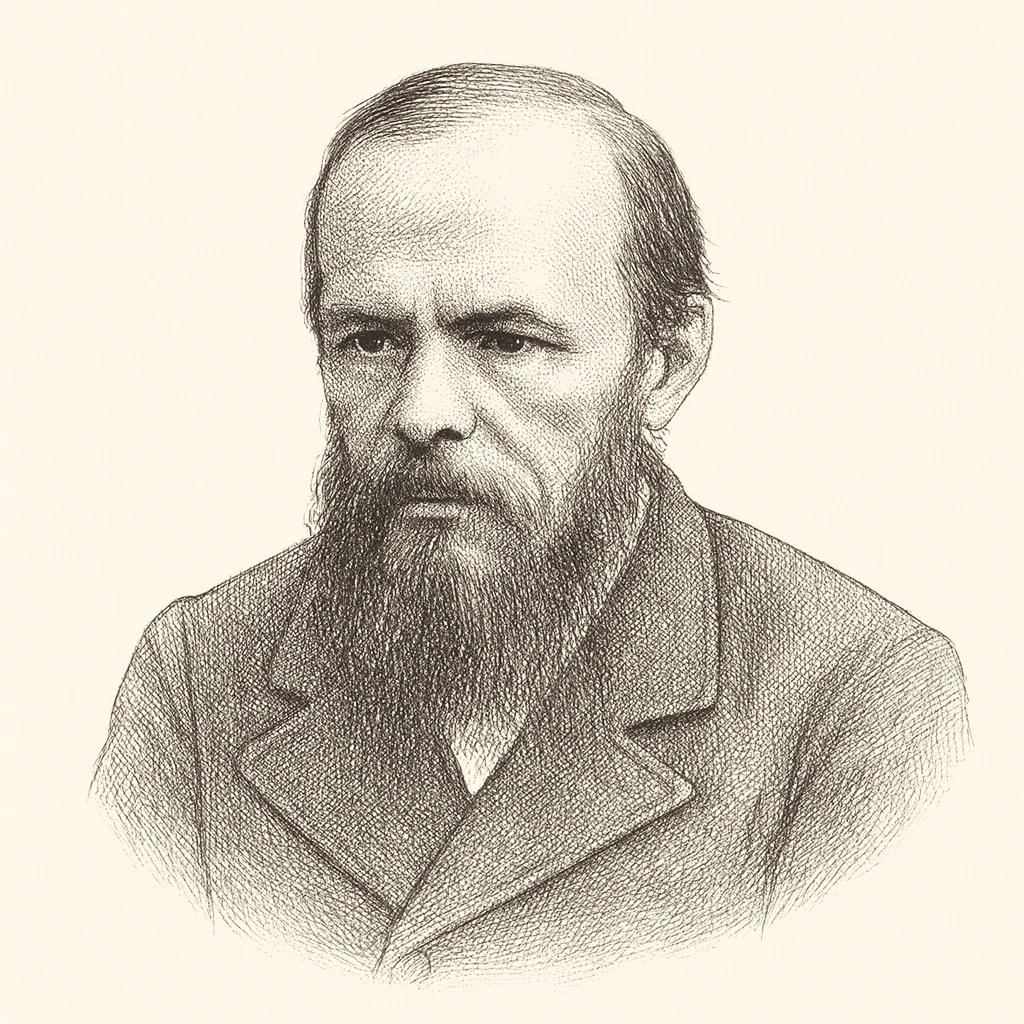
Fyodor Dostoevsky was a Russian novelist whose fiction explores faith, freedom, and evil through intense psychological portraiture. In his youth he belonged to the Petrashevsky Circle, a group of intellectuals who discussed utopian socialist and reformist ideas then filtering in from the West. Arrested for this political radicalism in 1849, Dostoevsky faced a mock execution before his sentence was commuted, and spent four years in a Siberian labor camp followed by compulsory military service—experiences that transformed him from socialist to Orthodox Christian conservative.
After his return, Dostoevsky developed the outlook of pochvennichestvo, a "return to the soil" that sought reconciliation between educated Russia and the common people, and rejected both revolutionary radicalism and imported Western liberalism. In his journalism and later his Diary of a Writer, he championed Russian Orthodoxy and a messianic vision of Russia's spiritual destiny, positions that placed him among the Slavophile-leaning currents opposed to the Westernizers. The same writings express hostility toward Catholicism, Western Europe, and Jews, including openly antisemitic passages.
Dostoevsky's major novels, among them Crime and Punishment, The Brothers Karamazov, The Idiot, and Demons, explore the consequences of ideas. If there is no God, is everything permitted? Can human reason alone ground morality? His characters (Raskolnikov, Ivan Karamazov, the Underground Man) embody philosophical positions pushed to their psychological extremes. Notes from Underground attacked the rational egoism and utopian schemes of the radical intelligentsia, insisting that human beings will reject a fully rationalized "crystal palace" society for the sake of their own free will. Demons drew on the real conspiratorial violence of revolutionary cells to portray nihilism as a destroying force, while the Grand Inquisitor parable dramatized the trade of freedom for bread and security.
Dostoevsky saw Western rationalism and socialism as nihilistic forces destroying traditional Russian faith and community. After 1917, readers including the philosopher Nikolai Berdyaev treated him as a prophet of the Russian Revolution, arguing that his novels had foreseen where revolutionary ideas would lead. His faith was hard-won, earned through suffering; in a late notebook he wrote that his hosanna had passed through a great furnace of doubt. Later existentialist and religious thinkers drew on his treatment of meaning, morality, and God's existence.
Fyodor Dostoevsky is associated with Traditionalist. See the archetype