
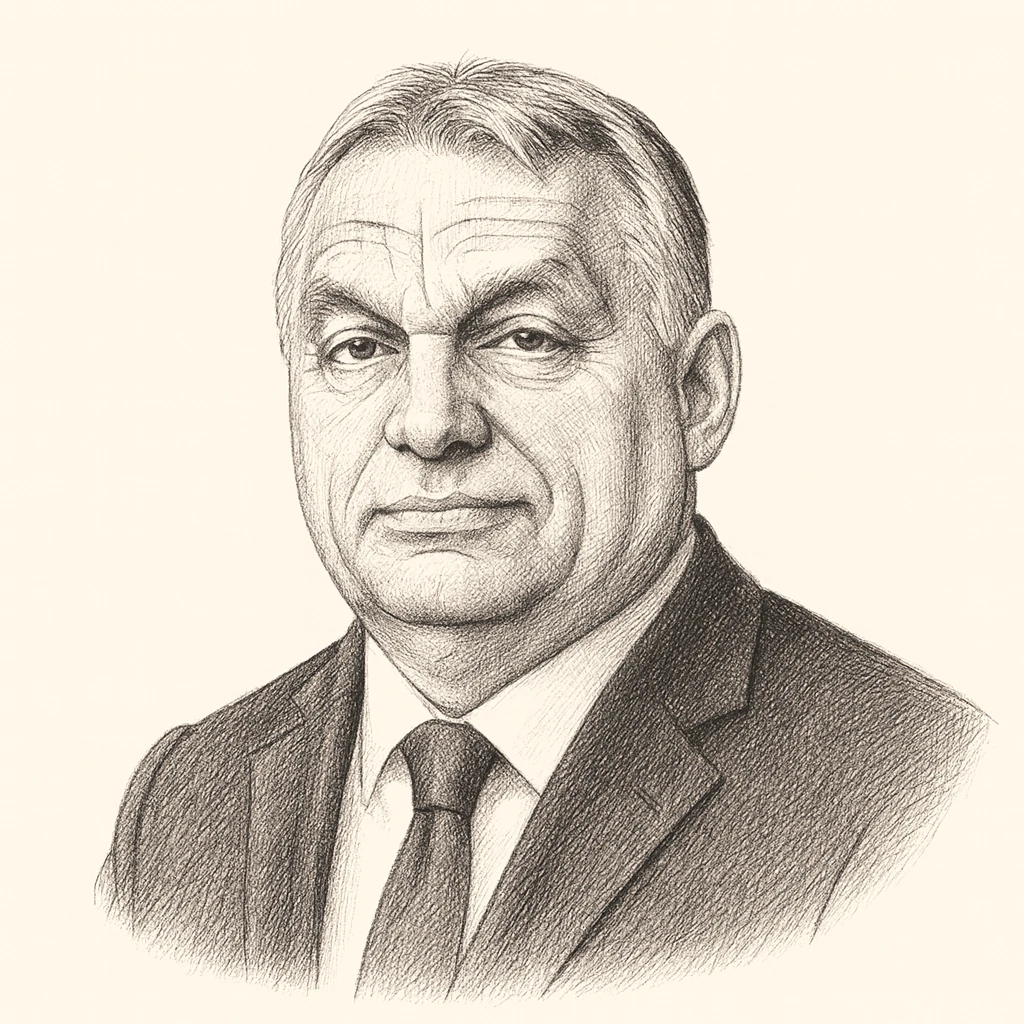
Viktor Orbán rose to prominence in the late 1980s as a founder of Fidesz, initially a liberal, anti-communist youth movement that opposed Soviet influence in Hungary. Over the following decades he transformed both the party and his own political outlook, steering Fidesz toward the conservative and nationalist right. Having served a first term as prime minister around the turn of the millennium, he returned to power in 2010 with a large parliamentary majority and used that mandate to reshape Hungary's constitutional and institutional order. He governed until May 2026, when Péter Magyar, whose Tisza party had won the April election, was sworn in as prime minister. This trajectory—from liberal dissident to standard-bearer of the nationalist right—is central to understanding his political thought.
Orbán is most closely associated with the concept of "illiberal democracy," a phrase he has embraced to describe a system that retains electoral competition while rejecting what he casts as the liberal consensus on individual rights, judicial constraints, and cosmopolitan openness. In his framing, the will of a national majority should not be checked by liberal institutions in the way Western constitutionalism prescribes. He couples this with an emphasis on national sovereignty, Christian cultural identity, traditional family structures, and skepticism toward supranational authority, particularly the European Union, and toward large-scale immigration. His rhetoric often invokes the defense of a distinct European and Hungarian civilization against forces he portrays as threatening it.
As a political thinker-practitioner, Orbán matters less for systematic theoretical writing than for demonstrating how democratic mandates can be used to concentrate power and reorder the state—through changes to the constitution, courts, media landscape, and electoral rules. In 2022 the European Parliament described the result as a "hybrid regime of electoral autocracy," while his supporters present it as a legitimate assertion of majoritarian and national self-determination against liberal overreach.
His influence extends well beyond Hungary. Orbán has become a reference point for national-conservative, populist, and sovereigntist movements across Europe and the United States, where his model is variously admired as a workable alternative to liberal democracy or condemned as its erosion from within. In doing so he has helped make "illiberalism" a live category in contemporary political debate, forcing scholars and politicians to reconsider the relationship between democracy, liberalism, and national identity.
Viktor Orbán is associated with National Conservative. See the archetype