
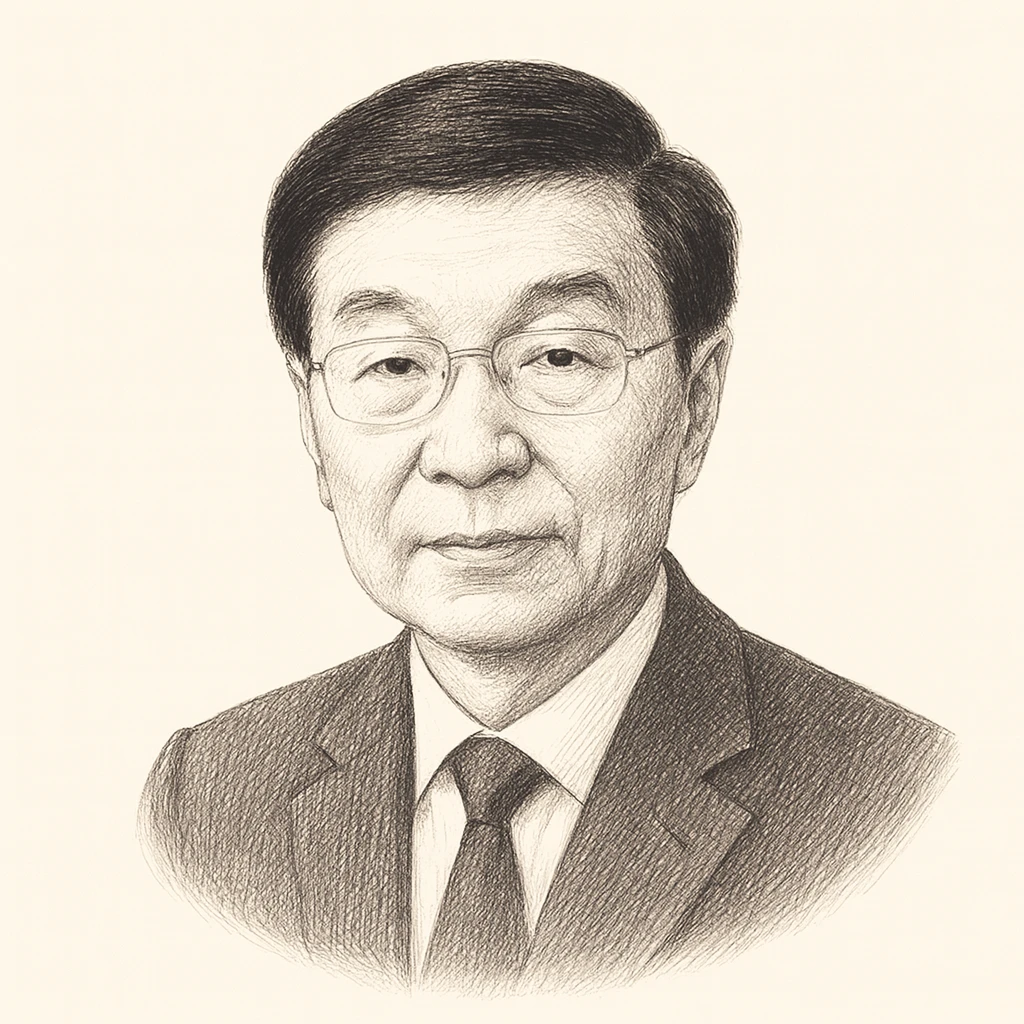
Wang Huning is a Chinese political scientist turned party strategist who rose from academia at Fudan University to become one of the most influential ideologists in the modern Chinese Communist Party. As a scholar in the 1980s he studied comparative politics and administration, and he spent an extended period observing the United States firsthand. That experience produced a book of impressions often rendered in English as America Against America, in which he examined American society, institutions, and culture with an eye to the tensions and contradictions he saw beneath its prosperity and pluralism. The work is frequently read as a diagnosis of liberal democracy's disorders and a warning against importing them.
Wang's central intellectual preoccupation has been the problem of political order in a rapidly modernizing society. He is associated with the idea that a strong, centralized authority is necessary to manage the disruptions of economic development and to hold a large, diverse country together, and with a concept sometimes described as "neo-authoritarianism" — the argument that a period of concentrated power is a precondition for stable reform. He emphasized cultural cohesion and the state's role in cultivating shared values, treating culture and ideology as instruments of governance rather than as autonomous spheres.
Recruited into the party's policy apparatus in the mid-1990s, Wang became a rare figure who served at the highest advisory levels under three successive leaders. He is credited with helping articulate the theoretical formulas that defined each era — the "Three Represents" under Jiang Zemin, the "Scientific Outlook on Development" under Hu Jintao, and the ideological framing surrounding Xi Jinping — and eventually rose to the Politburo Standing Committee, the party's top body. This continuity across leaders with differing priorities made him the closest thing the CCP has to a permanent house theorist.
Wang's thought is inseparable from an authoritarian project: his arguments have been used to justify concentrated one-party rule, restrictions on political liberalization, and the marshaling of ideology and technology in service of state control. Admirers see a disciplined analyst of order and modernization; critics see an architect of durable repression. Because he writes little for public consumption and rarely speaks, much of his influence is inferred from the doctrines he is believed to have shaped, which lends his reputation an outsized, somewhat enigmatic quality.
Wang Huning is associated with Techno-Authoritarian. See the archetype