
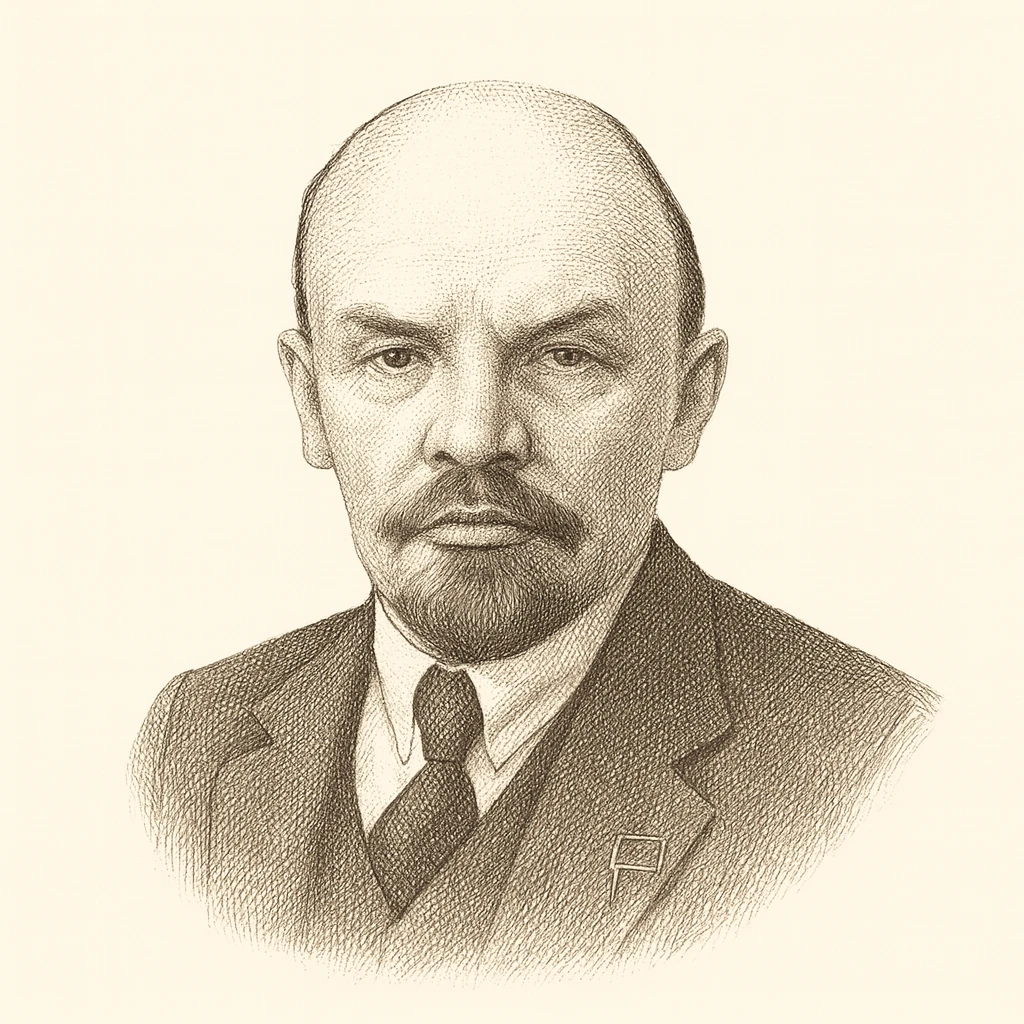
Vladimir Ilyich Ulyanov was born in 1870 in Simbirsk, a provincial town on the Volga, the son of a school inspector who had risen to the rank of actual state councillor — a position in the Tsarist bureaucracy that carried hereditary nobility. The family was cultivated, hardworking, and thoroughly committed to the values of the liberal intelligentsia: education, public service, rational progress. It was, in other words, precisely the kind of family from which the Tsarist system expected loyalty, and which the Tsarist system's own rigidity and injustice drove toward radicalism. The decisive event came in 1887, when Lenin was sixteen. His older brother Alexander — a science student at St. Petersburg University, methodical and serious — was arrested for participating in a plot to assassinate Tsar Alexander III, tried, and hanged. Lenin's mother traveled to St. Petersburg to beg for clemency and was refused. The family was thereafter treated as socially suspect; the neighbors and acquaintances who had been friends distanced themselves. Lenin was already a serious student; after Alexander's death he became something different. He later told his sister that it was then he understood there was no path forward through individual terrorism or liberal reform. The system required a different approach.
He studied law at Kazan University, was expelled after three months for participating in a student demonstration, and spent the next several years in internal exile in the provincial town of Kokushkino, where he read voraciously — Marx above all, but also the Russian revolutionary tradition, the populists and Narodniks who had preceded him. He completed his law degree externally, practiced briefly in Samara, and moved to St. Petersburg in 1893, where he was drawn immediately into the underground socialist circles that were attempting to build a workers' movement on Marxist rather than populist foundations. His organizational talent and his polemical clarity distinguished him rapidly. He was arrested in 1895, spent fourteen months in a St. Petersburg prison, and was then exiled for three years to the village of Shushenskoye in Siberia.
The Siberian exile was intellectually productive in a way that recalls other forced retreats from political activity. He had access to books, wrote extensively, and produced The Development of Capitalism in Russia (1899) — a 600-page empirical study arguing, against the populist view, that Russia was already a capitalist country and that the appropriate political strategy was therefore Marxist rather than agrarian. He also married Nadezhda Krupskaya, who had been exiled to a neighboring village and who would remain his political partner for the rest of his life. He returned from Siberia in 1900, spent a few months in Russia, and then went abroad to Geneva, Munich, and London, where he would live in emigration, with brief returns to Russia, until 1917.
The emigration years produced the theoretical work on which his subsequent career depended. What Is to Be Done? (1902) was the argument that organized the Bolshevik tendency and defined the subsequent century of revolutionary politics. Against the prevailing socialist view that the working class would develop revolutionary consciousness through its own experience of exploitation, Lenin argued that left to itself the class would develop only "trade union consciousness" — the desire for better wages and conditions within the existing system. Revolutionary consciousness had to be brought to the workers from without, by a professional revolutionary organization: a vanguard party of full-time cadres, organized on the principle of democratic centralism, capable of coordinating action with the discipline that genuine revolutionary work required. This argument split the Russian Social Democratic Labour Party at its 1903 London congress into Bolsheviks (majority, in the congress vote) and Mensheviks (minority) — a division that would prove decisive fourteen years later.
He returned to Russia during the 1905 Revolution, watched it fail, and went back into emigration where he spent the following decade in the increasingly fractious debates of the European socialist movement. The outbreak of the First World War was, paradoxically, the moment his analysis was confirmed: the Second International's member parties voted for war credits and supported their respective national governments, demonstrating the class collaboration that Lenin had always insisted parliamentary socialism would produce. Imperialism: The Highest Stage of Capitalism (1916) extended Marx's analysis to explain both the war and the persistence of capitalism past its predicted collapse: colonial exploitation generated superprofits that could buy off the working class in the metropole. Revolution would come first at the weakest link of the imperial chain.
He was in Zurich in February 1917 when word reached the emigration that the Tsar had abdicated and a Provisional Government had taken power. The German government, calculating correctly that Lenin would destabilize the Russian war effort, arranged for him to travel from Switzerland through Germany to Sweden and Finland in a sealed railway car. He arrived at the Finland Station in Petrograd in April 1917, immediately denounced the Provisional Government and any socialist cooperation with it, and reoriented the Bolshevik Party toward the seizure of power that occurred in October. The State and Revolution (1917), written in hiding during the months before October, provided the theoretical framework: the bourgeois state had to be smashed, not gradually reformed, and the transitional dictatorship of the proletariat would build socialism until the state could eventually wither away.
The withering away never came. What came instead was the Cheka, the Red Terror, the suppression of rival socialist parties, the Kronstadt massacre, and a one-party state that his own health prevented him from reversing even had he wanted to. He suffered a series of strokes beginning in 1922 and died in January 1924, fifty-three years old, having spent the last years of his life increasingly alarmed by the bureaucratic degeneration of the revolution and by the rise of Stalin, whom he attempted to have removed from power in a testament that the Party suppressed. He did not live to see the full consequences of what he had built, and was therefore spared the necessity of accounting for them.
Vladimir Lenin is associated with Vanguard Collectivist. See the archetype