
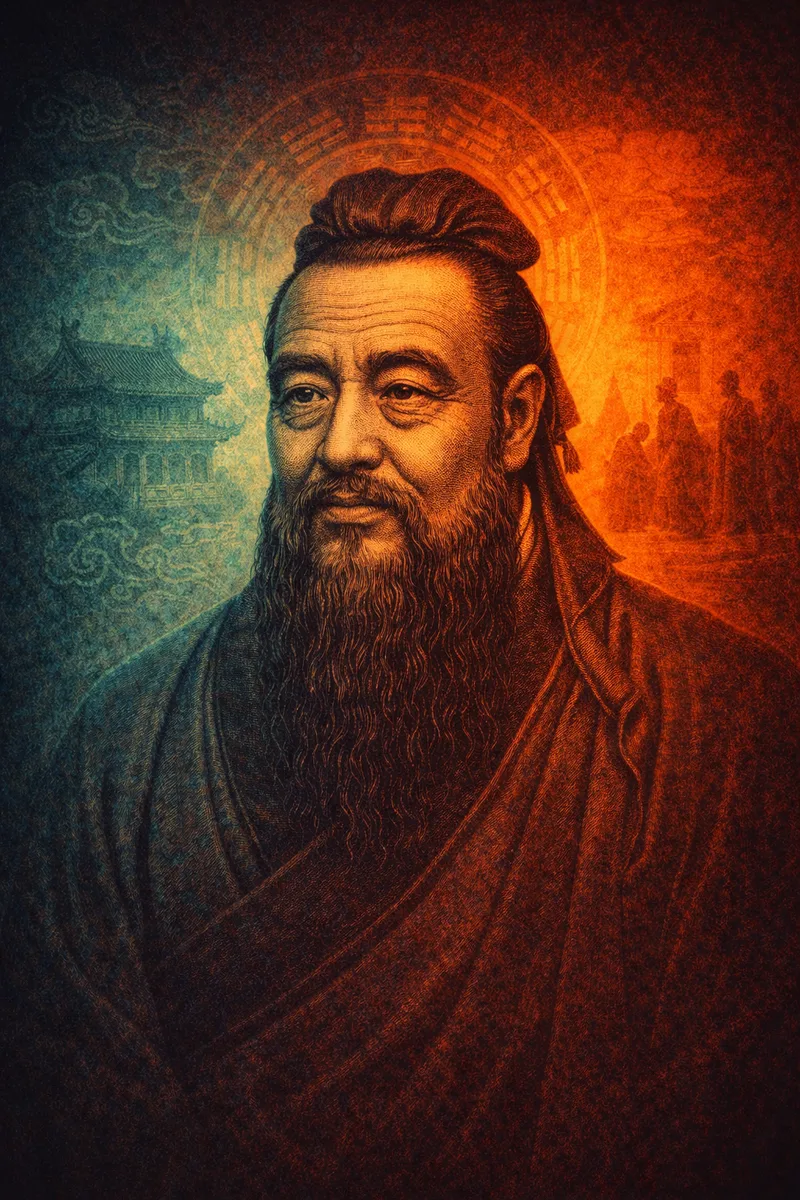
Confucius — Kong Fuzi — taught in the state of Lu during the collapse of Zhou authority, and left no book of his own. The Analects, compiled by his disciples after his death, records a set of commitments rather than a system: ren, humaneness toward others; li, the ritual propriety that makes social life legible and restrains power by binding it to form; xiao, filial obligation, from which wider political duty is extrapolated; and the junzi, the exemplary person, defined by conduct rather than by birth — a genuinely radical reassignment of nobility in an aristocratic age.
His central political claim is that order rests on the character of those who govern rather than on law or coercion. A ruler who is genuinely virtuous is obeyed as naturally as the stars turn about the pole; one who relies on punishment will get compliance without shame. The corollary, developed by Mencius, is that rulership is a trust which a tyrant forfeits — the mandate of heaven, and with it an explicit right of rebellion. Adopted as state orthodoxy under the Han and institutionalized through the imperial examinations, this became both the ethical vocabulary and the bureaucratic machinery of Chinese governance for two millennia.
His reception in Europe is the reason he belongs in a Western lineage. Jesuit missionaries, following Matteo Ricci's policy of accommodation, translated the Confucian classics into Latin as Confucius Sinarum Philosophus (Paris, 1687), and the result landed in the middle of Europe's own arguments. Leibniz drew on it in Novissima Sinica (1697) to argue that China possessed a natural theology and a practical ethics Europe could learn from. Voltaire made China the standing example in his case against clerical authority: a vast, ordered state governed by moral philosophy and examined administrators, with no revealed religion and no priesthood. Quesnay's Le Despotisme de la Chine (1767) recruited it for the physiocrats, and he was nicknamed the Confucius of Europe for his trouble.
The most concrete legacy is administrative. The Chinese examination system — entry to office by competitive written examination rather than purchase or patronage — was cited directly in the nineteenth-century British campaign that produced the Northcote-Trevelyan report and the modern civil service, and echoed in the American arguments that followed. It is among the few instances of a non-Western institution being consciously imported into Western government.
The European enthusiasm was also selective. Rome condemned the Jesuit accommodation in the Rites Controversy, and the philosophes who admired China were often using it as a stick with which to beat their own church rather than describing it accurately.
Confucius is associated with Traditionalist. See the archetype