
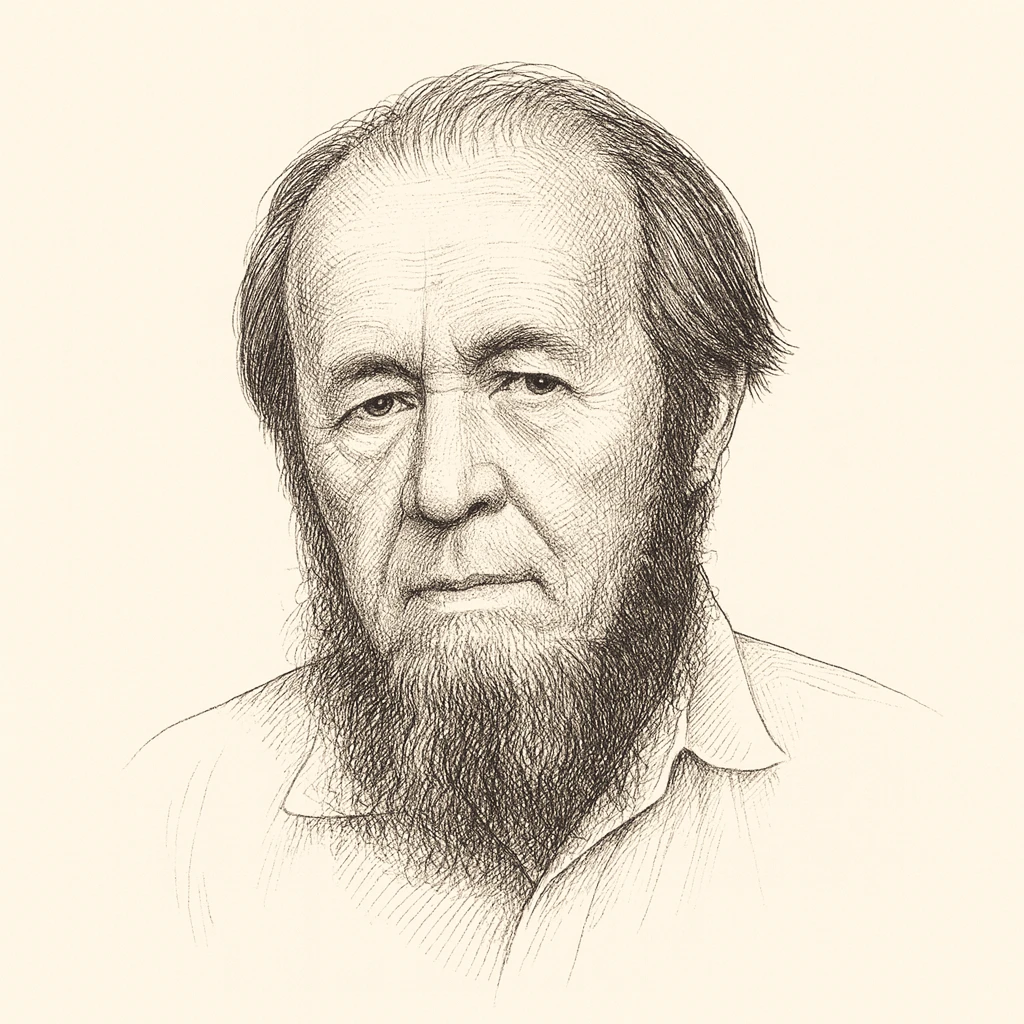
Aleksandr Solzhenitsyn earned his political authority not through office but through testimony. A decorated artillery officer in the Second World War, he was arrested in 1945 for critical remarks about Stalin in private correspondence and sentenced to years in the labor-camp system, followed by internal exile. That experience became the raw material for a body of work — most famously "One Day in the Life of Ivan Denisovich" and the monumental "The Gulag Archipelago" — that documented the machinery of Soviet repression with a factual and moral force that was difficult to answer. By treating the camps as a defining truth of the regime rather than an aberration, he did much to strip communism of its idealistic aura among Western intellectuals and dissidents alike.
His political thought was rooted less in liberal proceduralism than in moral and spiritual conviction. He argued that totalitarianism rested on the individual's willingness to "live by lies," and that resistance began with personal refusal to participate in falsehood. Expelled from the Soviet Union in 1974 and awarded the Nobel Prize in Literature, he became the era's foremost symbol of conscience against the state. Yet he was never a straightforward champion of the Western liberal order.
In his 1978 Harvard commencement address, Solzhenitsyn turned his critique on the West itself, condemning what he saw as materialism, moral cowardice, legalistic thinking detached from virtue, and a spiritual exhaustion he judged as dangerous in its own way. This is the basis for his placement in the traditionalist lineage: he insisted that political freedom without moral and religious foundations decays, and he looked to Russian Orthodox faith and national tradition as sources of renewal. After returning to Russia in 1994, his emphasis on national restoration, Orthodox identity, and skepticism of liberal individualism drew criticism from those who read strains of nationalism and authoritarian sympathy in his later views. Admirers regard him as the twentieth century's great moral witness; critics note that his prescriptions for Russia were more communitarian and illiberal than his anti-Soviet heroism might suggest. Both readings shape how his legacy is invoked in debates over freedom, faith, and the moral limits of the modern state.
Aleksandr Solzhenitsyn is associated with Traditionalist. See the archetype