
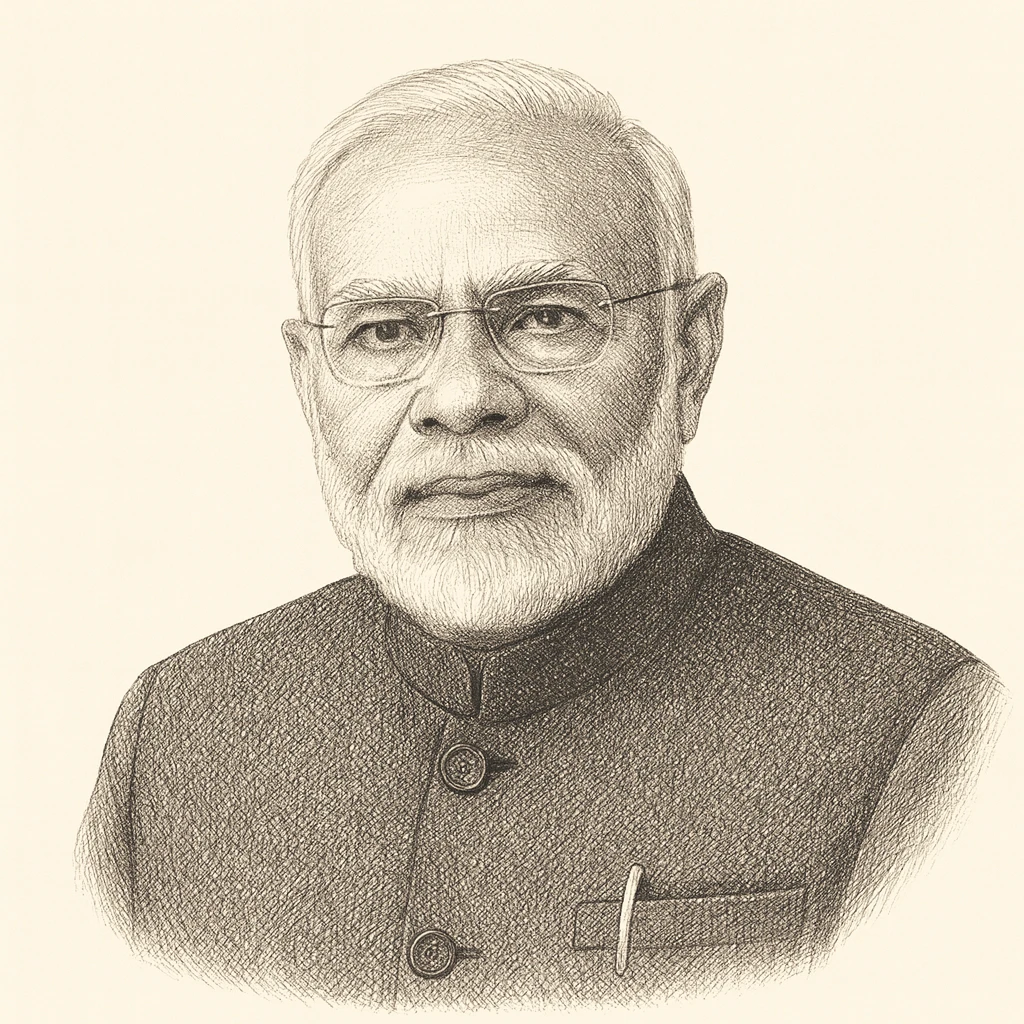
Narendra Modi rose through the Rashtriya Swayamsevak Sangh (RSS), the Hindu-nationalist organization whose ideology of Hindutva holds that Indian nationhood is rooted in a shared Hindu civilizational identity. That formation shaped the core of his political thought: a rejection of the secular, pluralist self-understanding associated with the Nehruvian Congress tradition, and its replacement with a narrative in which India's cultural and spiritual heritage is the true basis of the nation. As a Bharatiya Janata Party leader, he translated this ideological inheritance into a governing project at national scale, arguing that a strong, culturally confident India requires unapologetic assertion of majority identity alongside economic modernization and administrative efficiency.
Modi's politics blends nationalism with a populist style that positions him as a direct embodiment of the popular will, bypassing intermediary institutions and elites. He built his appeal on personal biography as a man of humble origins, on promises of development (often summarized in his rhetoric of growth and national dignity), and on a communications strategy that speaks over established media directly to voters. Critics and scholars describe this as a personalization of power and a weakening of institutional checks, situating him within a global wave of national-populist leaders who claim to represent an authentic people against a cosmopolitan establishment.
His record is seriously contested. As chief minister of Gujarat, he presided over the state during the 2002 communal riots in which large numbers of Muslims were killed; he was never convicted, but the episode remains central to critiques of his leadership. In national office, measures such as the citizenship law changes and the revocation of Jammu and Kashmir's special status, along with documented concerns about press freedom, treatment of religious minorities, and civil-society space, have led many observers to warn of democratic backsliding toward majoritarian authoritarianism. Supporters counter that he has delivered stability, infrastructure, welfare delivery, and a restored sense of national pride.
As a thinker within a lineage, Modi matters less for original theoretical writing than for demonstrating how an ideology once confined to a cadre movement can be scaled into durable electoral dominance. He shows how cultural nationalism, welfare provision, charismatic leadership, and mastery of mass communication can be combined into a governing formula, making him a defining reference point for contemporary debates about religion, democracy, and national identity.
Narendra Modi is associated with National Populist. See the archetype