
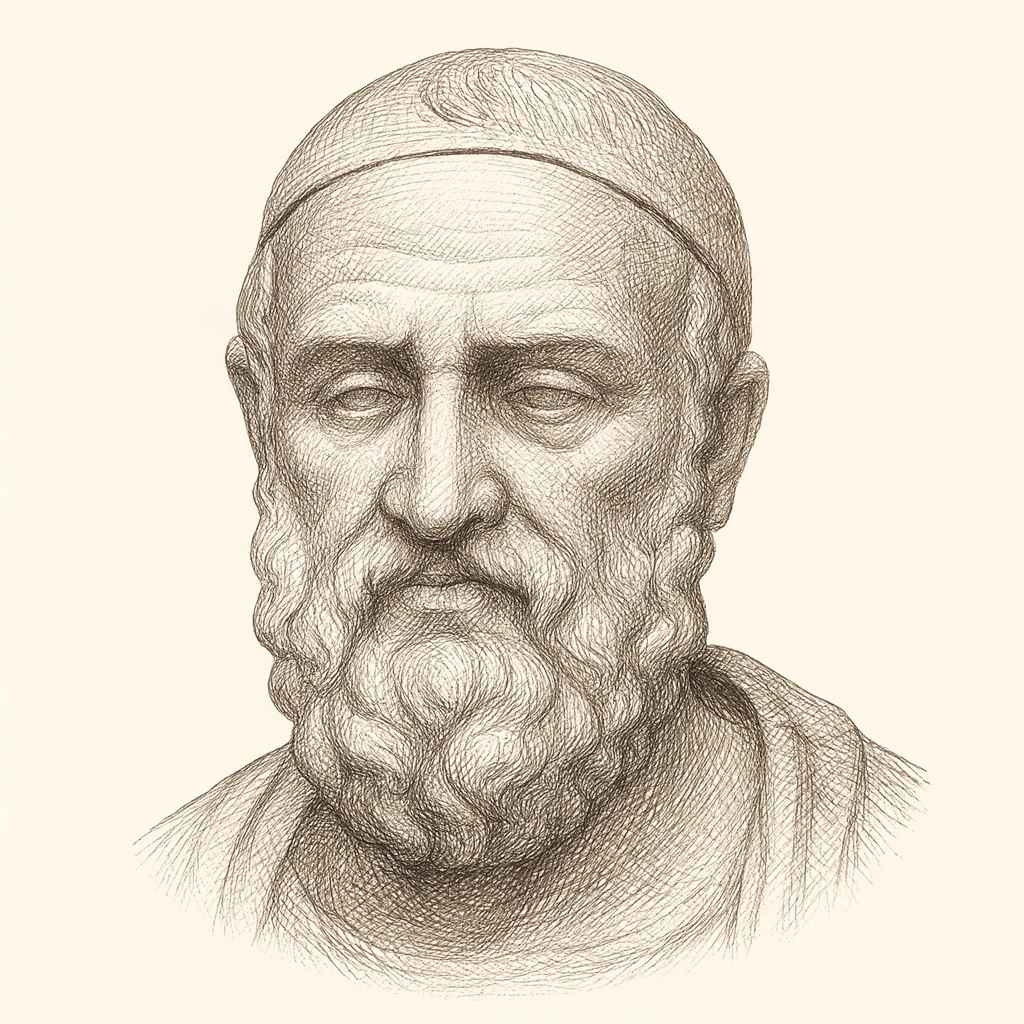
Polybius was a cavalry commander of the Achaean League deported to Rome as one of a thousand hostages after 168 BC. He became attached to the household of Scipio Aemilianus, watched the destruction of Carthage in his company, and wrote a history intended to answer one question: how, in not quite fifty-three years, almost the whole inhabited world had fallen under Roman rule.
His answer is constitutional, and it is set out in the sixth book of the Histories, which became one of the most consequential pieces of political analysis ever written. Simple constitutions, he argues, are inherently unstable and pass through a fixed cycle — kingship degenerating into tyranny, aristocracy into oligarchy, democracy into mob rule, and back to the beginning. He calls the cycle anacyclosis, and treats it as a natural process rather than a moral failure. What arrests it is mixture: a constitution combining monarchic, aristocratic and popular elements, each with the power to check the others, so that no single principle can run to its own extreme. Rome had arrived at such a constitution not by design but by trial and misfortune, in the consuls, the senate and the people, and this was why Rome had endured while Greek cities had not.
The analysis carried an implicit warning, which Polybius states plainly: no constitution escapes decay forever, and Rome's would in time be corrupted by the wealth its success produced. He was writing about the strengths of a republic already beginning to fail.
The afterlife of Book VI is remarkable. Cicero built the De Republica on it. Machiavelli made the mixed constitution and the productive role of class conflict the center of the Discourses. Montesquieu's separation of powers is a development of it. And the American founders read Polybius directly — Adams cited him at length in the Defense of the Constitutions, and the argument that ambition must be made to counteract ambition, which Madison put into the Federalist, is anacyclosis answered by mixture in eighteenth-century language. Nearly every written constitution that divides power between branches is downstream of a Greek prisoner's attempt to explain why his own country had lost.
Wondering where you land? Take the 4-minute assessment