
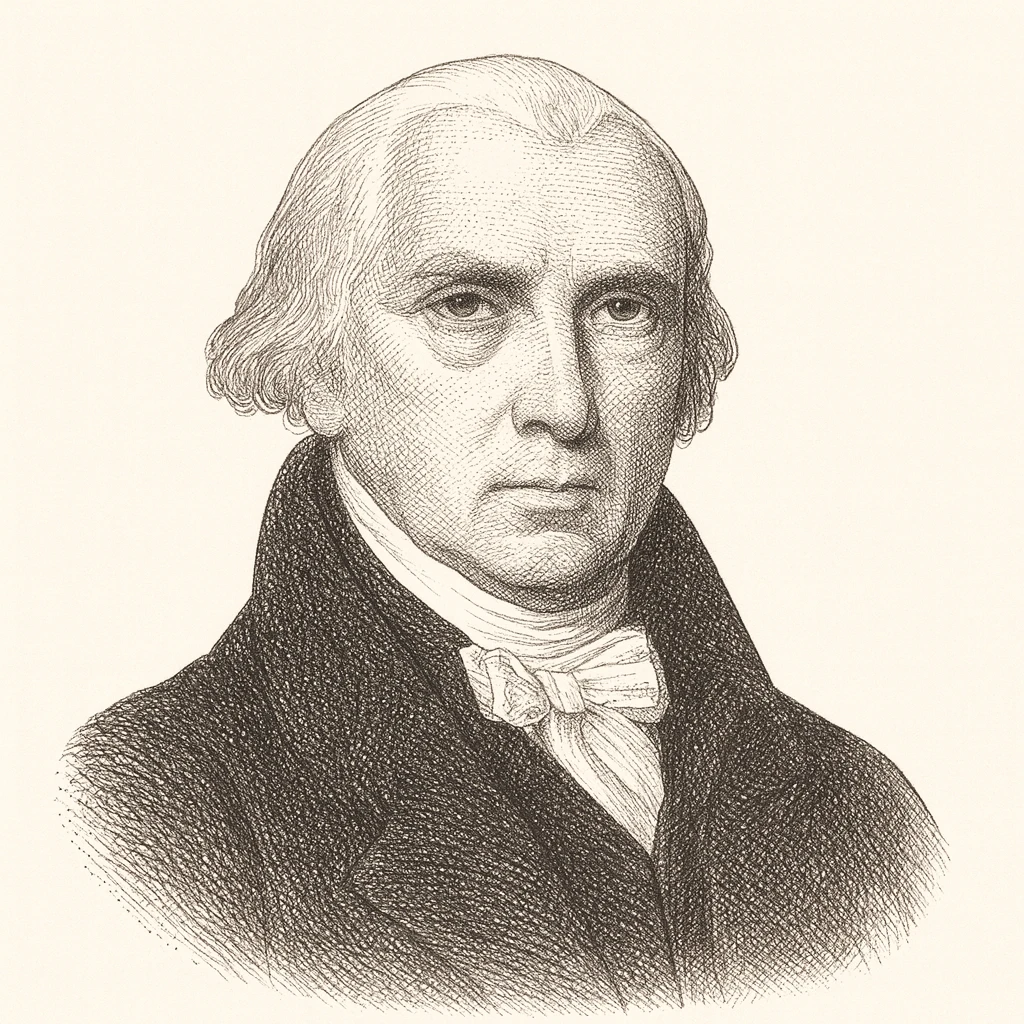
James Madison was the most systematic political thinker among the American founders, the figure who did more than any other to design the constitutional machinery of the new American republic and to provide its theoretical justification. If Jefferson was the rhetorical voice of the American founding, Madison was its constitutional engineer. The distinctive features of the American political system — federalism, separation of powers, checks and balances, the specific design of Congress, the enumerated powers approach to federal authority, the Bill of Rights — all bear Madison's direct imprint. His political theory, worked out in close collaboration with Alexander Hamilton and others but developed most systematically in his own writings, remains one of the most important American contributions to modern political thought.
Madison was born in 1751 in Virginia, the son of a wealthy planter, and educated at the College of New Jersey (later Princeton) under the presidency of John Witherspoon, a Scottish Presbyterian who had brought the intellectual framework of the Scottish Enlightenment to American higher education. Madison absorbed that framework deeply — the empirical approach to politics, the sensitivity to institutional design, the skepticism of human nature that tempered Enlightenment optimism with hard-headed realism — and it shaped everything he later wrote. He entered Virginia politics in 1776, served in the Continental Congress during the Revolution, and by the mid-1780s had become convinced that the Articles of Confederation under which the new American republic was operating were fundamentally inadequate and had to be replaced.
The effort to replace the Articles led to the Constitutional Convention of 1787, and Madison arrived at that convention better prepared than any other delegate. He had spent the previous year reading systematically through the history of every republican government he could find — ancient, medieval, modern — looking for patterns of success and failure. The notes he compiled became the intellectual foundation for what he and others brought to Philadelphia. During the convention, Madison was the most active and influential delegate, the primary author of the Virginia Plan that became the basic framework of the Constitution, and the most thorough notetaker, whose records remain the single most important source for understanding what happened in the closed-door sessions.
After the convention, when the Constitution faced a difficult ratification battle, Madison collaborated with Alexander Hamilton and John Jay to produce the Federalist Papers, a series of eighty-five essays defending the Constitution and explaining its provisions to the public. Madison wrote twenty-nine of them, including several of the most theoretically important. Federalist 10 is particularly famous: Madison's argument that the greatest threat to republican government comes from the formation of factions — groups of citizens united by a shared interest adverse to the rights of others or the permanent interests of the community — and that the best remedy is an "extended republic" large enough that no single faction can dominate. This was a radical departure from classical republican theory, which had assumed that republics could only function in small, homogeneous societies. Madison argued the opposite: that size and diversity were actually republican strengths, because they made factional tyranny harder to achieve.
Federalist 51 is equally famous for its defense of the separation of powers and checks and balances. Madison's most famous line — "If men were angels, no government would be necessary. If angels were to govern men, neither external nor internal controls on government would be necessary" — captures his realistic anthropology. Because people are neither angels nor demons but flawed creatures capable of both virtue and corruption, political institutions must be designed to channel ambition against ambition, using the natural self-interest of officeholders to check the abuses of other officeholders. This was Madison's central theoretical contribution: a framework for designing political institutions that could function well even in the absence of ideal virtue among the people who staffed them.
Madison's other major constitutional contribution came after ratification. He had initially opposed adding a Bill of Rights to the Constitution, believing it was unnecessary because the federal government had only enumerated powers. But the ratification debates convinced him that a Bill of Rights was politically necessary to secure broad public support, and in 1789 he drafted what became the first ten amendments to the Constitution. The First Amendment's protections for speech, press, religion, assembly, and petition remain the most influential single statement of civil liberties in modern political thought, and they bear Madison's direct authorship.
Madison served as Secretary of State under Jefferson and then as the fourth President of the United States from 1809 to 1817. His presidency was difficult, including the War of 1812 with Britain during which the White House was burned, but his retirement years were devoted to constitutional theory and to a long correspondence with Jefferson that shaped both men's legacies. He died in 1836, the last of the founding generation, having spent his final decades as the living embodiment of the constitutional framework he had done more than anyone else to create.
Madison's political philosophy has remained central to American constitutional theory ever since. Contemporary debates about federalism, separation of powers, judicial review, the scope of enumerated powers, and the relationship between majority rule and minority rights all run through Madisonian categories. His distinctive combination of classical republican commitments (civic virtue, fear of corruption, suspicion of concentrated power) with modern liberal commitments (individual rights, consent-based government, limited federal authority) makes him one of the most important synthetic thinkers in the Western tradition.
James Madison is associated with Classical Liberal. See the archetype