
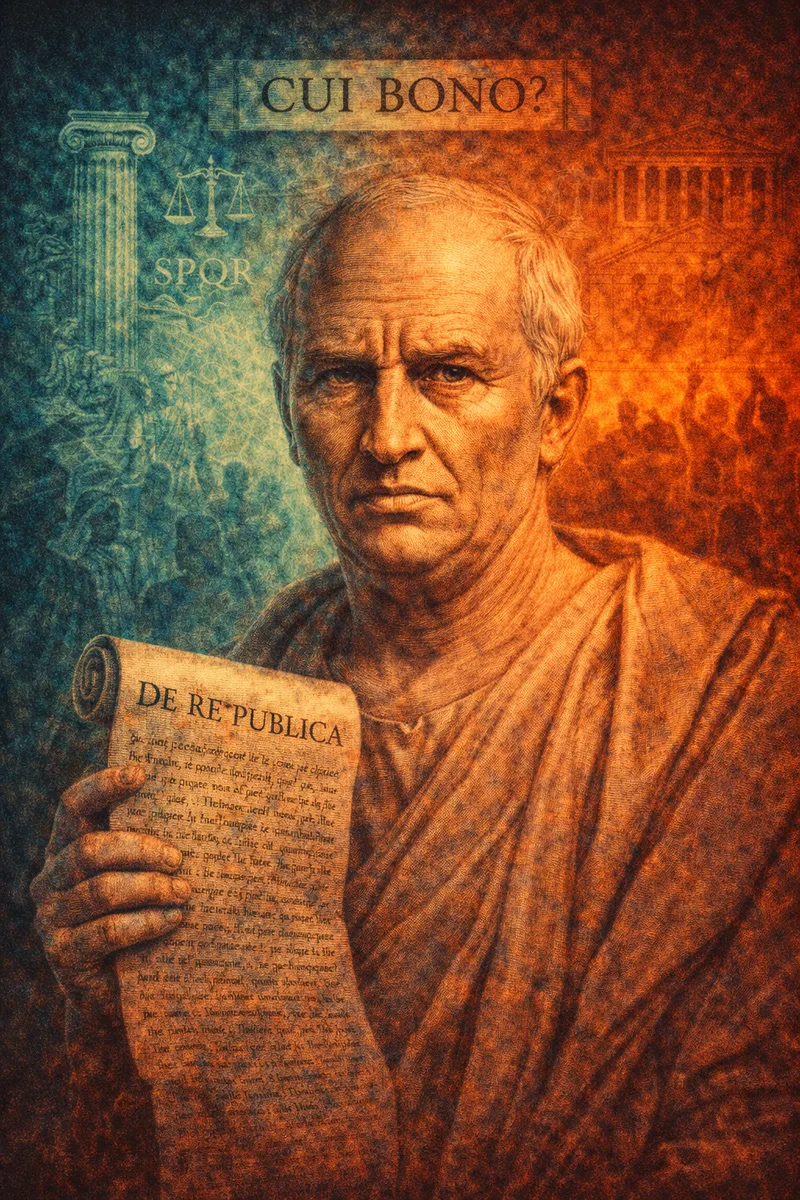
Marcus Tullius Cicero was born in 106 BC in a small Italian town outside Rome, into a family just prominent enough to launch a political career but not so prominent that he could coast on inherited connections. He became Rome's greatest orator, a senator, a consul (the highest office in the Roman Republic), a philosopher who translated Greek thought into Latin and made it accessible to generations of Romans and later Europeans, and finally a political martyr whose death at the hands of Mark Antony's assassins marked the end of the Roman Republic. His life is the story of the Republic's final decades, told from the inside by someone who believed in it passionately and watched it die.
Cicero's political career peaked in 63 BC when, as consul, he exposed and suppressed the Catilinarian Conspiracy, a plot to overthrow the Republic. His speeches against Catiline, delivered in the Senate, became classics of Latin rhetoric and are still studied today as models of political argument. But his success had a cost: he had executed the conspirators without trial, and this would be used against him for the rest of his career. When the balance of power shifted during the rise of Julius Caesar, Cicero was driven into exile, then recalled, then marginalized, then caught up in the violence that followed Caesar's assassination in 44 BC. He had tried to guide the young Octavian toward defending the Republic against Mark Antony; the strategy failed; Octavian and Antony reconciled; Cicero's name appeared on a proscription list; he was killed in December 43 BC, his head and hands displayed in the Forum.
What survived was his writing. Cicero produced an extraordinary body of philosophical, political, and rhetorical work in Latin, much of it composed in the last years of his life when he was cut off from active politics. His most important political works, On the Republic and On the Laws, were modeled on Plato's dialogues but argued that the mixed constitution of the Roman Republic represented the best form of government, combining monarchical, aristocratic, and democratic elements in a way that prevented any one from becoming tyrannical. Cicero gave Western political thought the vocabulary of civic virtue, natural law, and the common good that would shape political reflection for the next two thousand years.
His contribution to natural law thinking was particularly consequential. Cicero argued, drawing on Stoic philosophy, that there was a universal moral law built into the structure of reality, accessible to all rational beings regardless of their particular culture or religion, and that any human law that violated this natural law was not really law at all but a corruption. This framework, transmitted through Augustine and Aquinas, became one of the foundations of Western legal and political thought. It shaped medieval political theology, early modern social contract theory, and the human rights tradition that runs through figures like Grotius, Locke, and the American founders.
Cicero's other great contribution was stylistic: he developed a Latin prose of such clarity and power that it became the model every subsequent Latin writer tried to imitate. When the Renaissance humanists rediscovered classical learning in the 14th and 15th centuries, Cicero was their primary model for both political thought and literary style. Cicero's influence on the Western political imagination runs through the entire early modern period. The American founders read him closely. His name was invoked in debates about the Constitution. His account of civic virtue shaped republican political thought from Machiavelli through the Commonwealthmen to the founding generation of the United States. He is, along with Plato and Aristotle, one of the three or four classical thinkers whose influence on Western political thought is difficult to overstate.
Marcus Tullius Cicero is associated with Traditionalist. See the archetype