
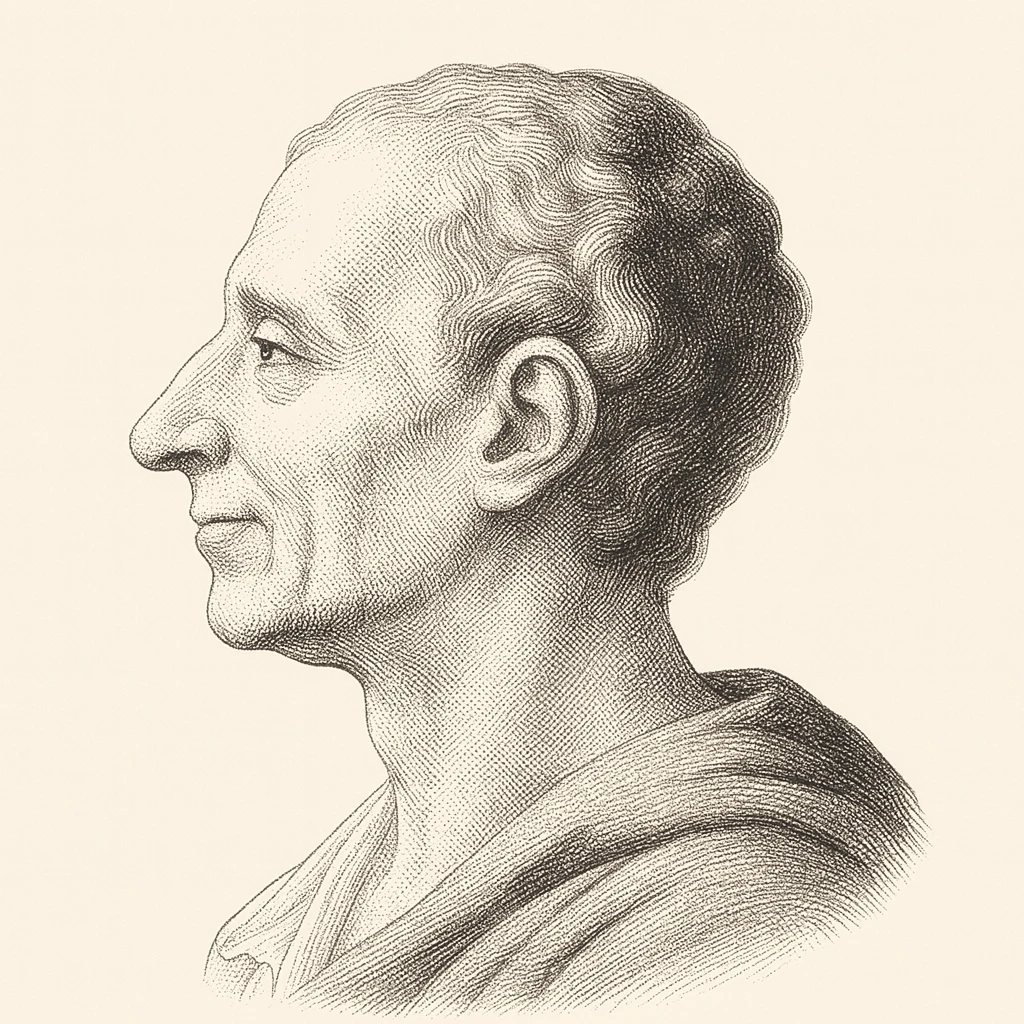
Charles-Louis de Secondat, Baron de Montesquieu, was born in 1689 into the French provincial nobility near Bordeaux. He inherited titles, land, and a seat in the regional parliament of Bordeaux, which meant he spent his early adulthood as both a practicing magistrate and a man of leisure with enough independent income to pursue whatever intellectual interests he wanted. This combination of practical legal experience and intellectual freedom shaped everything he later wrote. Unlike most of the philosophers he engaged with, Montesquieu had actually presided over courts, written legal judgments, and watched how laws worked in practice. His political philosophy was never the abstract rationalism of a Descartes or a Spinoza. It was the carefully considered judgment of someone who had handled law as a craft.
His first major book, Persian Letters (1721), was a satirical novel about two fictional Persians traveling through France and writing letters home about the absurdities of French society, politics, and religion. The conceit allowed Montesquieu to skewer the monarchy, the Catholic Church, and Parisian high society with a plausible deniability that the book was merely describing foreign observers' reactions. It was an enormous bestseller and made his reputation immediately. But Montesquieu was already planning something much more ambitious.
That something was The Spirit of the Laws (1748), the book Montesquieu spent over twenty years researching and writing, and which became one of the most influential works of political philosophy in the Western tradition. Its central insight was deceptively simple: political institutions do not exist in isolation. They are shaped by climate, geography, economic conditions, religion, customs, and the general character of the people they serve. Laws that work beautifully in one society may be disastrous in another. There is no single ideal form of government. The question is not "what is the best constitution" but "what form of government best suits these particular conditions." This was the birth of comparative politics as a systematic discipline, and it represented a profound break with the ahistorical rationalism of much earlier political philosophy.
Within this comparative framework, Montesquieu developed the idea for which he is most famous today: the separation of powers. He argued that political liberty was best preserved when the legislative, executive, and judicial functions of government were lodged in separate institutions that could check each other. No single person or body should be able to make laws, enforce them, and interpret them without meaningful resistance from the others. Montesquieu drew this argument from a somewhat idealized reading of the contemporary English constitution, but its real force came from his underlying insight that concentrated power was always dangerous and that the only reliable safeguard against tyranny was to build institutions that set power against power. This framework was picked up almost immediately by the American founders during the debates over the U.S. Constitution, and Montesquieu was one of the most frequently cited authorities in the Federalist Papers. The American constitutional system of separated powers among Congress, the presidency, and the federal judiciary is in many ways a direct implementation of Montesquieu's argument.
Montesquieu's other major contribution was his analysis of the three main forms of government he distinguished: republics, monarchies, and despotisms. Each, he argued, was animated by a distinctive principle: virtue for republics, honor for monarchies, fear for despotisms. When the animating principle was corrupted or lost, the form of government would collapse. This analysis of political types and their conditions of stability shaped much of later political sociology, and it continues to influence how political scientists think about regime types today.
Montesquieu died in 1755 in Paris, honored by fellow philosophers and broadly admired across Europe. The Spirit of the Laws was immediately placed on the Catholic Church's Index of Prohibited Books, which only enhanced its reputation. By the end of the 18th century it had been translated into every major European language and had shaped political thought in ways that no earlier work of comparative politics had managed.
Charles de Montesquieu is associated with Classical Liberal. See the archetype