
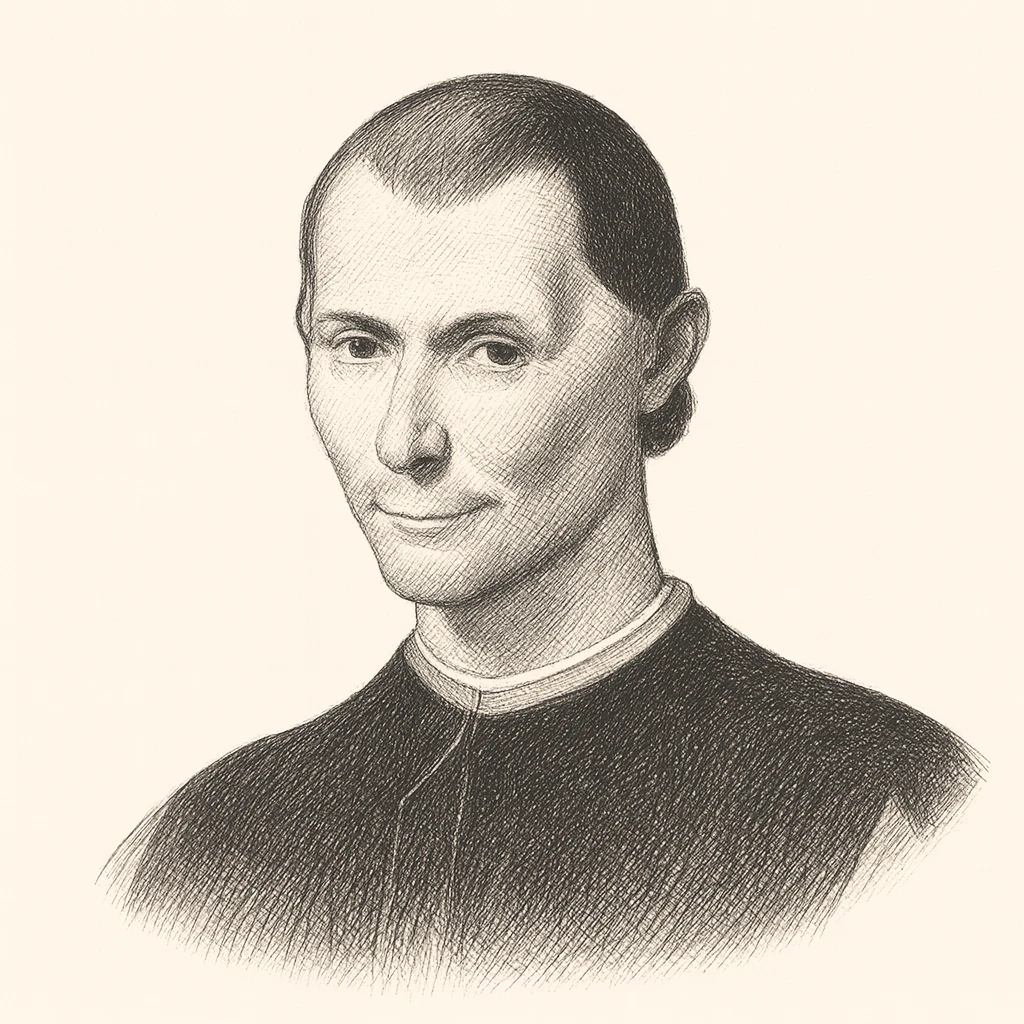
Niccolò Machiavelli was born in Florence in 1469, came of age during the Italian Renaissance, spent his most productive years as a diplomat for the Florentine Republic, and was tortured, exiled, and left to die in obscurity when the Medici returned to power. His reputation for moral monstrousness, captured in the adjective "Machiavellian," is largely based on a misreading of a book that was itself written in desperation by a man who had lost everything and was trying to claw his way back into public life. Reading Machiavelli carefully means encountering a much more interesting thinker than the caricature suggests: a republican patriot, a brilliant analyst of how power actually operates, and one of the most honest observers of political life in the Western tradition.
Machiavelli spent his adult years, from 1498 to 1512, as a senior civil servant in the Florentine Republic, conducting diplomatic missions, organizing a citizen militia, and watching up close how political power was actually exercised by popes, princes, kings, and military commanders across Italy and beyond. He met Cesare Borgia, Pope Julius II, and Louis XII of France. He watched the Borgia rise and fall. He saw city-states be conquered, betrayed, and dismembered. He saw virtue rewarded with destruction and cruelty rewarded with survival. Everything he later wrote was shaped by this fourteen-year immersion in the actual operation of political power during one of the most violent and politically creative periods in European history.
In 1512 the Florentine Republic fell, the Medici returned, and Machiavelli was out of a job. Worse, he was implicated in a conspiracy against the new regime, arrested, tortured on the rack, and only spared execution by a general amnesty. He retreated to his country estate outside Florence and, in the next few years, wrote two of the most important works of political philosophy ever produced. The Prince (1513) was the shorter, more famous, and more controversial work. The Discourses on Livy (1517), which Machiavelli himself probably considered his more important book, was a much longer defense of republican government grounded in a close reading of ancient Roman history. The two books are often taken as contradictory, but they share a fundamental insight: political life operates according to its own logic, and that logic cannot be understood by applying the moral categories that govern ordinary human relationships.
The Prince is structured as a handbook for a new ruler, advising him on how to acquire, maintain, and exercise political power. What made the book scandalous, and still makes it uncomfortable reading today, is Machiavelli's willingness to say out loud what political actors had always known but rarely admitted: that successful rulers must sometimes lie, break promises, use cruelty, and appear virtuous while being ready to act viciously when necessary. Machiavelli was not celebrating these qualities. He was describing them. His argument was that a ruler who refused to do these things when circumstances demanded them would be destroyed by rulers who did, and that the resulting chaos would harm many more people than the original cruelty. Political ethics, in Machiavelli's view, could not be the same as personal ethics because the consequences of political failure fell on entire communities, not just on the individual leader.
The Discourses on Livy is the book Machiavelli's defenders point to when trying to rehabilitate him, and they are right to do so. The Discourses is a sustained argument for republican government, drawing on Roman history to show that free republics are stronger, more creative, and more resilient than principalities. Machiavelli's preference for republics over monarchies was sincere; his entire political career had been in the service of a republic; and The Prince is probably best understood as a desperate attempt to find employment in a Medici regime that Machiavelli was not going to get, rather than as a considered statement of his deepest political convictions. He never did get his career back. He died in 1527, embittered and relatively unknown. His books would take decades to gain their reputation, and centuries to be properly understood.
Niccolò Machiavelli is associated with National Conservative. See the archetype