
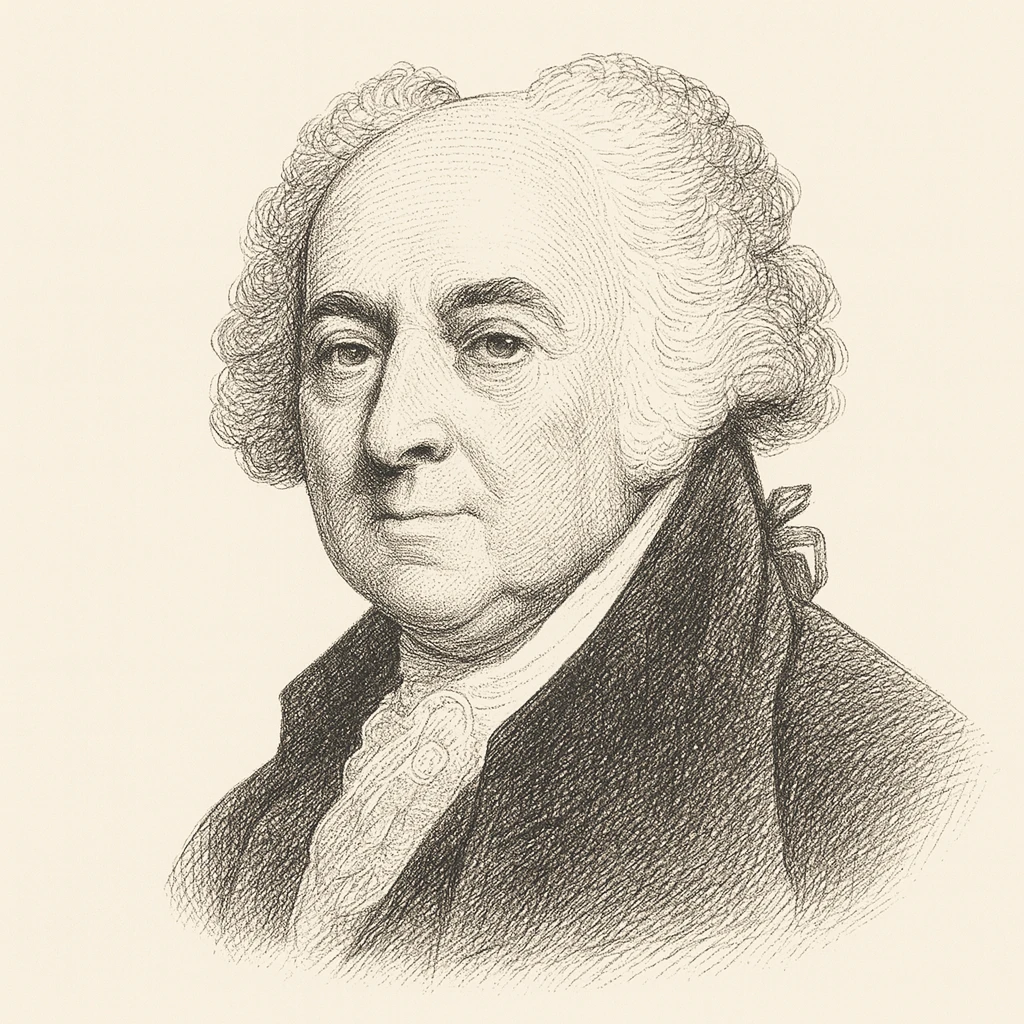
John Adams was a Founding Father who served as the first Vice President and second President of the United States. A Massachusetts lawyer, Adams gained fame defending British soldiers after the Boston Massacre, an unpopular case he took on as a matter of the rule of law. He was instrumental in pushing for independence and securing diplomatic recognition from European powers.
Adams's political philosophy was more conservative than Jefferson's democratic idealism. He warned against unchecked democracy, advocated for balanced government with strong executive, and defended social hierarchy as natural. Drawing on classical and Enlightenment sources, especially Montesquieu and the ancient idea of a mixed constitution, he argued that every society naturally divides into 'the one, the few, and the many,' and that stable liberty required balancing these forces against one another rather than trusting any single one. His 'Defense of the Constitutions,' a sprawling survey of republican governments throughout history, made the case for a strong independent executive and a bicameral legislature designed to check both popular passion and aristocratic ambition. His earlier pamphlet advising on republican government helped shape several state constitutions, and he was the principal author of the Massachusetts constitution, notable for its clear separation of powers.
Jefferson and his Democratic-Republican allies read Adams's emphasis on hierarchy and executive strength as monarchist, a charge that followed him politically. He also warned that the wealthy few would always try to augment their wealth and influence at others' expense, and doubted that virtue alone could restrain power.
His presidency (1797-1801) was marked by the Quasi-War with France and the Alien and Sedition Acts of 1798. The Sedition Act made it a crime to publish false, scandalous, or malicious writing against the government, and several Republican newspaper editors were prosecuted under it; Madison and Jefferson answered with the Virginia and Kentucky Resolutions. Defeated by Jefferson in 1800, Adams retired to Quincy, where he and Jefferson renewed their friendship through a long correspondence. Both died on July 4, 1826—the 50th anniversary of the Declaration. Adams's last words reportedly were 'Thomas Jefferson survives' (Jefferson had died hours earlier).
John Adams is associated with Classical Liberal. See the archetype