
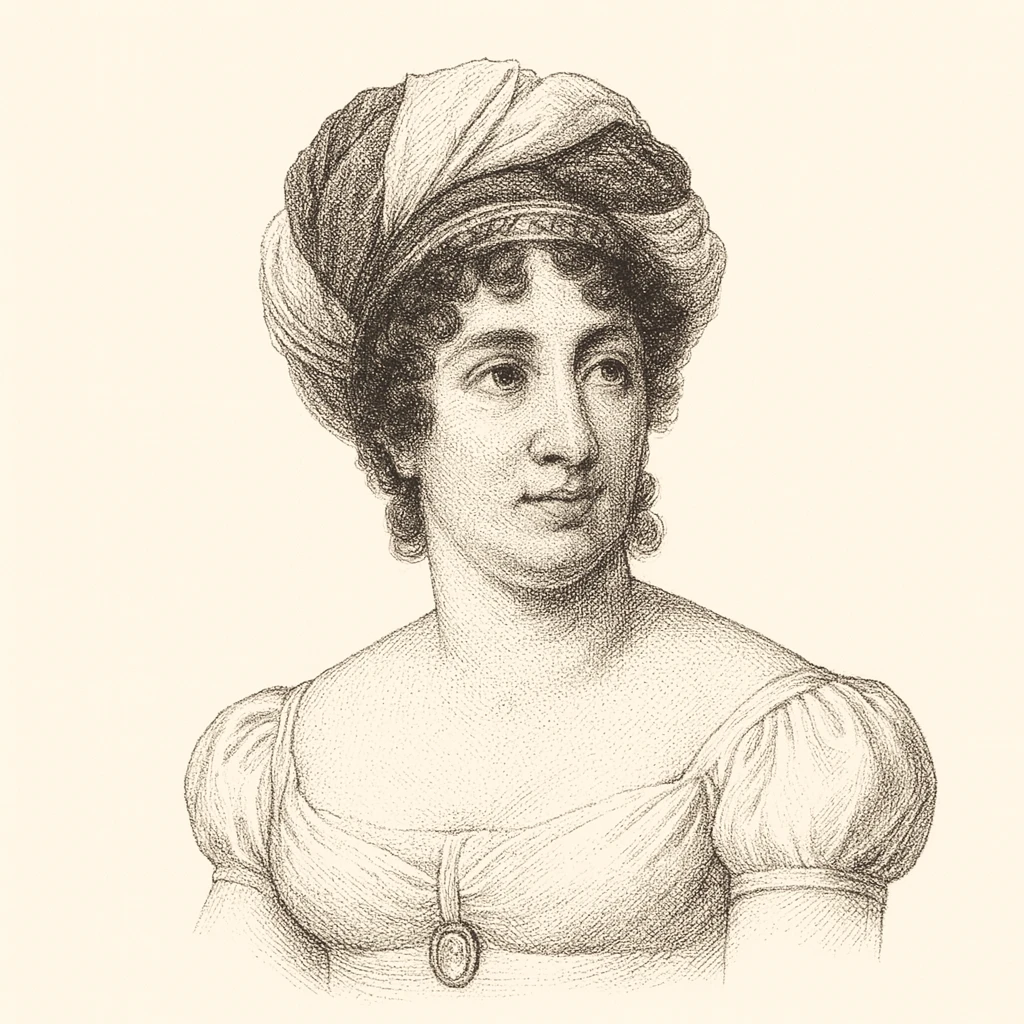
Germaine de Staël was the daughter of Necker, Louis XVI's finance minister, and grew up in the most consequential drawing room in Paris. She kept a salon of her own through the Revolution, welcomed 1789 and was appalled by the Terror, spent years in exile at Coppet on Lake Geneva, and was harried across Europe by Napoleon, who considered her more dangerous than an army corps and told her that the woman who takes up politics ceases to be a woman.
Her political position is a liberalism formed by watching a revolution fail. Considerations on the Principal Events of the French Revolution, published after her death, argues that 1789 was necessary and legitimate, that the Terror was neither its logic nor its accident but the consequence of a nation with no experience of liberty attempting it all at once, and that the remedy is the English model: constitutional monarchy, two chambers, ministerial responsibility, free press, and above all the slow formation of the habits that make free institutions work. She is one of the earliest writers to treat political culture as prior to constitutional design.
De l'Allemagne, published in 1813 after the French police pulped the first edition, did something more unexpected. It introduced French readers to Kant, Schiller, Goethe and the Schlegels, presented Germany as a nation of poets and thinkers whose inwardness offered an alternative to French classicism and French centralization, and effectively created the German-Romantic image of Germany that Europe held for a century. The book's implicit politics is that a culture may be great without a state and that variety among nations is a good in itself.
Her sociology of literature — the argument in De la littérature that literary forms depend on climate, religion, institutions and the position of women, and that criticism must therefore be historical — is a serious anticipation of the comparative study of culture.
Her partnership with Benjamin Constant, personal and intellectual and stormy for fourteen years, produced most of the ideas that French liberalism worked with for the next generation.
Wondering where you land? Take the 4-minute assessment