
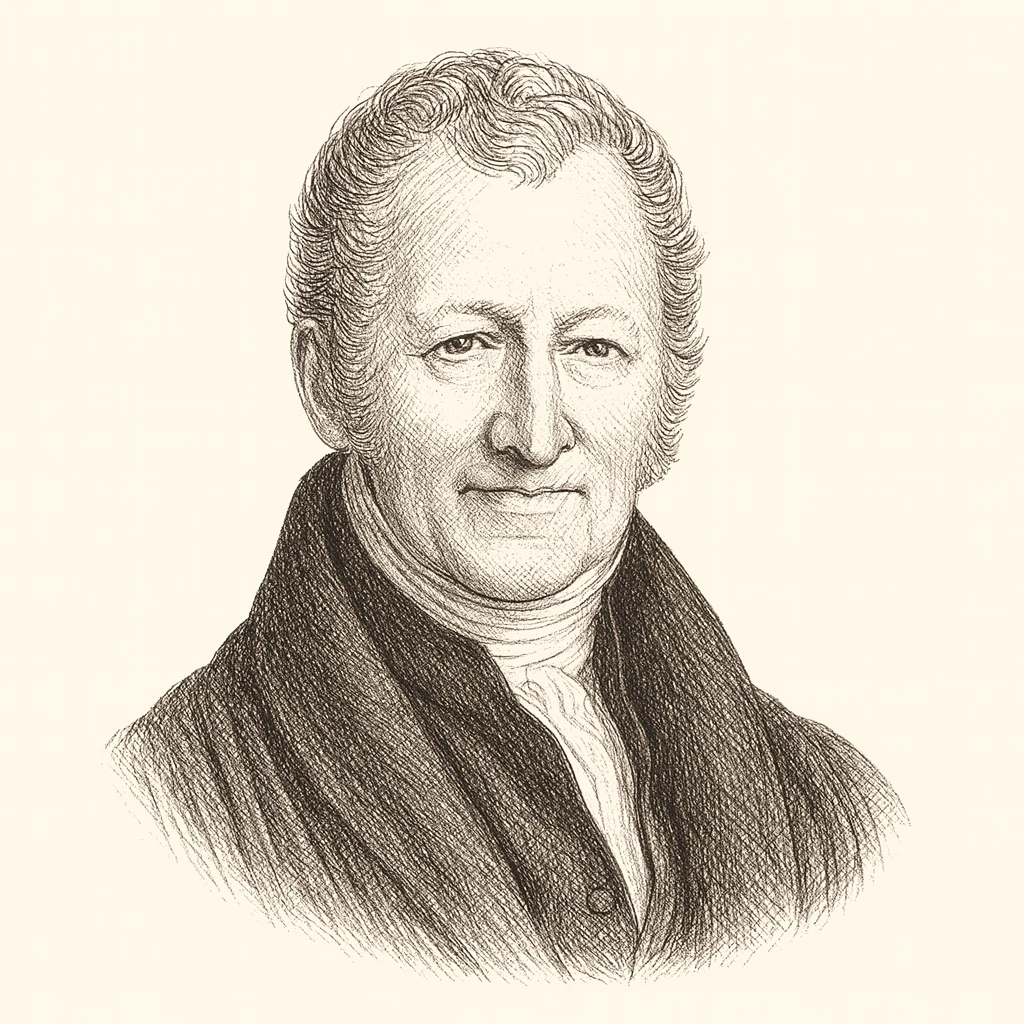
Thomas Malthus was a British political economist and Anglican clergyman best known for the argument, set out in his essay on population, that human numbers tend to grow faster than the means of subsistence. Because population expands geometrically while food supply expands only arithmetically, he contended, growth is checked by misery, starvation, disease, and vice unless restrained by what he called moral restraint. This claim, first published in the late 1790s and expanded across later editions, became one of the most influential and most contested ideas in modern economics and social policy.
Malthus's thought had a distinctly political edge. He wrote in part against the optimistic perfectibility of thinkers like William Godwin and the Enlightenment faith that reason and reform could steadily improve the human condition. Against them he argued that scarcity was a structural feature of the world, not a defect that better institutions could simply engineer away. This pessimism made him a sharp critic of poor relief: he worried that generous public provision for the poor would only encourage larger families and deeper hardship, an argument that shaped nineteenth-century debates over welfare and the reform of the Poor Laws. His conclusions have long drawn criticism for placing the burden of restraint on the poor and for underestimating both technological progress and human ingenuity.
As an economist Malthus stood alongside David Ricardo among the classical school, though the two disagreed sharply, notably over gluts and the possibility of general shortfalls in demand. His insistence on natural limits and on the disciplining force of scarcity aligns him with a strand of liberal economics wary of utopian schemes and confident that spontaneous constraints, rather than benevolent planning, govern human affairs.
Malthus's legacy runs deep into later political argument. His framework influenced Darwin's thinking on competition and survival, and in the twentieth century it resurfaced in environmental and resource debates, most famously in the clash between the pessimism of Paul Ehrlich and the resource optimism of Julian Simon. To be called a Malthusian remains shorthand for anyone who believes that finite resources will ultimately cap human expansion, and the label is invoked as often in condemnation as in agreement.
Thomas Malthus is associated with Classical Liberal. See the archetype