
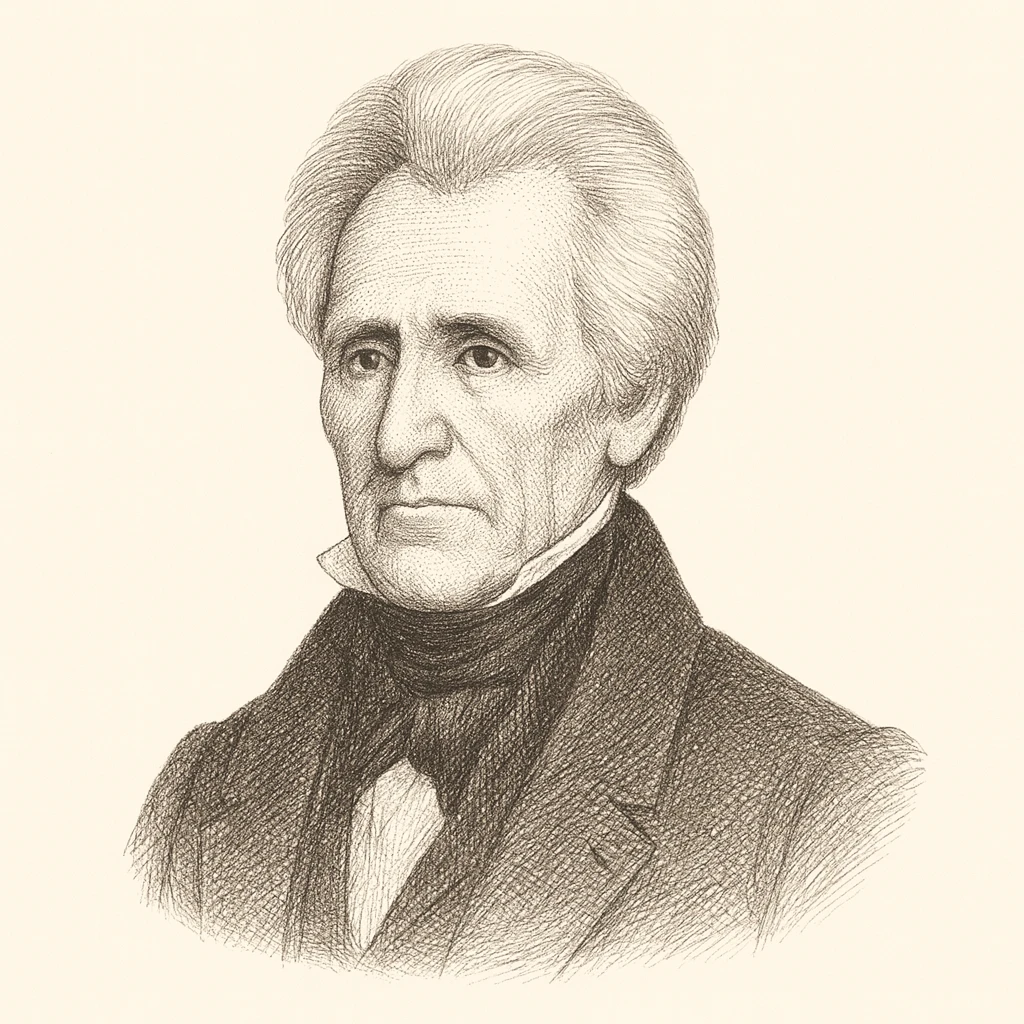
Andrew Jackson was the first 'people's president,' a self-made frontier general who transformed American democracy by extending political participation to common white men while forcibly expelling Native Americans from their lands. Born in poverty in the Carolinas, Jackson rose through military exploits, defeating the British at New Orleans and fighting Indian wars across the South. He was also a Tennessee planter who held more than a hundred people in slavery at his Hermitage plantation.
Jackson's presidency (1829-1837) mobilized mass democracy for the first time. He attacked the 'corrupt bargain' of elites, destroyed the Second Bank of the United States as a tool of privileged financiers, and championed the 'common man'—meaning white male farmers and workers. Jacksonian democracy was a real expansion of political participation. His political thought fused suspicion of concentrated wealth with a robust theory of executive power: Jackson called the president the direct representative of the American people and claimed the right to judge constitutional questions independently of Congress and the courts. He vetoed the Bank's recharter on constitutional as well as economic grounds, framing it as a monopoly that enriched the few at the expense of ordinary producers, and defended hard money against paper credit and speculation.
This view of the presidency drew organized opposition. The opponents who formed the Whig Party in the 1830s denounced him as 'King Andrew,' charging that his use of the veto, his removal of federal deposits from the Bank, and his patronage practices, later called the spoils system, concentrated power dangerously in the executive. Yet during the Nullification Crisis, when South Carolina claimed a state could void federal law, Jackson insisted on the supremacy of the Union and threatened force.
Jackson's presidency also carried out Indian Removal. The Indian Removal Act of 1830 forced the Cherokee, Choctaw, Creek, Chickasaw, and Seminole nations from their ancestral lands, and thousands died on the forced marches known as the Trail of Tears; the Cherokee removal of 1838 was completed under his successor, Martin Van Buren. Jackson took no action to enforce a Supreme Court ruling protecting Cherokee rights, Worcester v. Georgia (1832). He justified removal in the paternalistic and expansionist language of his era, presenting dispossession as both inevitable and benevolent.
Jacksonian democracy thus joined an expansion of political freedom for white men to the dispossession of Native nations. Jackson gave his name to a political era, founded the Democratic Party, and recast the presidency from chief administrator to popular tribune.
Andrew Jackson is associated with National Populist. See the archetype