
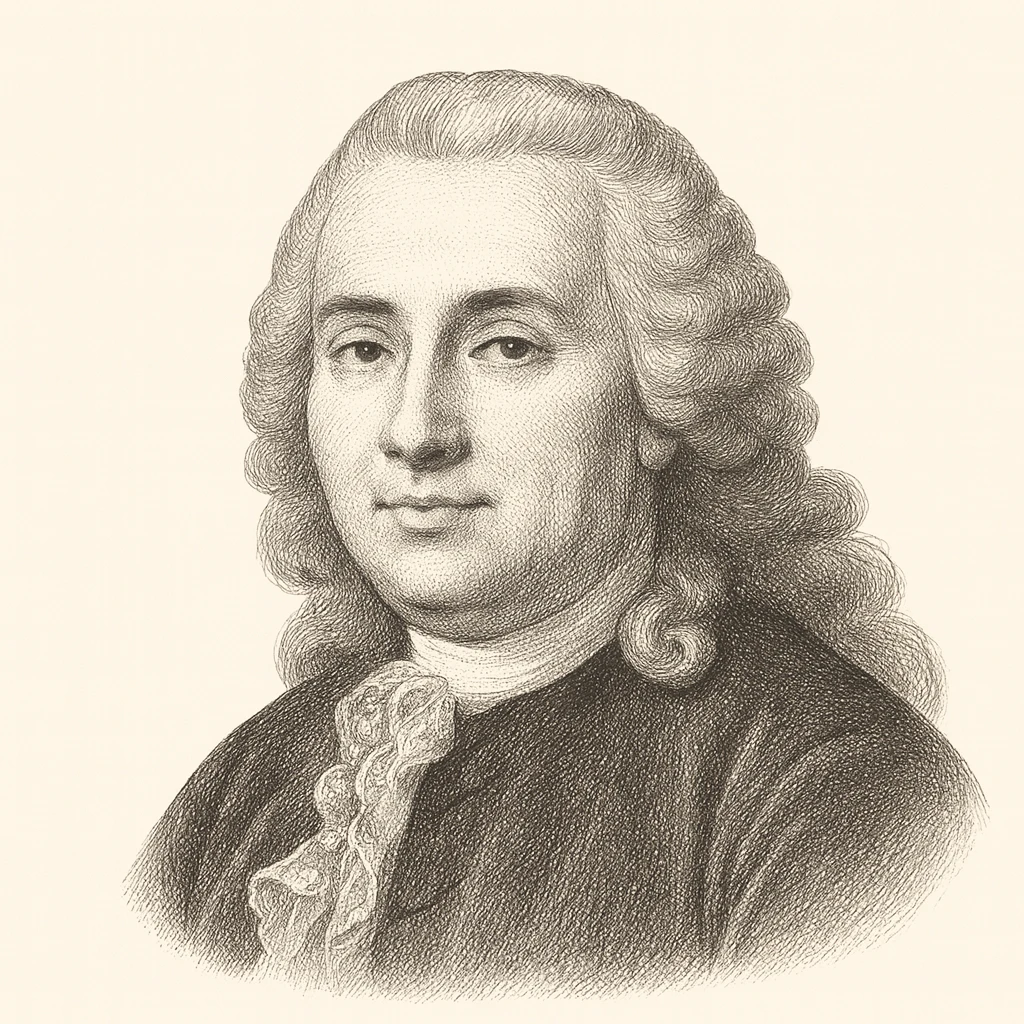
Anne-Robert-Jacques Turgot was intended for the church, left it, became an intendant in the Limousin where he spent thirteen years abolishing forced labor and improving roads, and in 1774 was made Controller-General of France by the new king. He lasted twenty months.
The program was the physiocratic one and he pursued it fast: free internal trade in grain, abolition of the corvée and its replacement with a tax on landowners, suppression of the guilds, retrenchment at court, no bankruptcy, no new loans, no tax increases. The grain reform coincided with a bad harvest and produced the Flour War; the abolition of guilds and the taxation of privilege united the parlements, the court and the queen against him. He warned the king in his letter of dismissal that never forget, sire, that it was weakness that put the head of Charles I on the block. He was gone thirteen years before the Estates General met.
His theoretical work was mostly done before office. The Reflections on the Formation and Distribution of Wealth of 1766 states with unusual clarity the role of capital in production, the distinction between the entrepreneur's profit and the interest on advances, and the tendency of returns to diminish as more labor is applied to a fixed quantity of land — the earliest clear statement of diminishing returns, half a century before Ricardo and Malthus made it central.
The two lectures given at the Sorbonne in 1750, when he was twenty-three, are the more startling documents. Turgot argues that while nature moves in cycles, humanity does not: because we have language and writing, each generation begins where the last stopped, so knowledge accumulates without limit and the human race advances continually, though unevenly and through periods of apparent decline. He sketches a stadial succession from hunting through pasturage and agriculture to commerce, and he treats the arts, sciences, morals and government as changing together. This is the doctrine of indefinite progress in the form the eighteenth century would take up.
Condorcet, his friend and biographer, wrote the Sketch of a Historical Picture of the Progress of the Human Mind in hiding from the Terror, working directly from it.
Wondering where you land? Take the 4-minute assessment