
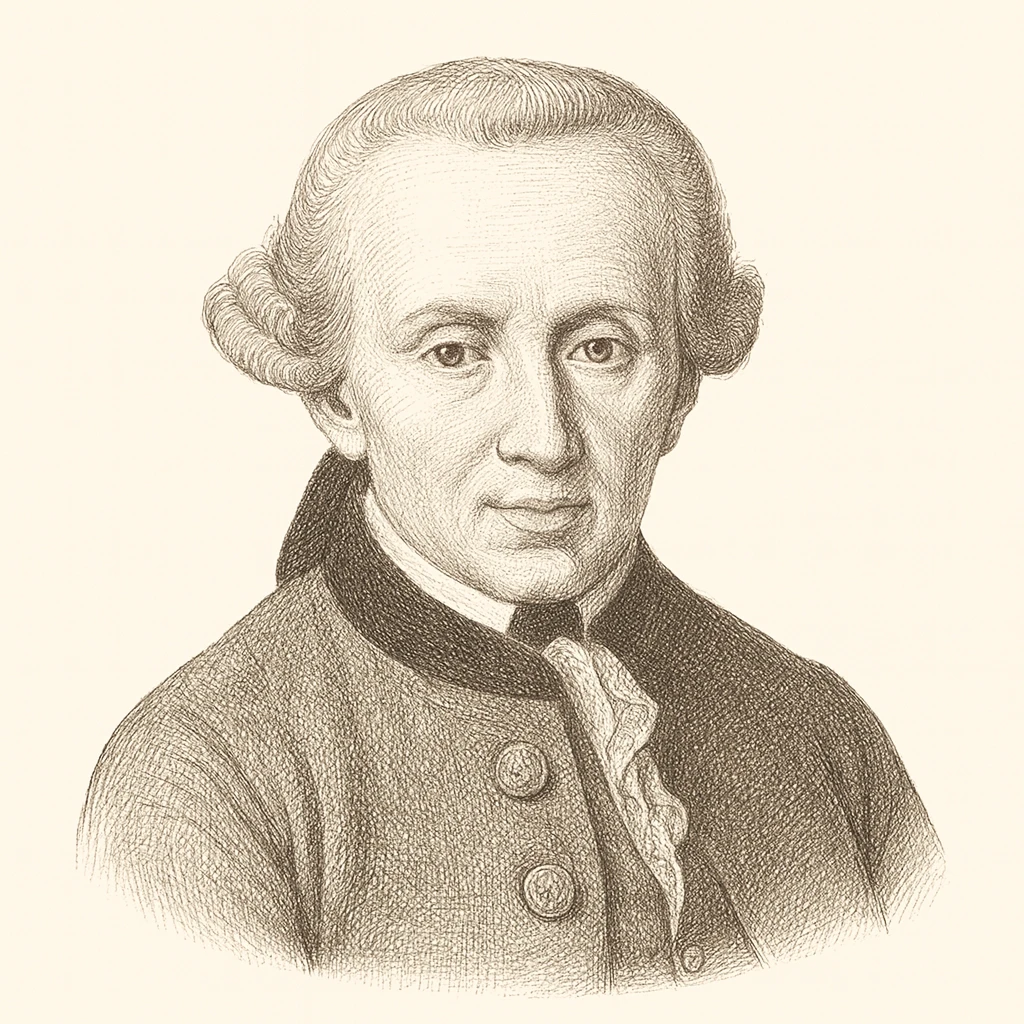
Immanuel Kant is one of the most important philosophers in the Western tradition, and also one of the most difficult to read. His prose is dense, his vocabulary is technical, his arguments are layered, and his major works run to hundreds of pages of sustained reasoning that rarely offers the reader an easy foothold. The reward for the difficulty is a body of work that reshaped nearly every subsequent Western philosophical tradition and still dominates contemporary debates about metaphysics, epistemology, ethics, and political philosophy more than two centuries after his death.
Kant was born in 1724 in Königsberg, the capital of East Prussia, and he famously spent his entire eighty-year life there. He never traveled, never married, and maintained a daily schedule so regular that the townspeople reportedly set their clocks by his afternoon walks. He was the son of a harness maker, raised in a strict Pietist Lutheran household, educated at the University of Königsberg where he later taught for most of his career, and generally regarded by his contemporaries as a cheerful, witty, deeply civilized man who happened to produce the most difficult philosophical prose of his century.
His philosophical career had two distinct phases. For the first forty years, Kant was a capable but unremarkable professor of philosophy working in the German rationalist tradition inherited from Leibniz and Wolff. Then, in middle age, he read David Hume, and as he later said, Hume "awakened me from my dogmatic slumber." Hume's devastating skeptical arguments about causation and the limits of reason convinced Kant that the entire rationalist tradition had been proceeding on faulty foundations. He spent the next decade working in silence on a response, and in 1781, when he was fifty-seven years old, he published the Critique of Pure Reason, one of the most important philosophical books ever written.
The Critique was Kant's attempt to answer a single question: how is knowledge possible? His answer was radical. Knowledge is not simply a matter of the mind passively receiving information from the world, as the empiricists had thought, nor is it a matter of pure reason operating independently of experience, as the rationalists had thought. Knowledge is the product of a structured interaction between the mind and the world, in which the mind actively imposes certain categories and forms on the raw material of experience. We know the world as it appears to us (phenomena), not as it is in itself (noumena). This insight, which Kant called his "Copernican revolution," reframed the entire project of philosophy and shaped nearly every subsequent Western philosophical tradition, from German Idealism through phenomenology to contemporary analytical philosophy.
Kant's ethical philosophy, developed in the Groundwork of the Metaphysics of Morals (1785) and the Critique of Practical Reason (1788), was equally consequential. He argued that moral obligations are grounded in rationality itself: any rational being must recognize that moral rules apply universally, and that acting morally means acting according to principles one could will to be universal laws. This is Kant's famous "categorical imperative." From this foundation, Kant derived the claim that human beings, as rational beings, possess an inherent dignity that must never be violated by treating them merely as means to other people's ends. This framework is the philosophical foundation for nearly all modern thinking about human rights, and it remains the dominant alternative to consequentialist ethics in contemporary moral philosophy.
Kant's political philosophy, developed in his later writings including Perpetual Peace (1795), extended his ethical framework into the public sphere. He argued for republican government, the rule of law, and a federation of free states as the long-term route to ending war and establishing a just international order. His vision of perpetual peace through cosmopolitan legal institutions directly influenced the 20th century founding of the League of Nations and the United Nations.
Kant died in 1804 at eighty, having spent his final years watching the French Revolution unfold and trying to make sense of its promises and its terrors. His last words, reportedly, were "Es ist gut" — "It is good." His influence on the next two centuries of Western thought has been nearly impossible to overstate. Every major philosophical tradition since Kant has either extended his framework or defined itself against it.
Immanuel Kant is associated with Social Liberal. See the archetype