
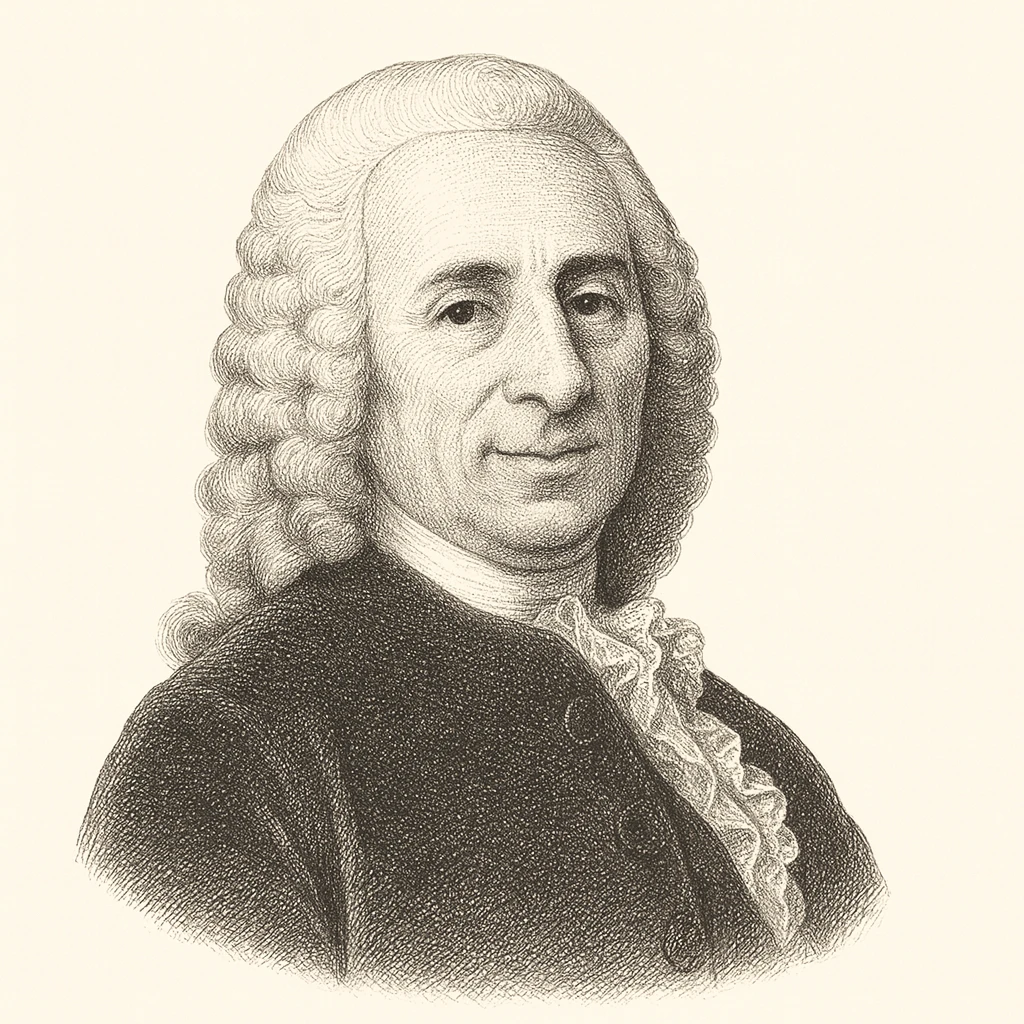
François Quesnay was the son of a peasant, trained as a surgeon, became physician to Madame de Pompadour and then to Louis XV, and lived in an entresol at Versailles where the economists met. He turned to economics at sixty, having spent a career on the circulation of the blood, and the analogy is not accidental.
The Tableau Économique of 1758 is the first attempt to represent an entire economy as a system of flows. It divides society into three classes — the productive class working the land, the proprietors who receive rent, and the sterile class of artisans and merchants — and traces, through a zigzag diagram of payments, how the annual product circulates among them and reproduces itself. Mirabeau called it one of the three great inventions of humanity, alongside writing and money, which was excessive; but the idea that an economy is a self-reproducing circuit whose parts must balance is genuinely new here, and it is the ancestor of Marx's reproduction schemes, of input-output analysis, and of national accounts.
The doctrine attached to it is that only agriculture yields a net product — a surplus over what was consumed in producing it — while manufacture and trade merely transform values without adding to them. This is wrong, and it followed from an accurate perception of where the French surplus was actually being generated and an inaccurate theory of why. Its policy conclusions were more durable: a single tax on the net product of land, since all other taxes are ultimately paid out of it anyway; the removal of internal tolls and restrictions on the grain trade; and the abandonment of the whole Colbertist apparatus of regulation. Laissez faire, laissez passer belongs to this circle.
Underneath is a claim about natural order. There exists a natural and beneficial order of society discoverable by reason, and the sovereign's task is to recognize and enforce it rather than to design arrangements of his own — legal despotism, they called it, meaning absolute power exercised strictly within the natural law it did not create.
Adam Smith spent 1765-66 in France, knew Quesnay, and later said that with all its imperfections the physiocratic system was the nearest approximation to the truth yet published on the subject; Dupont de Nemours reported he would have dedicated the Wealth of Nations to Quesnay had he lived.
Wondering where you land? Take the 4-minute assessment