
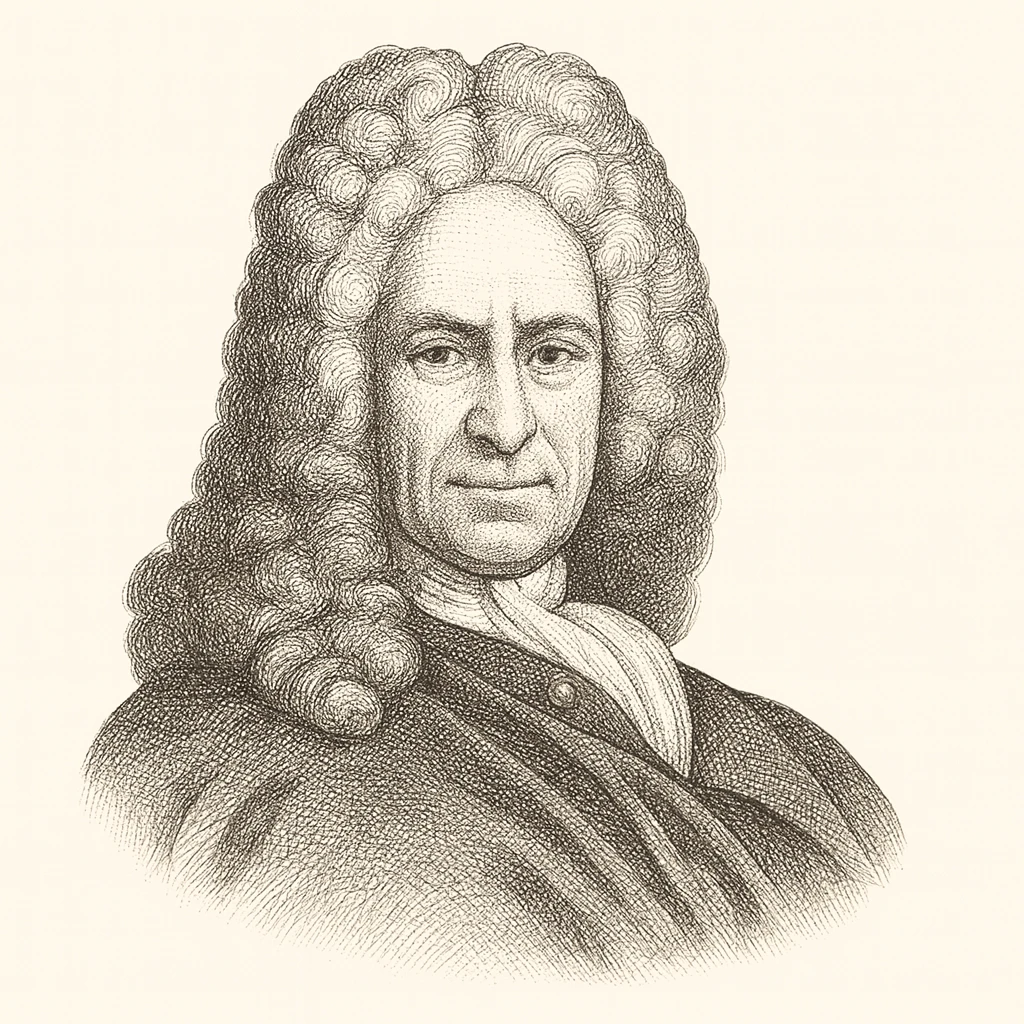
Christian Wolff taught at Halle and was, for a generation, simply what philosophy meant in Germany. He took Leibniz's scattered insights and built them into an ordered system covering logic, metaphysics, natural theology, physics, ethics, politics and law, presented in a demonstrative form modeled on mathematics, and published it twice over — in German for a wide audience and in Latin for Europe.
The German publication is more consequential than it sounds. Philosophy in Germany had been conducted in Latin; Wolff wrote it in the vernacular and had to invent the terms as he went. Bewusstsein, Begriff, Verhältnis, Vorstellung — much of the vocabulary that Kant, Hegel and their successors used was coined or fixed by Wolff, and German became a philosophical language largely through his textbooks.
In 1721 he gave a public oration on the practical philosophy of the Chinese, arguing that Confucius had produced a workable morality on natural reason alone, without revelation, and that this demonstrated the sufficiency of reason in ethics. His pietist colleagues reported him to the king; they added that his determinism would excuse army deserters, which was the argument that told. Frederick William I ordered him to leave Prussian territory within forty-eight hours on pain of hanging. He went to Marburg, became more famous for the persecution than he had been for the philosophy, and was recalled in triumph by Frederick the Great in 1740 as one of the new reign's first acts. The episode became the founding parable of the German Enlightenment.
His political and legal writing extended natural law in a distinctive direction. Wolff held that the duty of self-perfection is the ground of all obligation, and that the state exists to promote the welfare and perfection of its subjects — a positive, developmental account of the state's purpose rather than a merely protective one. This is the theoretical basis of enlightened absolutism and of the well-ordered police state in its eighteenth-century sense, and it is the tradition Kant reacted against when he insisted that no government may make its subjects happy on its own conception of happiness.
Kant was raised on Wolffian textbooks and lectured from them for decades, and the critical philosophy is in large part an accounting with what Wolff had claimed reason could do unaided.
Wondering where you land? Take the 4-minute assessment