
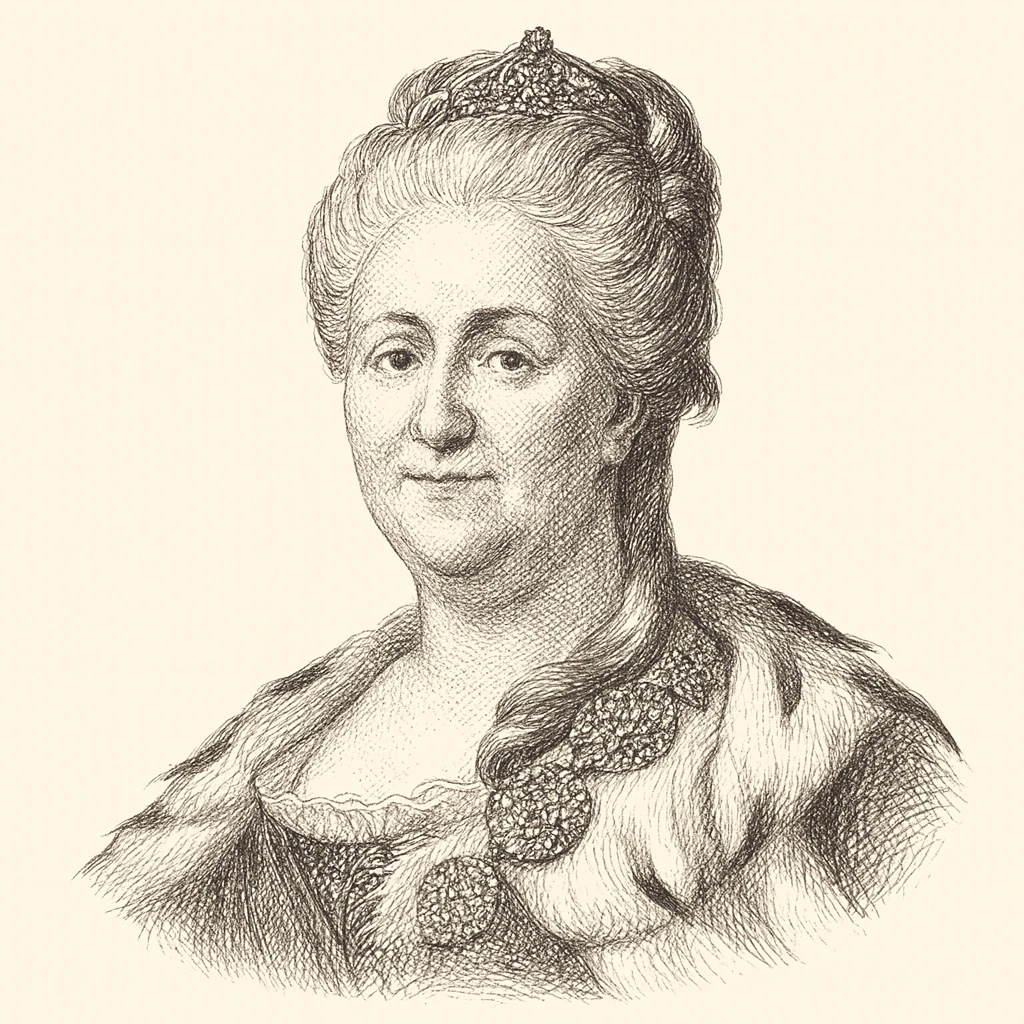
Catherine II was the longest-ruling female leader in Russian history, transforming Russia into a major European power while corresponding with philosophes and promoting Enlightenment culture. A German princess who seized power from her husband Peter III, Catherine ruled Russia for 34 years.
Catherine's 'enlightened despotism' combined Western ideas with Russian autocracy. Her Nakaz (Instruction), drafted to guide a Legislative Commission convened to modernize Russia's laws, quoted extensively from Montesquieu's writings on law and government and Beccaria's arguments against torture and cruel punishment. It floated principles of legal equality, moderate penalties, and the rule of law—yet Catherine also insisted that Russia's vast territory required absolute monarchy, and the Commission dispersed without producing a code. Reforms remained limited, and much of the borrowed language served to advertise her regime to a European audience.
She founded the Hermitage, patronized arts and sciences, and corresponded with Voltaire and Diderot, whom she treated as advisers and publicists as much as thinkers; her patronage helped fund and shelter figures the French monarchy distrusted. Yet serfdom expanded under her rule, both in the numbers bound and in the powers granted to landowners. Her 1785 Charter to the Nobility entrenched aristocratic privilege, binding her reforms to the interests of the very class Enlightenment critics condemned. This tension—liberal vocabulary resting on unfree labor and unchecked autocracy—defines the central debate over her rule.
Catherine's conquests were substantial—Crimea, Poland's partitions, expansion to the Black Sea. Her wars against the Ottoman Empire established Russia as a Mediterranean power and were justified in part through the rhetoric of civilizing and Christian mission. The Pugachev Rebellion (1773–1775), a massive Cossack and peasant revolt, frightened her into tightening noble control over the countryside and hardened her caution toward reform from below.
The French Revolution deepened this conservatism: alarmed that Enlightenment ideas could turn against monarchy itself, she moved against domestic critics, and the same principles she had once broadcast became grounds for censorship and repression. Catherine's legacy includes Russian cultural Westernization, territorial expansion, and the enduring contradiction of enlightened ideas without liberal reform—a model of 'enlightened absolutism' later admirers and critics alike have read as proof both of reform imposed from above and of its narrow limits when autocracy sets the terms.
Wondering where you land? Take the 4-minute assessment