Angela Merkel
Thinker

Angela Merkel

1954– · German · politician

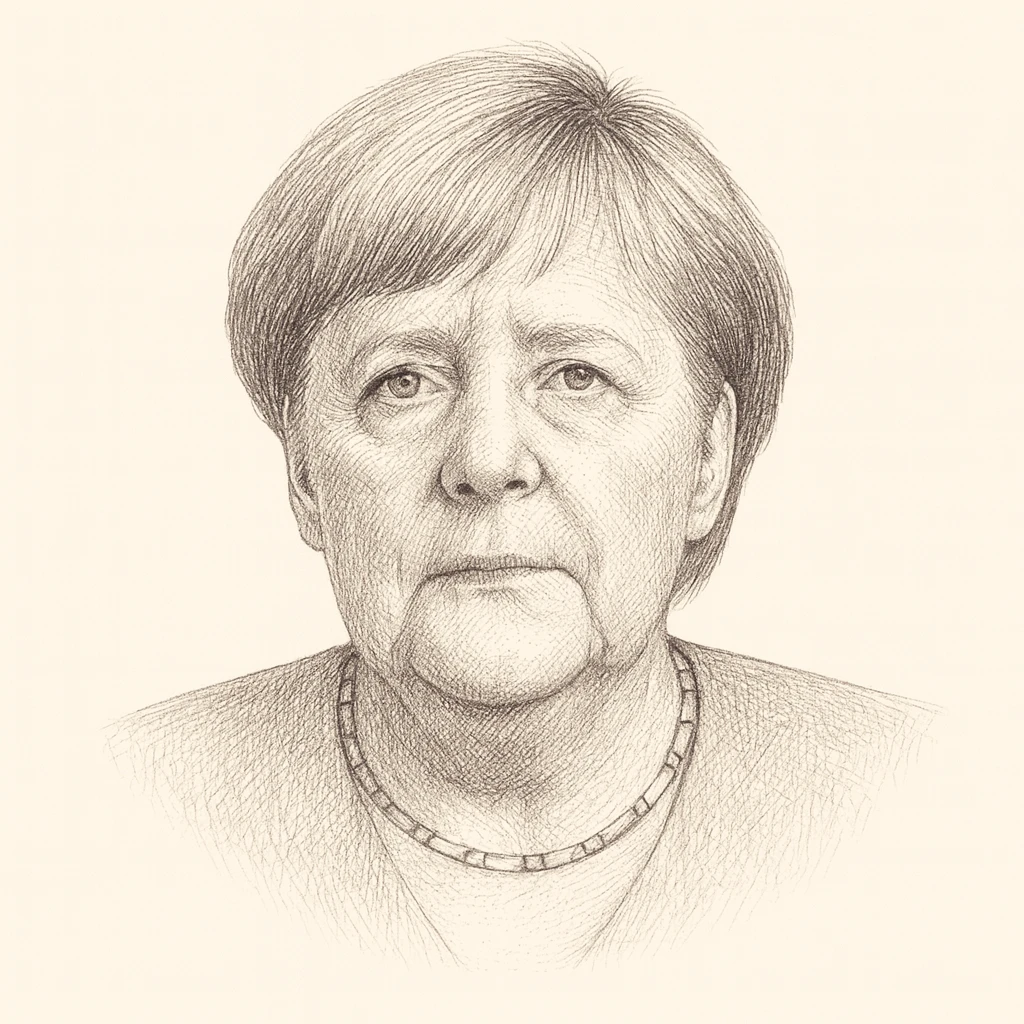
Angela Merkel is the former German chancellor whose cautious, evidence-driven crisis management defined a pragmatic Christian-democratic centrism for a generation of European politics.

Angela Merkel's political thought is best understood not as a doctrine but as a method. Trained as a physicist in East Germany before entering politics after reunification, she carried into government a habit of provisional, evidence-weighing reasoning: identify the constraints, test the options, avoid the grand gesture, and revise as circumstances change. As leader of the Christian Democratic Union and chancellor from 2005 to 2021, she loosened the party from some of its more traditional social commitments and steered it toward a broad, consensus-seeking center, absorbing positions from rival parties where public opinion had moved. Whether this was tactical drift or a durable formula for governing a fragmented democracy remained in dispute.

Her intellectual signature lay in crisis management treated as the ordinary business of politics rather than the exception. Through the global financial crisis, the eurozone debt crisis, and the pandemic, she favored incremental, negotiated solutions over ideological clarity, often waiting until a consensus had ripened before acting. This gave rise to a governing style sometimes described by a coined verb meaning "to Merkel": to deliberate, delay, and hedge until a workable path emerged. She defended fiscal discipline within the European Union, particularly toward indebted southern states, a stance widely credited with holding the eurozone together and widely criticized for imposing austerity on weaker economies.

The most contested moment of her career was the 2015 decision to keep Germany's borders open to large numbers of refugees, encapsulated in her insistence that the country could manage the challenge. The choice drew praise as a humane exercise of leadership and blame for fueling a populist backlash and the rise of the Alternative for Germany.

Merkel's broader influence lies in modeling a politics of stability, procedure, and de-escalation at a time of rising polarization. She demonstrated how a center-right party could occupy the pragmatic middle for over a decade, and how patient, unshowy management could substitute for charismatic vision. Debate continues over whether her caution left Germany underprepared on energy, defense, and long-term reform, but her tenure remains a reference point for anyone weighing the strengths and costs of governing from the center.

Angela Merkel is associated with Pragmatic Centrist. See the archetype
Positions on the recordReviewed Sep 2026

Where Angela Merkel stands

Associated with the Pragmatic Centrist archetype, in the Centrist family. Its nearest types are Reform Conservative and Conservative Democrat.

  1. Liberty

    Authority to Liberty

    In June 2013 she said Germany valued U.S. security cooperation but that gathering information required balance and proportionality. The State Department reported that in March 2021 she and the state premiers decided to ask churches to cancel in-person Easter services; on March 24 the federal government dropped the plan but still urged churches to avoid them.

    Sources: The White House (Obama archives), Remarks by President Obama and German Chancellor Merkel in Joint Press Conference (19 Jun 2013)U.S. Department of State, 2021 Report on International Religious Freedom: Germany (2 Jun 2022)

  2. Economy

    State to Market

    In a 2009 address to Congress she called freedom the essence of the economy but said the financial crisis showed a globalized economy needed global rules on transparency and supervision. In June 2013 she said Europe was not competitive enough, calling budget consolidation one piece of the mosaic alongside structural reforms, less red tape and lower deficits.

    Sources: U.S. Government Publishing Office (Congressional Record), Congressional Record, Volume 155 Issue 162 (Tuesday, November 3, 2009) - JOINT MEETING TO HEAR AN ADDRESS BY HER EXCELLENCY DR. ANGELA MERKEL, CHANCELLOR OF THE FEDERAL REPUBLIC OF GERMANY (3 Nov 2009)The White House (Obama archives), Remarks by President Obama and German Chancellor Merkel in Joint Press Conference (19 Jun 2013)

  3. Scope

    National to Global

    Addressing Congress in 2009 she called globalization a great opportunity whose alternative meant isolation, and urged binding climate commitments. The State Department reported that after the December 2016 Berlin attack she defended accepting refugees; in March 2017 she called free movement in the EU important and said its external borders must be protected.

    Sources: U.S. Government Publishing Office (Congressional Record), Congressional Record, Volume 155 Issue 162 (Tuesday, November 3, 2009) - JOINT MEETING TO HEAR AN ADDRESS BY HER EXCELLENCY DR. ANGELA MERKEL, CHANCELLOR OF THE FEDERAL REPUBLIC OF GERMANY (3 Nov 2009)U.S. Department of State, 2016 Report on International Religious Freedom: Germany (15 Aug 2017)The White House (Trump archives), Joint Press Conference with President Trump and German Chancellor Merkel (17 Mar 2017)

  4. Culture

    Traditional to Progressive

    In December 2016 she told the CDU the full-face veil should be banned wherever legally possible; in 2018 she said Germany was shaped by its Judeo-Christian heritage but four million Muslims could live their religion there. She and her party had opposed same-sex marriage; in June 2017 she said she was open to a conscience vote, and parliament legalized it.

    Sources: U.S. Department of State, 2016 Report on International Religious Freedom: Germany (15 Aug 2017)U.S. Department of State, 2018 Report on International Religious Freedom: Germany (21 Jun 2019)Reason, Legal Gay Marriages Begin in Germany; Australia Gets Mired in a Messy Referendum (2 Oct 2017)

Summarized from Angela Merkel's public statements and record, with a source for each position. The archetype is an editorial association, not a Scan result.

Traditions1
Archetypes1
Influences & connections4

A selection of notable, documented connections — not an exhaustive map.

Intellectual lineage

  • Ludwig Erhard

    The architect of West Germany's soziale Marktwirtschaft, whose synthesis of free markets with a welfare backstop became the CDU economic doctrine Merkel governed within and invoked defending fiscal discipline through the eurozone crisis.

In tension with

  • Wolfgang Streeck

    In 'Buying Time', the sociologist indicted the ordoliberal austerity regime Merkel imposed on the eurozone as a betrayal of democratic capitalism, making him the leading German academic critic of her crisis management.

  • Yanis Varoufakis

    As Greece's 2015 finance minister and in 'Adults in the Room', the economist made resisting Merkel's austerity his central cause, indicting the creditor-imposed bailouts and ordoliberal discipline she championed as economic irrationality.

Influenced

Discover your political archetype.

A four-minute assessment across four axes — no account required, no signup, no spam.

Take the Scan