
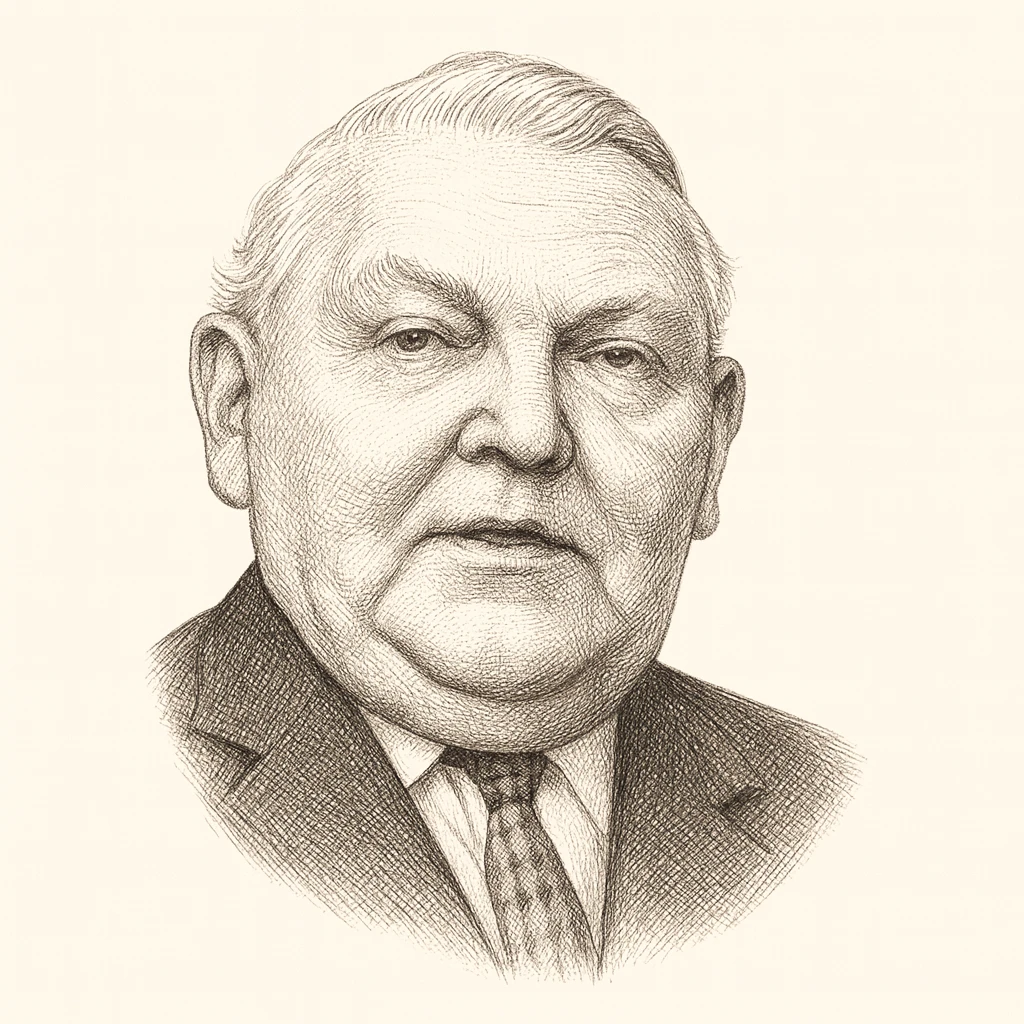
Ludwig Erhard is remembered above all as the political architect of West Germany's postwar economic order, the man most associated with the practice of the "social market economy" (Soziale Marktwirtschaft). Trained as an economist, he entered public life in the wake of the Second World War, and in June 1948, as director of the Bizone's economic administration under Allied occupation, he seized the moment of the currency reform to abolish most price controls in a stroke — the liberalization that set the stage for the West German recovery often called the Wirtschaftswunder. From 1949 he carried that course into the new state as the Federal Republic's first economics minister under Konrad Adenauer. His name became shorthand for the argument that a market economy, properly ordered, could deliver both prosperity and political legitimacy to a democracy rebuilding itself out of dictatorship and ruin.
Erhard's political thought drew on the intellectual tradition of ordoliberalism and the ideas of thinkers such as Wilhelm Röpke, with whom he is closely associated. The core conviction was that markets do not sustain themselves automatically: the state's task is to establish and defend a stable framework of rules — sound money, open competition, protection against monopoly and cartels — within which free exchange can flourish. Against both socialist planning and unregulated laissez-faire, this vision cast the strong but limited state as guardian of competition rather than director of the economy. Erhard framed this as more than technical policy; he presented economic freedom and consumer choice as foundations of a free and cohesive society.
He served as chancellor for a few years in the mid-1960s, succeeding Adenauer, but proved less commanding as a political leader than as an economic standard-bearer, and his tenure ended amid economic difficulties and coalition strains. His enduring influence lies less in his years at the top than in the model he embodied: a European center-right settlement that reconciled capitalism with the welfare and social expectations of a democratic public.
Erhard's legacy is claimed by liberals and Christian Democrats alike, and debated by those who argue the German "miracle" owed as much to external circumstances and demand as to his liberalizing reforms. Still, he remains a defining reference point for anyone weighing how open markets, international trade, and a rules-based order can be married to social stability without collapsing into either central planning or unfettered speculation.
Ludwig Erhard is associated with Cosmopolitan. See the archetype