
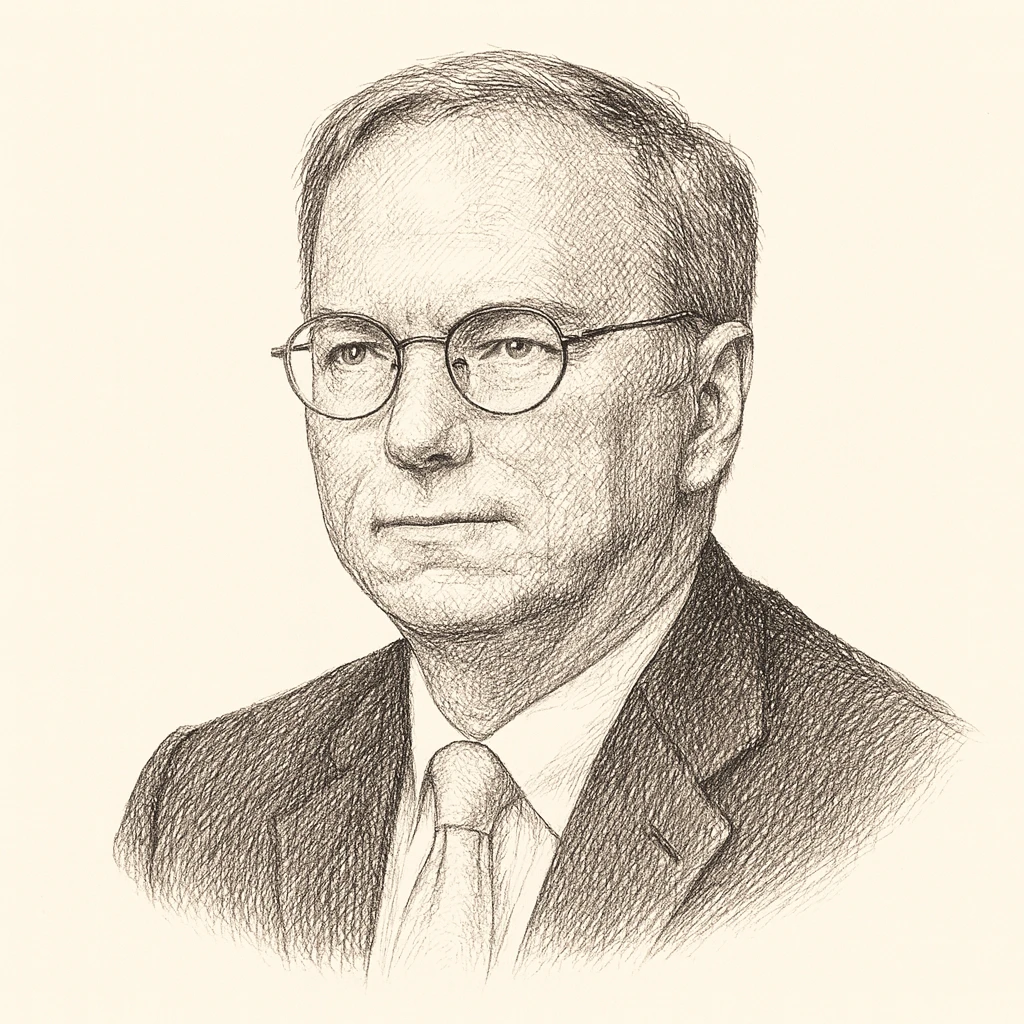
Eric Schmidt is best known as the executive who guided Google from a young startup into a global corporate power, serving as its chief executive and later as executive chairman of Google and its parent company Alphabet. While his primary reputation is that of a business leader and engineer, in the later part of his career he became a prominent voice in American debates about technology policy, national security, and the geopolitics of artificial intelligence. His political significance lies less in a systematic ideology than in his role as a bridge between Silicon Valley and Washington, articulating and popularizing the view that leadership in emerging technologies is inseparable from state power and strategic advantage.
Schmidt's most consequential political contribution has been his framing of technological competition, especially with China, as an existential contest for national security and economic dominance. He chaired U.S. government advisory bodies focused on artificial intelligence and defense innovation, through which he argued that the United States must sustain and expand its lead in AI, semiconductors, and related fields to preserve its geopolitical standing. This work placed him firmly within a tradition that treats innovation as a matter of statecraft, calling for closer collaboration between government, the technology industry, and the defense establishment. In this respect his thought echoes long-standing American ideas linking scientific and industrial supremacy to military and diplomatic strength.
His positions have made him a recognizable exponent of a broadly hawkish, competition-driven approach to technology governance, one that emphasizes great-power rivalry over utopian or purely commercial framings of digital progress. Schmidt has co-authored writings, including reflections on artificial intelligence and its implications for society and world order, that consider how AI may reshape human decision-making, warfare, and the balance of power among nations. These interventions have influenced how policymakers and commentators think about the strategic stakes of AI.
Schmidt is also a notable figure in debates about the political influence of wealthy technologists, given his philanthropic and advisory activities that seek to shape public policy. In 2022 Politico reported that he was helping fund the salaries of more than two dozen Biden administration officials through the Federation of American Scientists, and Katie Paul of the Tech Transparency Project said he "appears to be systematically abusing" such programs "to exert his influence in the federal government." Supporters see him as bringing needed technical expertise to slow-moving governmental institutions. His career thus embodies a broader contemporary question: how democracies should integrate, and constrain, the power of the private technology sector in matters of state.
Eric Schmidt is associated with Techno-Authoritarian. See the archetype