
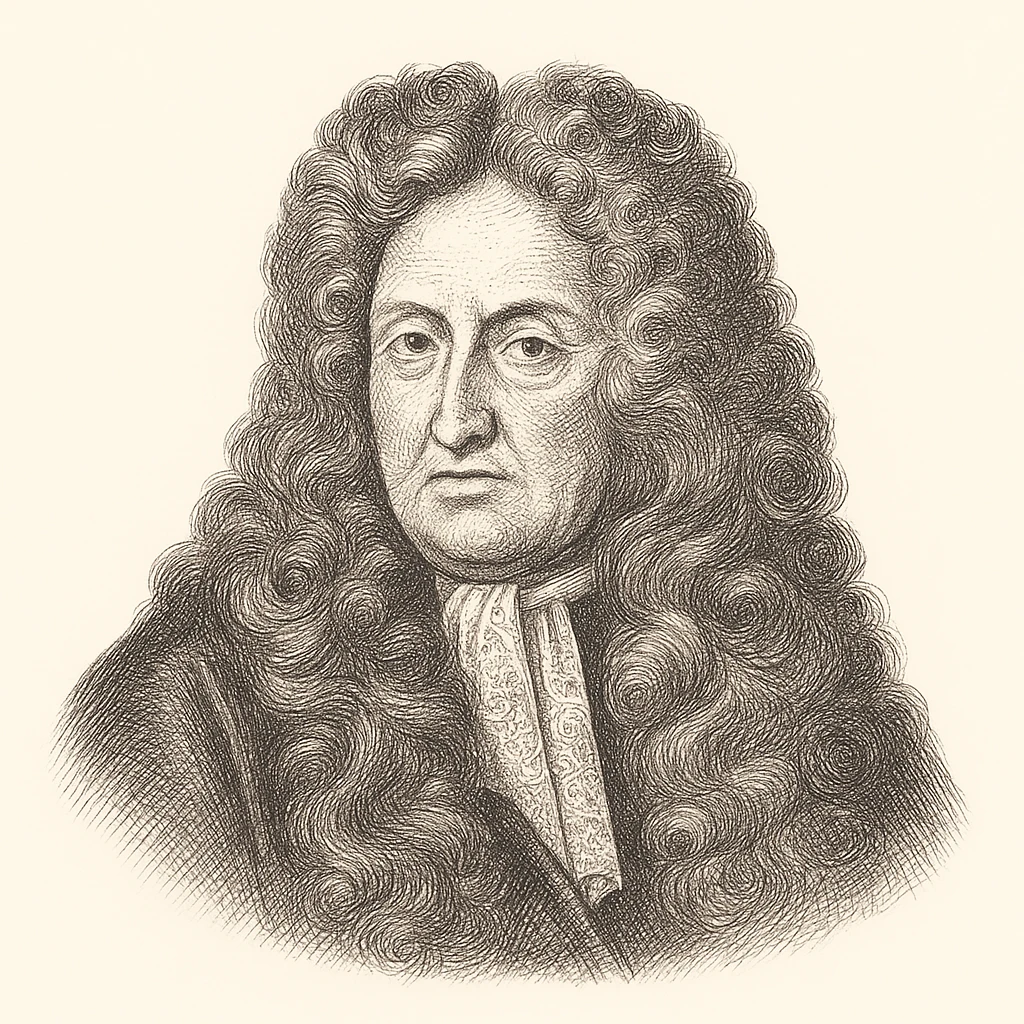
Samuel Pufendorf held the first chair of the law of nature and nations anywhere in Europe, at Heidelberg from 1661, and later taught at Lund and served as historiographer to the Swedish and Brandenburg crowns. His importance is less originality than consolidation and transmission: he took what Grotius and Hobbes had done and made it into a system that could be taught, and it was taught almost everywhere for a century.
His foundation is sociability. Human beings are weak, needy and dangerous to one another, and cannot survive outside society; the fundamental law of nature is therefore that everyone should cultivate and maintain a sociable attitude toward others, and every particular duty is derived from it. This is a deliberate middle course. Against Hobbes he denies that the state of nature is a war of all against all, holding it a state of peace, though a precarious and miserable one. Against Grotius he insists more firmly that obligation requires a superior's command, so that natural law binds because God imposes it, not merely because reason perceives it.
He separates moral entities from physical ones — status, office, obligation, property are imposed on the world by will rather than found in it, which makes the moral order a human and divine construction rather than a natural fact, and lets him treat law as a distinct science with its own objects. He then constructs the state through two contracts and a decree: an agreement to associate, a decision on the form of government, and an agreement between rulers and ruled fixing the terms. The ruler's authority is accordingly conditional in a way Hobbes's is not, though Pufendorf is cautious about resistance.
The transmission is his real significance. De Officio Hominis et Civis, the abridgement he wrote for students, was translated into every major European language and became the standard university text on ethics and politics. Locke recommended it as the best book of its kind for a gentleman's education. Hutcheson lectured on it at Glasgow and Smith heard those lectures; Barbeyrac's French edition with its enormous notes carried it to the philosophes; Blackstone drew on it; and it was on the curriculum at Harvard, Yale and William and Mary, which is much of how the vocabulary of natural rights, contract and the duties of sovereigns became second nature to the American founding generation.
Wondering where you land? Take the 4-minute assessment