
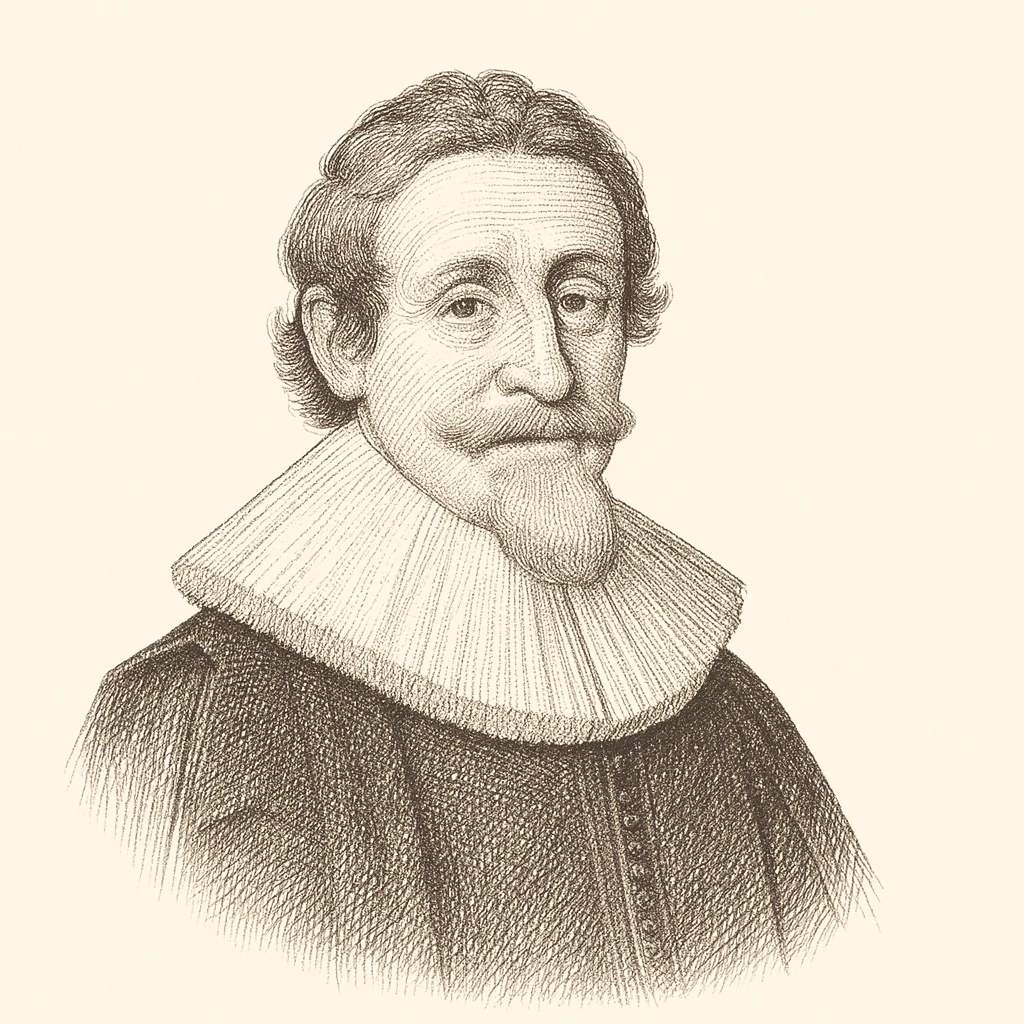
Hugo Grotius is usually called the father of international law, which undersells his significance. What he actually did was something more fundamental: he took the natural law tradition that had developed within medieval Catholic theology and showed how it could operate in a world where religious consensus had collapsed. The result was a philosophical framework that could ground legal and political obligations across religious boundaries, which was exactly what early modern Europe desperately needed in the middle of the bloody Wars of Religion.
Grotius was born in 1583 in Delft, in the Dutch Republic, a staggeringly precocious child who entered the University of Leiden at eleven and was writing Latin poetry and Greek translation at an age when most children were still learning to read. By his early twenties he was a practicing lawyer, a diplomat, and a published scholar. By his thirties he was one of the most prominent legal minds in the Netherlands and a political ally of Johan van Oldenbarnevelt, the great Dutch statesman. When Oldenbarnevelt fell from power in 1618 in a religious and political coup, Grotius was arrested with him and sentenced to life imprisonment in the fortress of Loevestein. He escaped two years later — smuggled out in a chest of books by his wife — and spent the rest of his life in exile, mostly in France, serving as Swedish ambassador and writing the books that would establish his reputation.
The book that made his name was On the Law of War and Peace (1625), which he wrote in exile and published in Paris. The immediate occasion was the Thirty Years' War, which was tearing Europe apart in the name of religious orthodoxy, and Grotius was trying to provide a framework by which Catholic, Protestant, and non-Christian peoples could at least limit the brutality of armed conflict. But the deeper project was more ambitious. Grotius argued that there existed a natural law that bound all human beings regardless of their religious commitments, and that this natural law could be derived from rational reflection on human nature and the requirements of social life. The famous line that captured his framework was the claim that natural law would be valid "even if we should concede that which cannot be conceded without the utmost wickedness, that there is no God, or that the affairs of men are of no concern to Him." This was a radical statement for 1625. Natural law, Grotius was arguing, did not require theological premises to function. It could stand on purely rational foundations.
This secularization of natural law was enormously consequential. Medieval natural law, as developed by Aquinas and the Thomist tradition, had been deeply embedded in Catholic theology. Protestant natural law thinking had religious foundations of its own. Grotius showed that natural law could work independently of any particular religious commitment, and in doing so he provided the philosophical framework that would shape subsequent European thinking about rights, obligations, legitimate authority, and the relations between political communities. Locke absorbed Grotius and extended him. Pufendorf built explicitly on Grotius. Vattel systematized the Grotian framework into the modern law of nations. When the American founders talked about natural rights and the laws of nature, they were working within a tradition whose modern form Grotius had created.
Grotius also wrote extensively on theology, biblical interpretation, and political theory proper. His book On the Freedom of the Seas (1609), written much earlier, argued for the principle that the oceans could not be owned by any single nation and must remain free for commerce and navigation. This principle became foundational to the development of international maritime law and shaped centuries of subsequent diplomatic and commercial practice. His De Jure Belli ac Pacis (On the Law of War and Peace) developed the doctrines of just war, lawful conduct in wartime, the rights of neutrals, and the obligations of treaties that remain the foundation of contemporary international humanitarian law.
Grotius died in 1645 during a shipwreck off the coast of Rostock, in what is now Germany, while traveling between diplomatic assignments. His last words were reportedly, "By understanding many things, I have accomplished nothing." Whatever he meant by that, posterity disagreed sharply. His secularization of natural law shaped the entire subsequent development of early modern political philosophy and gave the Western tradition a framework for thinking about rights and international order that remains alive today whenever people appeal to "human rights" or "the laws of humanity" in debates about the conduct of war, the limits of state sovereignty, or the universal obligations that transcend any particular religious or cultural community.
Hugo Grotius is associated with Classical Liberal. See the archetype