
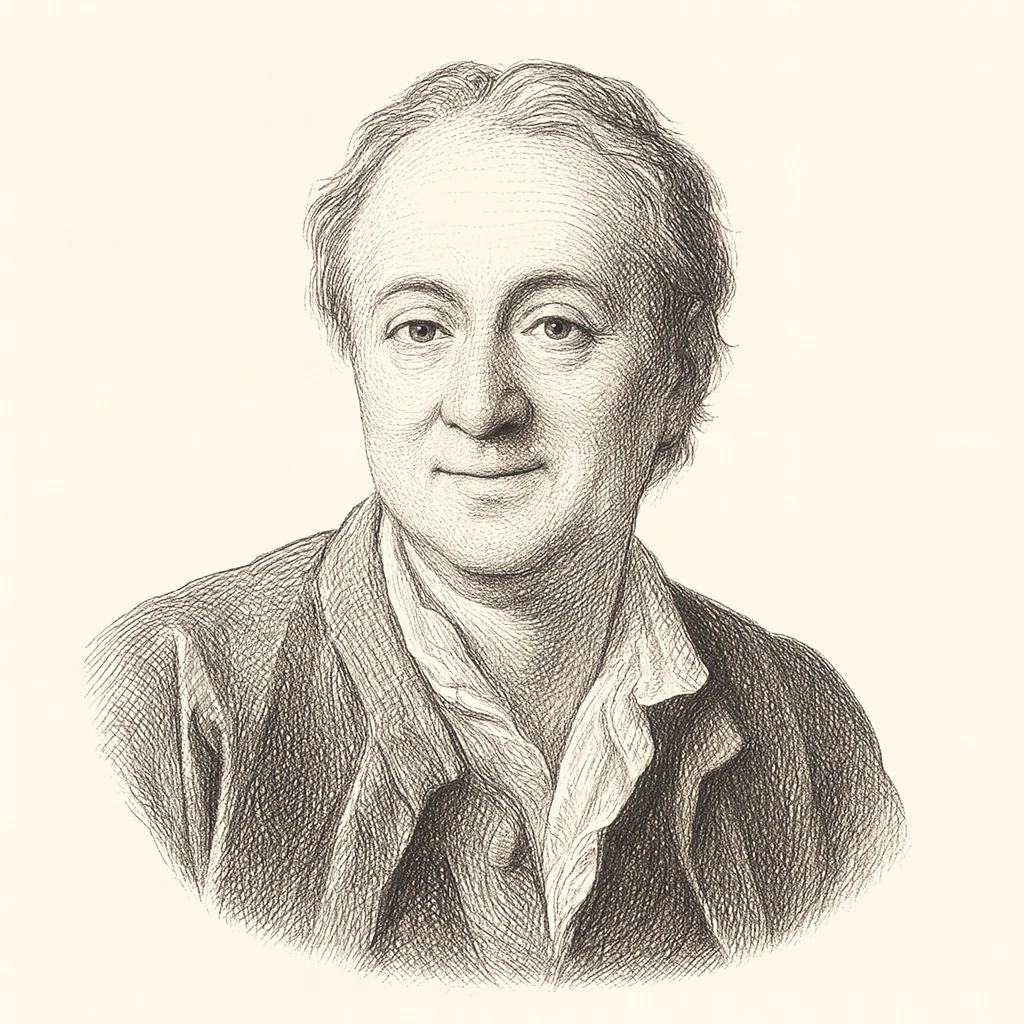
Denis Diderot was imprisoned at thirty-six for the Letter on the Blind, agreed on release to be more careful, and then spent a quarter of a century editing the Encyclopédie — seventeen volumes of text and eleven of plates, some seventy thousand articles, produced under censorship, suspended twice, and completed after his publisher secretly mutilated the last volumes to avoid trouble, which Diderot discovered only when it was too late.
The Encyclopédie is the Enlightenment's characteristic monument and a political act. It treats the mechanical arts with the same seriousness as theology, illustrating the workshops of tanners and glassmakers in exhaustive plates on the premise that useful knowledge is knowledge. It routes subversion through cross-references, so that an unobjectionable article on a religious topic directs the reader to one on superstition. Its underlying claim is that knowledge belongs to everyone, is worth having for its own uses, and does not require an authority to certify it.
His own philosophical work he mostly kept in a drawer. D'Alembert's Dream, unpublished for fifty years, imagines matter as sensitive throughout, life as a matter of organization rather than a separate principle, species as fluid over time, and the self as a temporary swarm — speculations that read as anticipations of evolution and of a materialist theory of mind. Rameau's Nephew, a dialogue between a moralizing philosopher and a brilliant parasite who is not refuted, was published only in Goethe's German translation in 1805, whereupon Hegel made it the center of his account of alienated self-consciousness in the Phenomenology. The Supplement to Bougainville's Voyage uses Tahiti to argue that European sexual morality is a local custom mistaken for nature.
He was a materialist who found La Mettrie crude and Helvétius simplistic, an atheist with a strong taste for moral heroism, and a determinist who could not stop making moral judgments — the inconsistencies are conscious and he dramatizes them rather than resolving them. Rousseau was his closest friend until a permanent rupture in 1758. Catherine the Great bought his library, left him the use of it, and paid him fifty years' salary in advance as its librarian.
Wondering where you land? Take the 4-minute assessment