
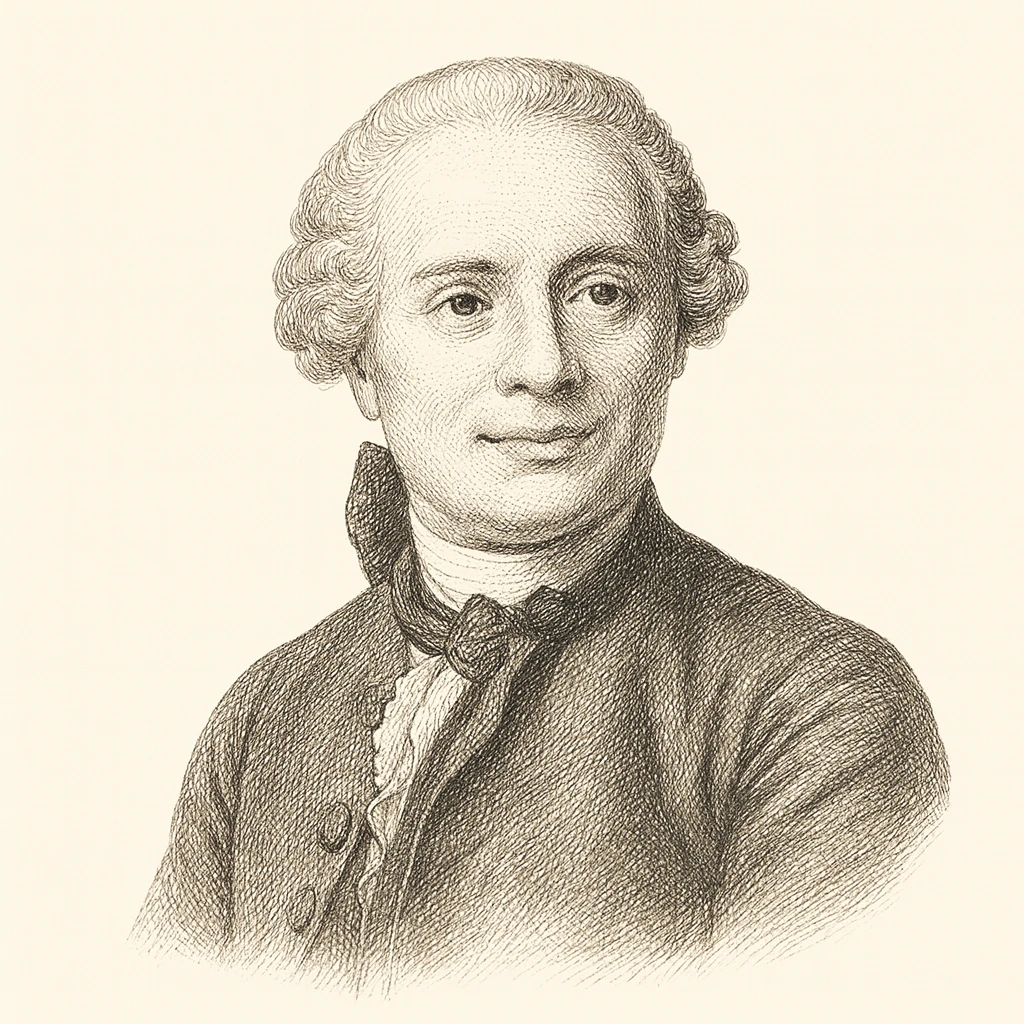
Jean le Rond d'Alembert was abandoned as an infant on the steps of the church that gave him his name, raised by a glazier's wife, and secretly supported by the artillery officer who was his father. He was elected to the Académie des Sciences at twenty-four for work on the dynamics of rigid bodies, and d'Alembert's principle — that the internal forces of constraint in a system do no net work — remains in every mechanics course.
His importance to the Enlightenment is the Preliminary Discourse to the Encyclopédie of 1751, which is both a manifesto and a map. It gives an account of the origin of ideas that is Lockean and unapologetic: all knowledge grows from sensation, the mind abstracts and combines, and the sciences are related to one another as branches of a single tree rooted in memory, reason and imagination. It then narrates the progress of knowledge since the Renaissance as a story of liberation from scholastic authority, naming Bacon, Descartes, Newton and Locke as the men who made it possible. The Discourse gave the project a philosophical charter, and it was read across Europe as the statement of what the age took itself to be doing.
He wrote a great many of the mathematical and scientific articles himself, and the article on Geneva in 1757 — which observed, with approval, that the city's pastors had drifted toward Socinianism — caused such an explosion that it provoked Rousseau's Letter to d'Alembert on the theater and helped push d'Alembert into resigning the editorship in 1759. Diderot carried the remaining volumes alone.
He was more cautious than Diderot in temperament and more skeptical in doctrine, holding that the questions of metaphysics are mostly unanswerable and that the honest position on the soul, on causation and on God is suspension rather than assertion. As permanent secretary of the Académie Française from 1772 he used the position to elect philosophes, which did more for the party's respectability than any book. Frederick the Great and Catherine both tried to hire him, and he declined both, preferring Paris and a modest pension.
Wondering where you land? Take the 4-minute assessment