
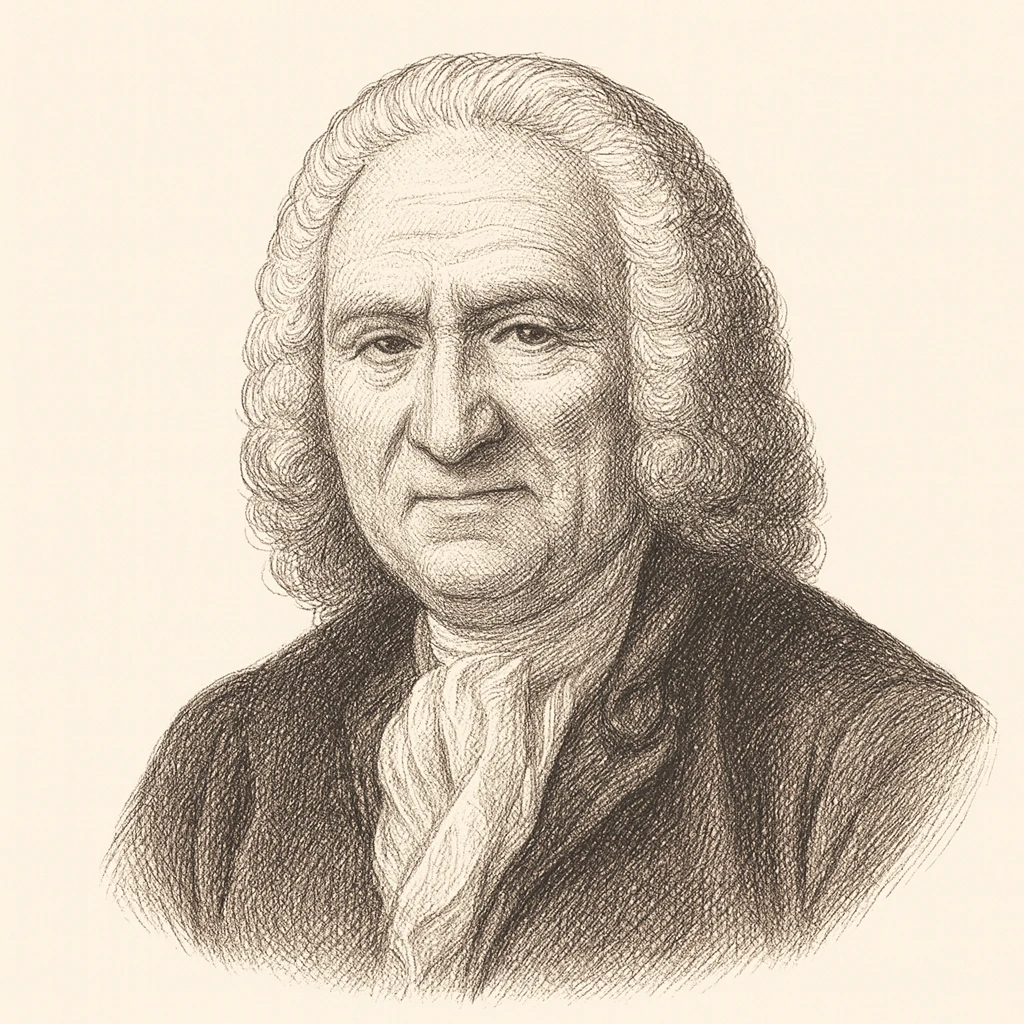
Paul-Henri Thiry, Baron d'Holbach, was a wealthy German-born baron who kept a house in Paris where the philosophes dined twice a week for thirty years. Diderot, Rousseau, Hume, Sterne, Gibbon, Franklin, Beccaria and Adam Smith all passed through it. He wrote or edited more than four hundred articles for the Encyclopédie, mostly on chemistry and mineralogy, and published his own books anonymously or under the names of dead men, through Amsterdam, because what they said was a capital matter.
The System of Nature of 1770 is the most complete statement of eighteenth-century materialism. There is nothing but matter in motion, governed throughout by necessary laws. Man is wholly part of nature and no exception to it; what is called the soul is the brain considered in its functions; freedom of the will is an illusion arising from ignorance of the causes acting on us. There is no God, no purpose in nature, no design and no providence — not a hidden God, not an impersonal one, but none, which distinguishes him sharply from the deists who dominated the period and whom he attacked as vigorously as he attacked the church.
His account of religion is naturalistic and hostile: it originates in fear of natural forces, is elaborated by priests and sustained because it is useful to rulers, and its effect is to make people miserable, obedient and cruel. Christianity Unveiled and The Sacred Contagion pursue this at length. Voltaire, who thought a God necessary to keep servants honest, wrote against the book; Frederick the Great, an atheist himself, wrote against it too on the ground that determinism destroyed the basis of government.
Against La Mettrie's conclusion that morality is convenience, d'Holbach constructed an ethics on the same materialist premises. Since we necessarily seek our own happiness, and since we cannot obtain it alone, virtue is the set of dispositions that make us useful to others and therefore secure their regard; enlightened self-interest and social utility converge. Education and good laws, not divine sanctions, are the instruments.
Marx and Engels treated the French materialists as the immediate ancestors of their own position, and d'Holbach is the fullest of them.
Wondering where you land? Take the 4-minute assessment