
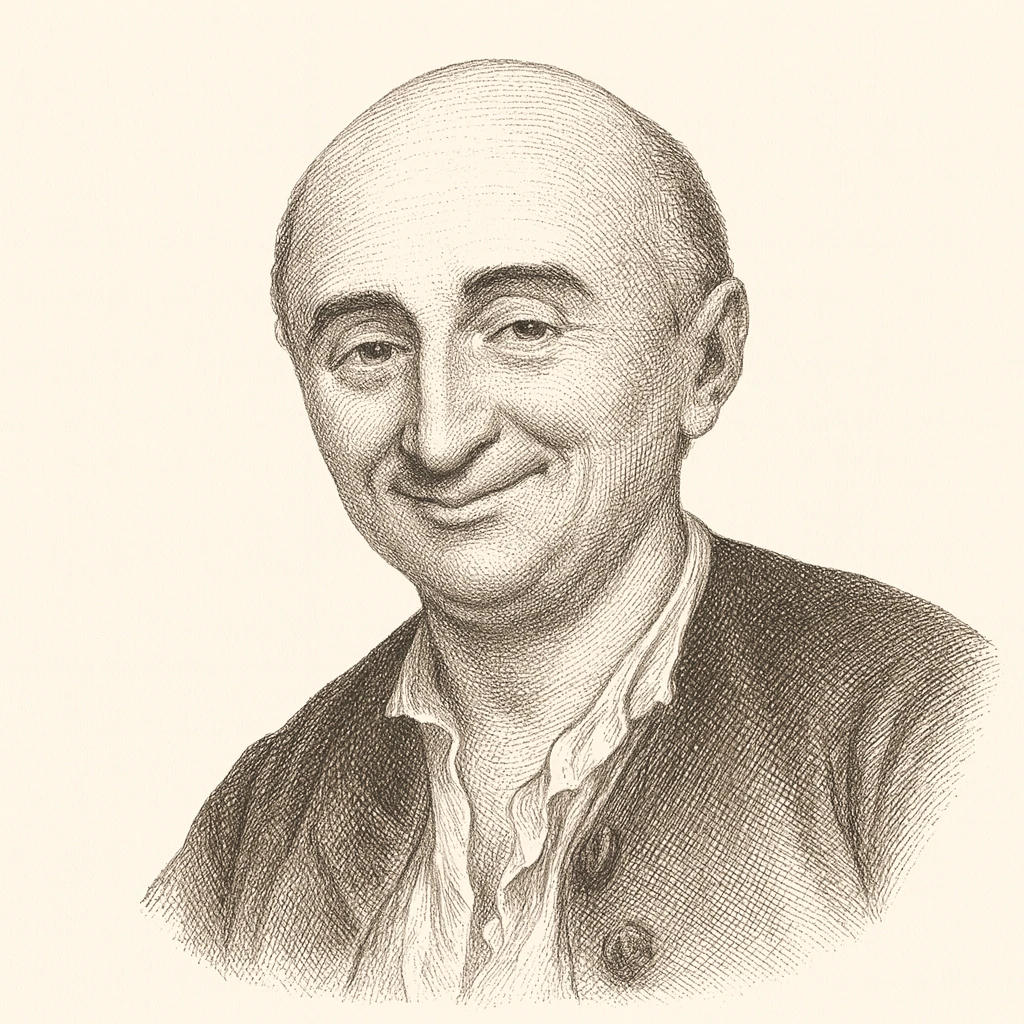
Julien Offray de La Mettrie was an army doctor who fell ill with fever during a campaign and observed, as his thought slowed with his pulse, that mind seemed to be tracking body rather than directing it. He published the observation and its consequences, was driven out of France, then out of the Netherlands — where his books were burned by the public hangman — and ended at the court of Frederick the Great, who gave him a pension and wrote his eulogy.
L'Homme Machine of 1747 argues that Descartes was right that animals are machines and wrong to exempt human beings. There is no separate thinking substance; thought is a property of organized matter, as motion is; the soul is an empty term for a function of the brain. His evidence is medical rather than metaphysical, which is what makes the book effective: opium alters judgment, fever alters character, hunger makes men savage, a blow to the head ends a personality, and the differences between species track differences in the size and structure of the brain. He notes that the ape's anatomy is close enough to ours that one might be taught language, and that a man deprived of education is scarcely a man at all.
The moral consequences he drew are more provocative than the physiology. If we are machines, remorse is useless and punishment should be corrective rather than retributive; if pleasure is the natural end of an organized body, then the pursuit of it needs no apology; and if there is no immortal soul, the terrors of religion are simply a means by which some men govern others. His Anti-Seneca argues that a good conscience is a physical state and that the wicked frequently sleep well.
Even the other materialists disowned him. Diderot found him shallow and thought his hedonism gave the party a bad name; d'Holbach constructed a materialist ethics precisely to avoid La Mettrie's conclusion that morality is a convenience. He remains the point at which eighteenth-century materialism said the quiet part out loud, and every subsequent reduction of mind to brain has had to answer the same objections he first attracted.
Wondering where you land? Take the 4-minute assessment