
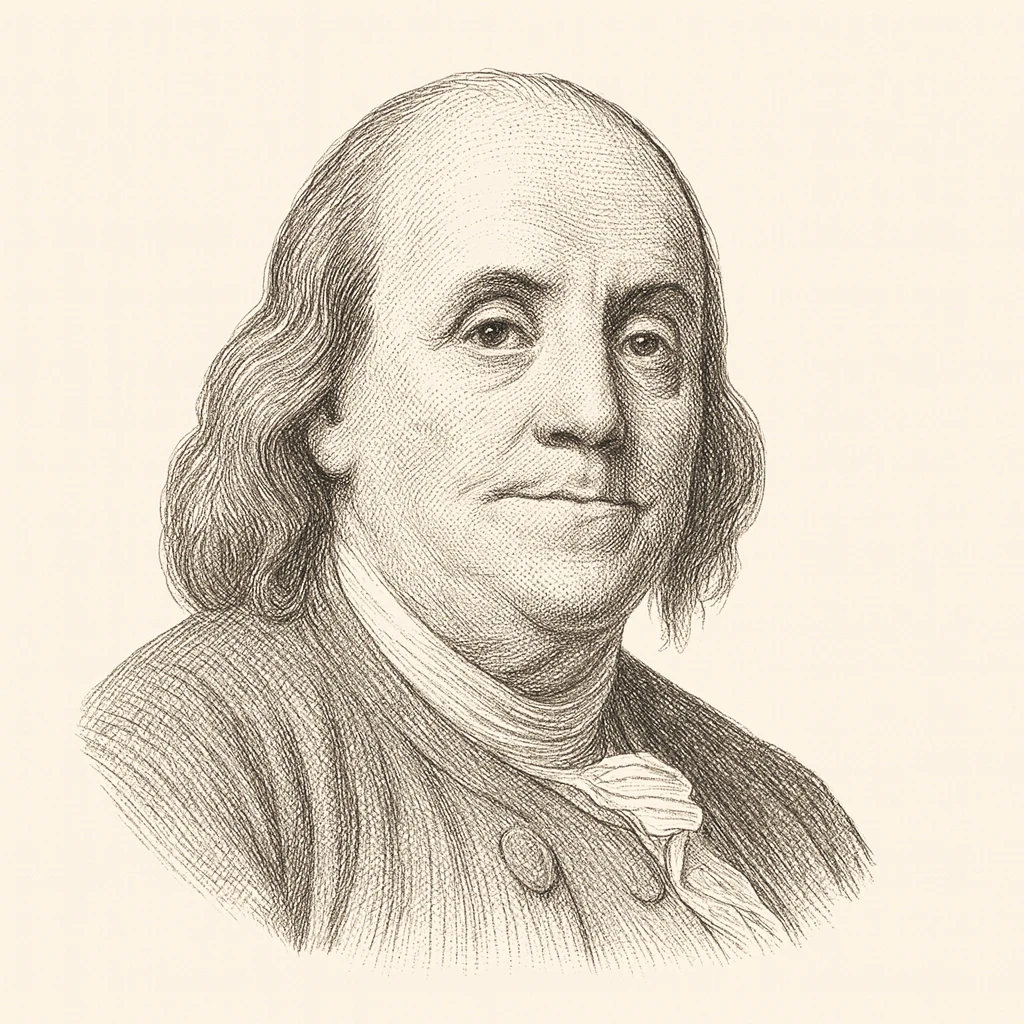
Benjamin Franklin was a printer, scientist, inventor, diplomat, and philosopher of the American founding who rose from humble Boston origins to become the most famous American in the world. Running away from apprenticeship at 17, Franklin built a printing empire in Philadelphia, then retired at 42 to pursue science and public service.
Franklin's electrical experiments made him internationally famous; his practical inventions (bifocals, the lightning rod, the Franklin stove) improved everyday life. Poor Richard's Almanack spread his wit and maxims. In Philadelphia he also helped found civic institutions, among them the Library Company of Philadelphia, a volunteer fire company, the American Philosophical Society, and the academy that became the University of Pennsylvania.
As Pennsylvania's agent in London, then America's minister to France, Franklin put his reputation to work for the revolutionary cause; in Paris he directed the negotiations that produced treaties of commerce and alliance with France. He came late to independence, turning against British rule only gradually during nearly two decades in London. His "Join, or Die" cartoon and the Albany Plan of Union (1754) had earlier urged uniting the colonies under a common Grand Council; the plan was never put into effect but served as a model for later attempts at union.
The oldest delegate at the Constitutional Convention, Franklin was identified with the pragmatic, worldly spirit of the American Enlightenment. At the close of the Convention he urged compromise, conceding in a speech read for him by James Wilson that there were parts of the Constitution he did not approve, asking objecting delegates to doubt a little of their own infallibility, and consenting to it because he expected no better. His Autobiography became a template for American self-improvement.
Franklin owned enslaved people and later became an abolitionist, serving from 1787 as president of the Pennsylvania Abolition Society and in 1790 sending Congress its petition asking for the abolition of slavery and an end to the slave trade. He was the father of an illegitimate son and conducted multiple romantic attachments. He remained curious, productive, and widely quoted to the end of his life.
Benjamin Franklin is associated with Classical Liberal. See the archetype