
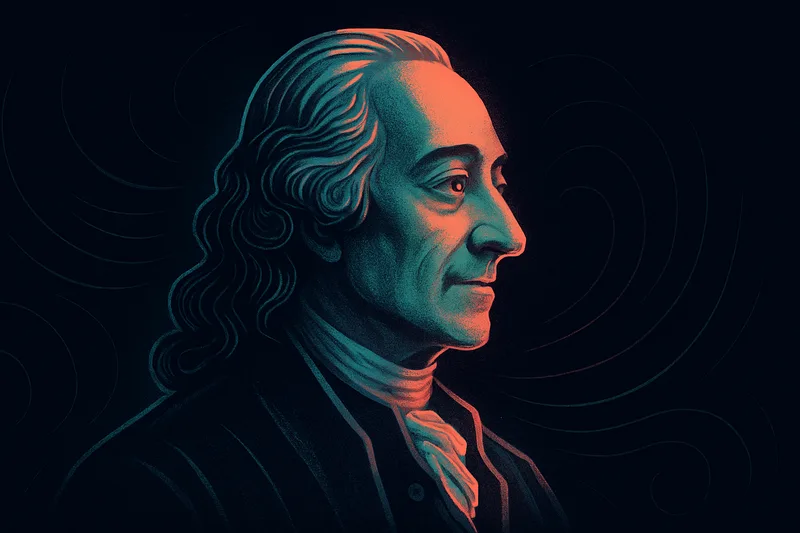
François-Marie Arouet — Voltaire — was born in 1694 in Paris, the son of a notary of modest prosperity and genuine social ambition. He was educated by Jesuits at the Collège Louis-le-Grand, one of the finest schools in France, where he acquired the classical learning, the rhetorical facility, and the taste for irony that would characterize his writing for the next eighty years. The Jesuits gave him an excellent education and left him with an inextinguishable contempt for clerical authority — a combination that proved historically consequential. He chose the pen name Voltaire in his twenties, probably as an anagram of the Latinized version of his family name, and used it exclusively thereafter, as if the bourgeois notary's son needed to be replaced by someone more adequate to his ambitions.
His early career was literary and intermittently scandalous. He wrote verse satires that were reckless by the standards of a society in which insulting the powerful had direct physical consequences. In 1717 a lampoon widely attributed to him — satirizing the regent, Philippe d'Orléans — earned him eleven months in the Bastille, where he had nothing to do but read and write. He used the time to begin his first major work, the epic poem La Henriade, and to develop the ironic distance from the world that confinement tends to encourage. He was imprisoned again briefly in 1726 after a quarrel with the Chevalier de Rohan, a nobleman who had mocked his plebeian origins. When Voltaire responded with what was received as an intention to fight a duel, the Rohan family had him briefly imprisoned again and then arranged his exile to England.
The English exile, which lasted eighteen months from 1726 to 1728, was the turning point of his intellectual life. He learned English, read Locke and Newton and Shakespeare, attended Quaker meetings, observed parliamentary debates, and encountered a society that was, by the standards of absolutist Catholic France, remarkably tolerant, empirical, and free in its public culture. He had arrived with the prejudices of a Frenchman trained in Cartesian rationalism and found instead a country whose philosophical culture was empiricist, whose religious culture was pluralist, and whose political culture allowed dissent in ways that France could not imagine. He returned to France transformed and determined to use what he had seen as leverage against the French institutions he found most objectionable.
The Philosophical Letters (1734) — his account of English intellectual and political life — was the result, and it was immediately recognized as a subversive document. By holding up English empiricism, religious tolerance, and parliamentary self-government as alternatives worth emulating, Voltaire was implicitly condemning the French institutions that fell short of these standards. The Paris parlement ordered the book burned and a warrant issued for Voltaire's arrest. He fled to the château of Cirey in Lorraine, the estate of his companion Émilie du Châtelet, where he would live for the next fifteen years in what was, despite its clandestine character, the most intellectually productive sustained period of his life. Du Châtelet was a mathematician and natural philosopher of genuine distinction — she produced the definitive French translation of Newton's Principia — and their relationship was a genuine intellectual partnership as well as a personal one. At Cirey, Voltaire wrote histories, plays, philosophical tales, and the correspondence that eventually ran to more than 20,000 letters.
The years after du Châtelet's death in 1749 were more peripatetic. He accepted an invitation from Frederick the Great of Prussia, with whom he had been corresponding for years in the mutual flattery of a philosopher and a philosophically inclined monarch. The Prussian years (1750-1753) ended badly — Frederick was revealed to be not a philosopher but a king, interested in Voltaire's celebrity more than his ideas and capable of treating him with contempt when the relationship became inconvenient. The experience deepened his skepticism about enlightened despotism as a practical politics. He settled eventually at Ferney, near Geneva, where he spent the last twenty years of his life as a kind of independent intellectual republic of one, writing, corresponding with every significant mind in Europe, receiving visitors, and organizing the campaigns against specific injustices that gave his abstract arguments for tolerance and freedom of expression their most powerful expression.
The Calas affair (1762) was the most consequential of these campaigns. Jean Calas was a Protestant merchant in Toulouse who was broken on the wheel and executed for the alleged murder of his son — the assumption being that the son had intended to convert to Catholicism and the father had killed him to prevent it. The evidence was nonexistent; the conviction was produced by anti-Protestant hysteria in a city where the annual mock execution of a Protestant heretic was still an official celebration. Voltaire organized a campaign of pamphlets, letters, and public argument that eventually resulted in the conviction being overturned and the family partially compensated. He understood the case not merely as an individual injustice but as a demonstration of what religious fanaticism in alliance with state power could produce, and the Treatise on Tolerance he wrote around it remains one of the most effective philosophical arguments for religious pluralism in the Western tradition.
He returned to Paris for the last time in 1778, at eighty-three, and was received as a living monument. The reception at the Comédie-Française, where the audience rose for him and crowned him with laurels, was the largest public ovation for an intellectual that the old regime had ever witnessed. He died three months later, having dictated, in his last weeks, a final revision of one of his tragedies. He was buried outside Paris to avoid the Church's refusal to allow a Christian burial for someone who had spent his life attacking it; his remains were moved to the Panthéon during the Revolution he had helped to make possible.
Voltaire is associated with Civil Libertarian. See the archetype