
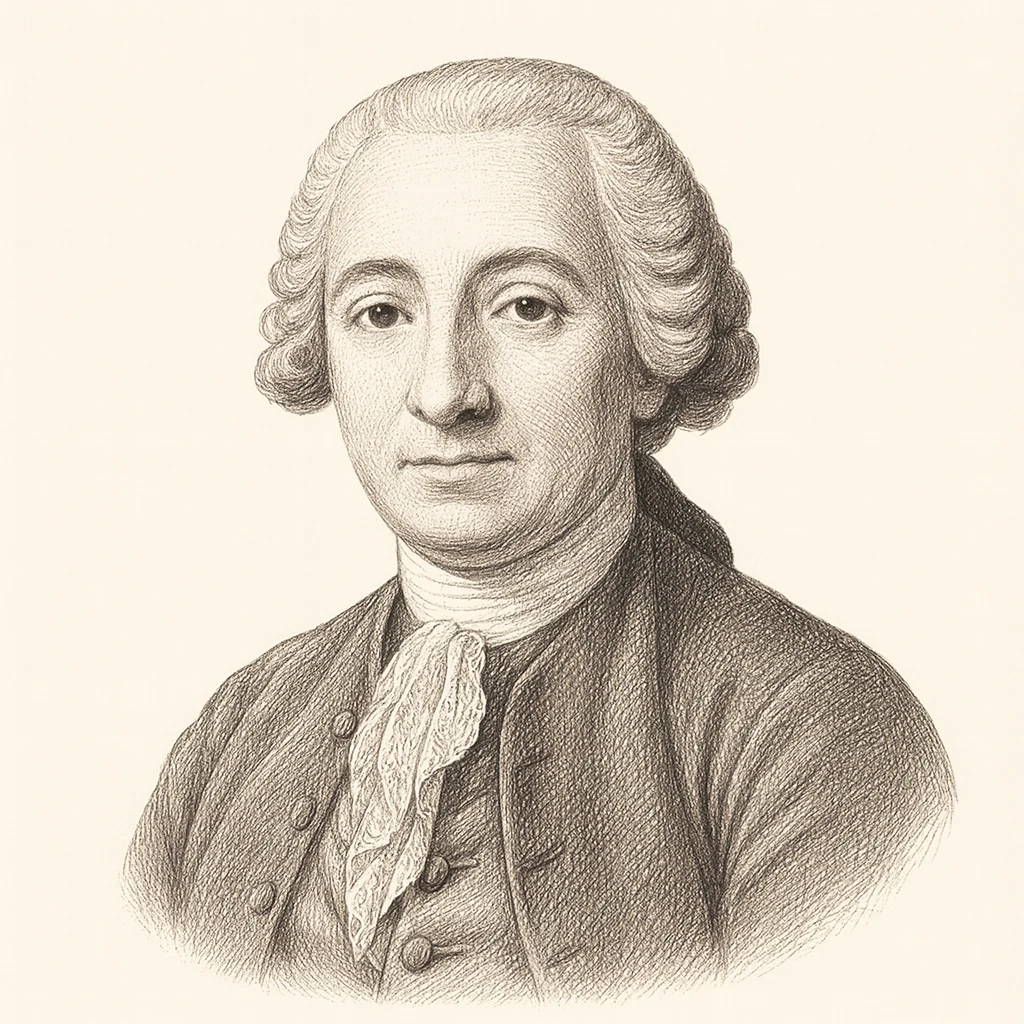
Claude Adrien Helvétius made a fortune as a farmer-general of taxes, retired at thirty-six, and published De l'Esprit in 1758. The book was condemned by the Sorbonne, the Parlement of Paris and the pope, burned publicly, and forced its author into two humiliating retractions. The scandal was so large that it brought down the censor and led directly to the suspension of the Encyclopédie.
Its argument starts from sensationalism. If all ideas come from sensation, as Locke had said, then all men who are not physically defective begin with the same faculties, and the enormous differences between them must be produced by circumstance: education, chance, the accidents of what one is exposed to and rewarded for. Genius is not innate. L'esprit is the product of conditions, and the differences between a peasant and a philosopher are differences of education rather than of nature.
The second premise is that self-interest governs everything, including apparent altruism, and is not to be deplored but used. If men necessarily pursue their own pleasure, then virtue cannot be produced by exhortation; it can only be produced by arranging institutions so that the interest of the individual coincides with the interest of the public. Good legislation is therefore the whole of moral science, and the legislator's art is to attach pleasure to what is socially useful and pain to what is not.
Put together, these give a program: since character is made by circumstance and circumstance can be designed, there is no limit in principle to what education and law can do. Helvétius held that a well-constructed system of laws could make a people virtuous, and that existing vice is evidence of bad legislation rather than of fallen nature.
Bentham is explicit about the debt. He said that Helvétius taught him that the greatest happiness of the greatest number is the object of legislation, and that what Bacon was to the physical world Helvétius was to the moral. Through Bentham the argument reaches James Mill, who applied it to education with severity, and John Stuart Mill, who was the experiment. Diderot wrote a detailed refutation, objecting that organization does differ between individuals; Rousseau, characteristically, could not bear the book at all.
Wondering where you land? Take the 4-minute assessment