
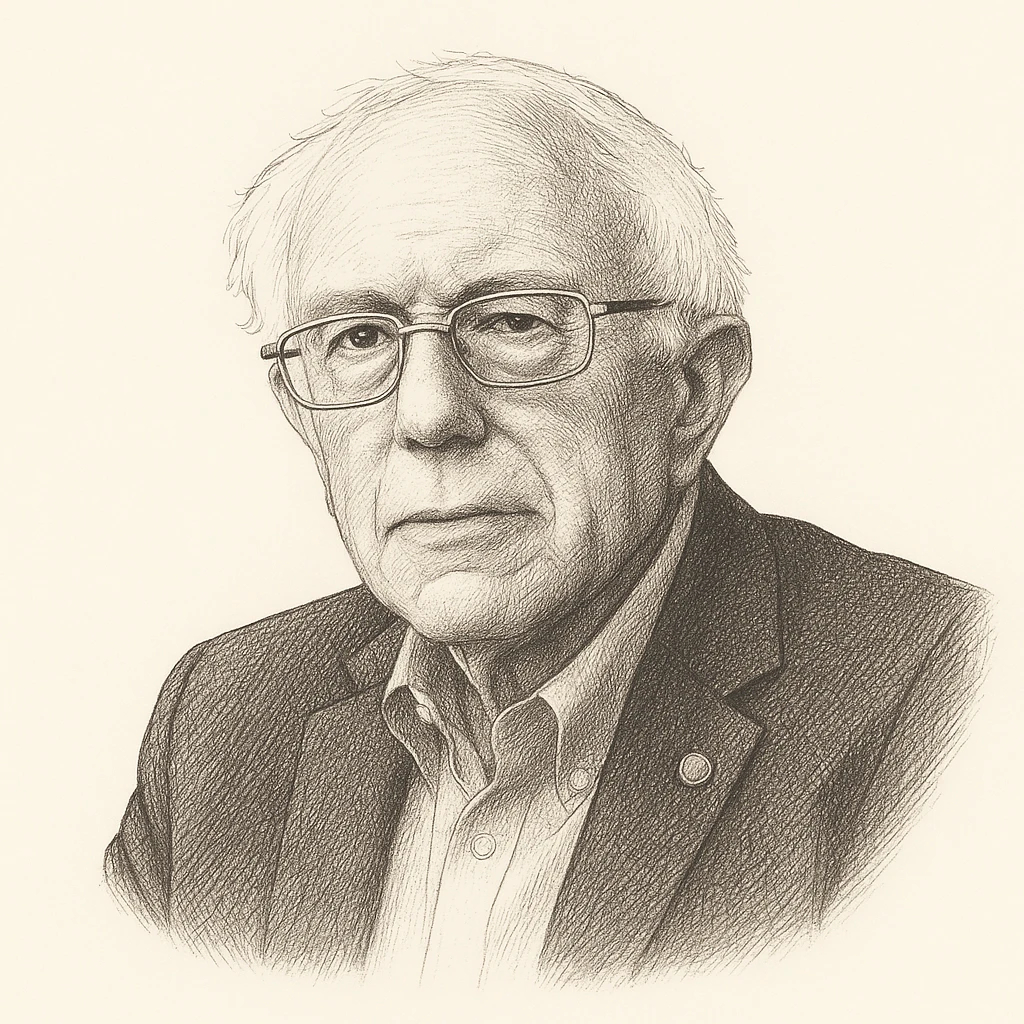
Bernie Sanders
Thinker

Bernie Sanders

1941– · American · politician

Bernie Sanders is an independent senator and democratic socialist whose insurgent presidential campaigns brought class-centered populist economics into the American political mainstream

Bernie Sanders is an American politician whose long career has been organized around a consistent set of ideas: that concentrated wealth and corporate power distort democracy, that basic goods such as health care and education should be treated as social rights, and that ordinary working people are best served by an activist government redistributing resources and curbing inequality. Identifying himself as a democratic socialist long before the label carried mainstream currency, he has repeatedly pointed to the social democracies of northern Europe—with their universal health systems, strong labor protections, and generous public provision—as models of what he considers a more humane capitalism. His political vocabulary emphasizes class rather than narrow identity, framing politics as a contest between a "billionaire class" and the many.

Sanders draws on an older American tradition of prairie populism and labor radicalism, invoking figures and movements associated with the New Deal and earlier socialist and progressive currents. He has served for decades as an independent, first as mayor of Burlington, Vermont, then in the U.S. House and Senate, where he became known for caucusing with Democrats while maintaining his own ideological identity. Signature causes include a single-payer health system often described as "Medicare for All," tuition-free public higher education, a substantially higher minimum wage, aggressive action on climate change, and campaign-finance reform aimed at reducing the influence of money in politics.

His two campaigns for the Democratic presidential nomination proved his most influential intervention in political thought. By mobilizing large numbers of younger voters and relying on small-dollar donations, he demonstrated that avowedly left economic programs could command a substantial constituency. In doing so he shifted the terms of debate within the Democratic Party and helped make democratic socialism a legitimate, widely discussed position in American politics rather than a marginal one.

Sanders's significance lies less in any single policy achievement than in his role as a durable ideological pole. He revived redistributive, class-centered argument in a political culture that had largely absented it, inspired a generation of activists and candidates who identify with his program, and forced sustained public argument over questions of inequality, health care, and the proper scope of government. Objections to his agenda center on its fiscal feasibility and political viability, but few dispute his effect on the landscape of American political ideas.

Bernie Sanders is associated with Democratic Socialist. See the archetype
Positions on the recordReviewed Sep 2026

Where Bernie Sanders stands

Associated with the Democratic Socialist archetype, in the Socialist family. Its nearest types are Progressive Activist and Market Socialist.

  1. Liberty

    Authority to Liberty

    He voted against the USA PATRIOT Act in 2001 and its reauthorization in 2005. On guns he voted against the 1993 Brady Bill and for the 2005 Protection of Lawful Commerce in Arms Act, whose repeal he cosponsored in 2019, and for assault weapons bans in 1994 and 2013.

    Sources: Office of the Clerk, U.S. House of Representatives, Roll Call 398 | Bill Number: H. R. 3162 (24 Oct 2001)Office of the Clerk, U.S. House of Representatives, Roll Call 627 | Bill Number: H. R. 3199 (14 Dec 2005)Office of the Clerk, U.S. House of Representatives, Roll Call 564 | Bill Number: H. R. 1025 (10 Nov 1993)Office of the Clerk, U.S. House of Representatives, Roll Call 534 | Bill Number: S. 397 (20 Oct 2005)U.S. Government Publishing Office, S. 1779 Introduced in Senate (IS): To repeal the Protection of Lawful Commerce in Arms Act. (11 Jun 2019)Office of the Clerk, U.S. House of Representatives, Roll Call 156 | Bill Number: H. R. 4296 (5 May 1994)U.S. Senate, Roll Call Vote 113th Congress - 1st Session (17 Apr 2013)

  2. Economy

    State to Market

    In April 2025 he introduced the Medicare for All Act, under which Medicare would cover every American with no premiums, co-payments or deductibles and would add dental, hearing and vision care. That month he also filed the Raise the Wage Act to lift the federal minimum wage to $17 by 2030.

    Sources: U.S. Senator Bernie Sanders, NEWS: Sanders, Jayapal, Dingell, Hundreds of Health Care Workers Introduce Medicare for All (29 Apr 2025)U.S. Senator Bernie Sanders, NEWS: Sanders, Scott, 175 Colleagues Introduce Bill to Raise Minimum Wage to $17 by 2030, Benefitting Nearly 22 Million Americans (8 Apr 2025)

  3. Scope

    National to Global

    He voted against NAFTA in 1993, permanent normal trade relations with China in 2000 and the USMCA in 2020, and against the 2002 Iraq war authorization after telling the House he opposed a unilateral invasion. In November 2024 his three Senate resolutions to block offensive arms sales to Israel all failed.

    Sources: Office of the Clerk, U.S. House of Representatives, Roll Call 575 | Bill Number: H. R. 3450 (17 Nov 1993)Office of the Clerk, U.S. House of Representatives, Roll Call 228 | Bill Number: H. R. 4444 (24 May 2000)U.S. Senate, Roll Call Vote 116th Congress - 2nd Session (16 Jan 2020)U.S. Government Publishing Office, Congressional Record (Bound Edition), Volume 148 (2002), Part 14 - FURTHER CONSIDERATION OF H.J. RES. 114, AUTHORIZATION FOR USE OF MILITARY FORCE AGAINST IRAQ RESOLUTION OF 2002 (9 Oct 2002)Office of the Clerk, U.S. House of Representatives, Roll Call 455 | Bill Number: H. J. Res. 114 (10 Oct 2002)U.S. Senator Bernie Sanders, PREPARED REMARKS: Sanders Speech On Senate Vote to Block Offensive Arms Sales to Israel (20 Nov 2024)U.S. Senate, Roll Call Vote 118th Congress - 2nd Session (20 Nov 2024)

  4. Culture

    Traditional to Progressive

    In 1996 he was one of 67 House members to vote against the Defense of Marriage Act. After the Supreme Court overturned Roe v. Wade in June 2022, he called for Democrats to end the filibuster, codify Roe and make abortion legal and safe.

    Sources: Office of the Clerk, U.S. House of Representatives, Roll Call 316 | Bill Number: H. R. 3396 (12 Jul 1996)U.S. Senator Bernie Sanders, NEWS: Sanders Calls for End of Filibuster to Codify Right to Abortion (24 Jun 2022)

Summarized from Bernie Sanders's public statements and record, with a source for each position. The archetype is an editorial association, not a Scan result.

Traditions1

Where Democratic Socialism sits

Gave rise toSocial Democracy
Provoked a reaction inSyndicalism
Archetypes1
Influences & connections13

Bernie Sanders's influence is too pervasive to map in full — these are among the most direct and consequential lines.

Intellectual lineage

  • Eugene V. Debs

    Sanders keeps a Debs plaque in his Senate office and recorded a spoken-word tribute; Debs's democratic, moral socialism—class solidarity without Leninism—is the template for Sanders's 'democratic socialist' self-definition.

  • Franklin D. Roosevelt

    FDR's 1944 Economic Bill of Rights and the Four Freedoms are the explicit foundation of Sanders's democratic socialism — he invokes Roosevelt's call for guaranteed jobs, housing, and health care as America's unfinished agenda.

Discover your political archetype.

A four-minute assessment across four axes — no account required, no signup, no spam.

Take the Scan