
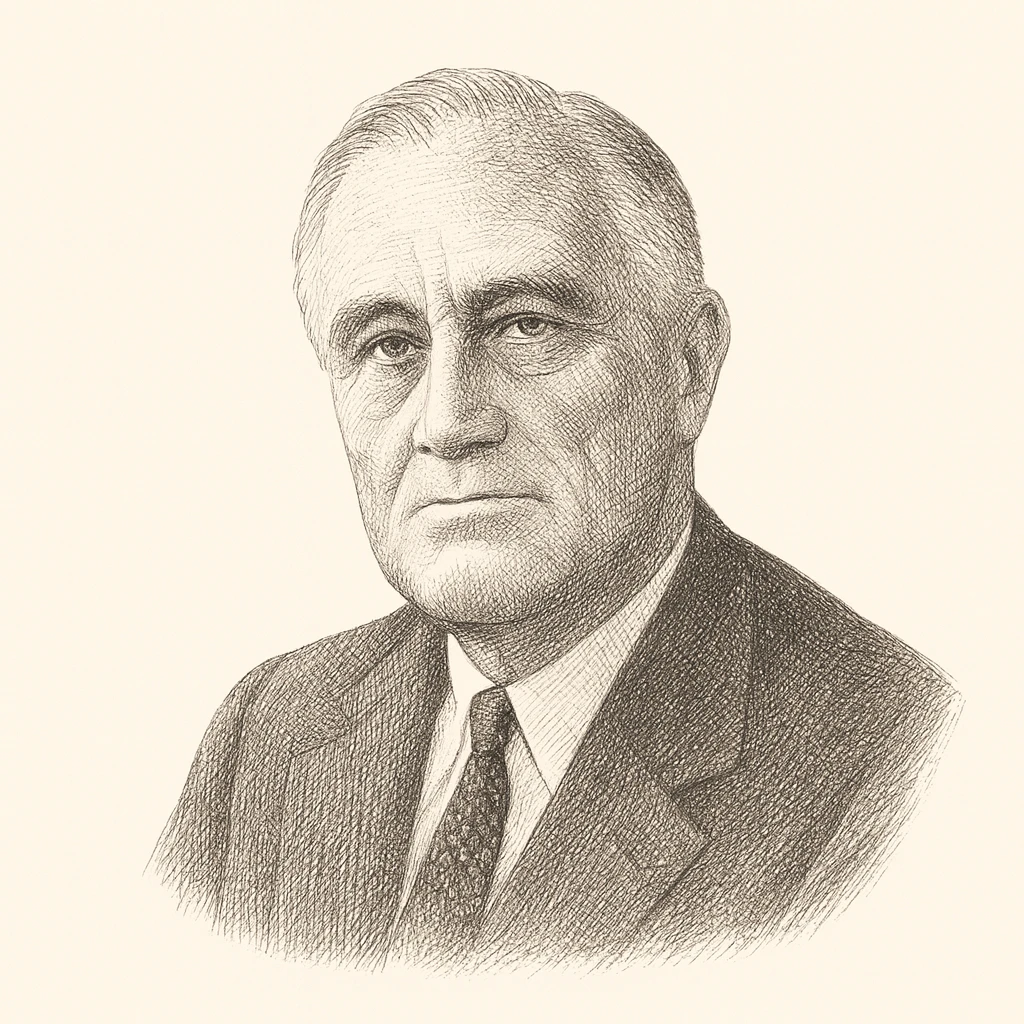
Franklin Delano Roosevelt served an unprecedented four terms as President, fundamentally transforming the relationship between the American government and its citizens. Born to wealth and privilege, FDR overcame polio to become Governor of New York before winning the presidency in 1932 amid the Great Depression.
The New Deal was the largest expansion of federal power in American history to that time. Through programs like Social Security, the SEC, and the Tennessee Valley Authority, Roosevelt created the modern welfare state and regulatory framework. His fireside chats pioneered presidential mass communication, and his assertion that 'the only thing we have to fear is fear itself' aimed to restore national morale. He favored 'bold, persistent experimentation' over fixed doctrine, and he redefined American liberalism, shifting it from a laissez-faire emphasis on freedom from government toward the idea that liberty required economic security—arguments he set out in the 'Four Freedoms' and later in his call for a 'Second Bill of Rights' covering employment, housing, medical care, and education.
This expansion of federal authority met organized resistance. Business leaders and conservatives, notably in the American Liberty League, denounced the New Deal as a threat to constitutional government, and the Supreme Court struck down major early programs. Roosevelt's 1937 plan to enlarge the Court drew opposition from within his own party, and the Democratic-controlled Senate Judiciary Committee reported against it; it failed, though the Court soon shifted toward upholding New Deal legislation.
As war engulfed Europe and Asia, FDR navigated isolationist sentiment while preparing America for conflict, framing the United States as the 'arsenal of democracy' and extending aid to the Allies. After Pearl Harbor, he led the Allied coalition to victory, though he died just months before Germany's surrender. In 1942 his Executive Order 9066 led to the forced removal and incarceration of about 120,000 people of Japanese ancestry, most of them U.S. citizens; a federal commission concluded in 1983 that it had stemmed from race prejudice, war hysteria, and a failure of political leadership, and the Civil Liberties Act of 1988 issued a formal apology and reparations.
The modern presidency, international institutions like the UN, and the social safety net all trace to his administration and continue to shape American politics.
Franklin D. Roosevelt is associated with Establishment Progressive. See the archetype