
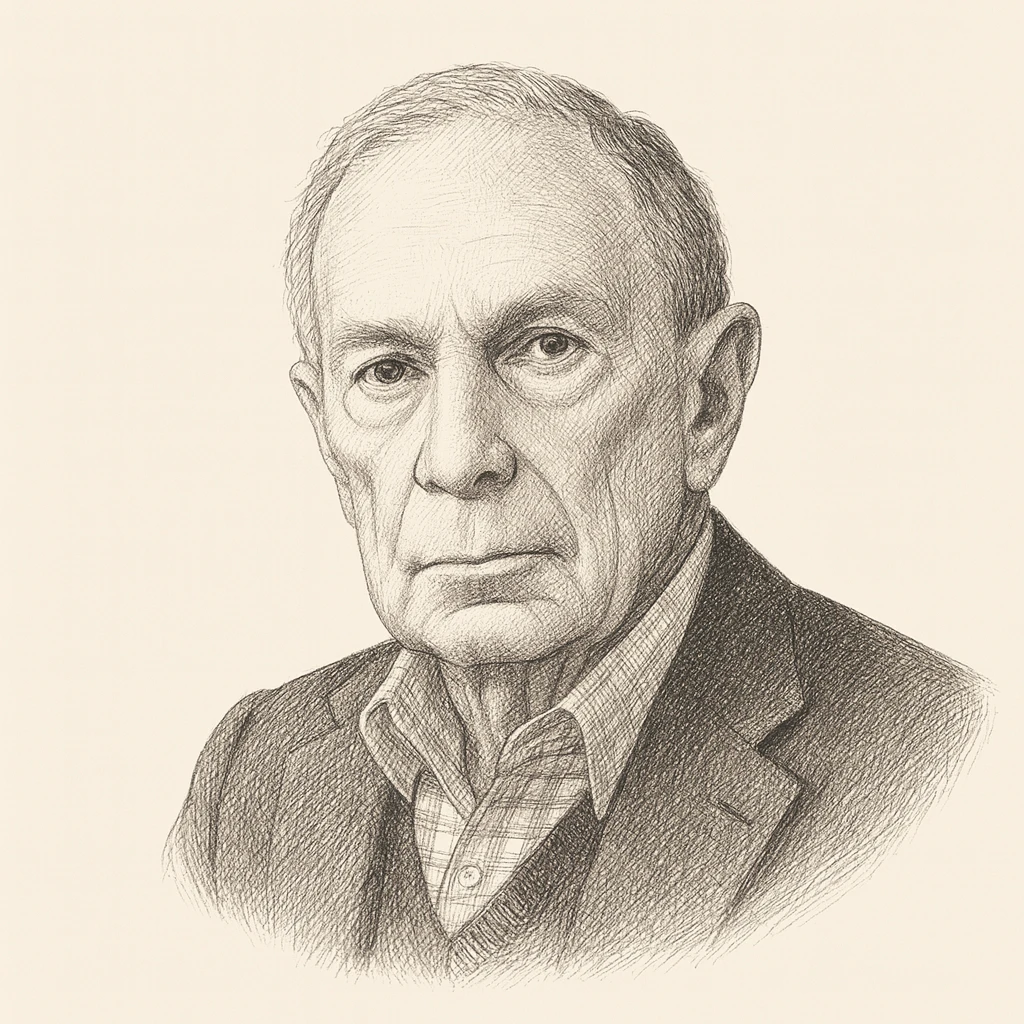
Michael Bloomberg is best understood as an exponent of managerial, data-driven centrism—a political sensibility that treats governance less as ideological contest than as a series of solvable problems amenable to measurement, expertise, and results. Having built a financial-information company before entering politics, he carried into public life a conviction that empirical evidence and professional management should guide policy. Elected mayor of New York City, he governed as a nominal Republican and later independent before returning to the Democratic Party, a trajectory that itself reflected his impatience with rigid partisan categories and his belief that competent administration transcends party labels.
His political thought is most distinctive in its embrace of an active, paternalistic role for government in shaping public behavior and health. Bloomberg became closely associated with the idea that public authority can and should intervene to reduce harm—through measures targeting smoking, and through initiatives aimed at diet and obesity—an approach critics decried as a "nanny state" and defenders framed as evidence-based public health. This willingness to use regulatory power for population-level welfare distinguishes his outlook from more libertarian strands of American conservatism, even as his fiscal and business instincts remained market-friendly.
Beyond municipal governance, Bloomberg has channeled substantial personal wealth into shaping national political debate, most prominently around gun control and climate change. He has funded advocacy organizations and campaigns that reframe these issues as matters of public safety and technical problem-solving, and his philanthropic and political spending has made him a significant, if debated, force in progressive-leaning causes. His approach raises enduring questions about the role of great private wealth in democratic politics—whether concentrated philanthropic capital broadens or distorts the terms of public debate.
As a thinker, Bloomberg is less a systematic ideologue than an embodiment of a recurring American tradition: the businessman-reformer who believes that the disciplines of enterprise and empirical analysis can be applied to public life. His influence lies in legitimizing a technocratic, results-oriented centrism that appeals to voters weary of partisan gridlock, while inviting criticism that such managerialism understates the value-laden and contested nature of political choices.
Michael Bloomberg is associated with Pragmatic Centrist. See the archetype