
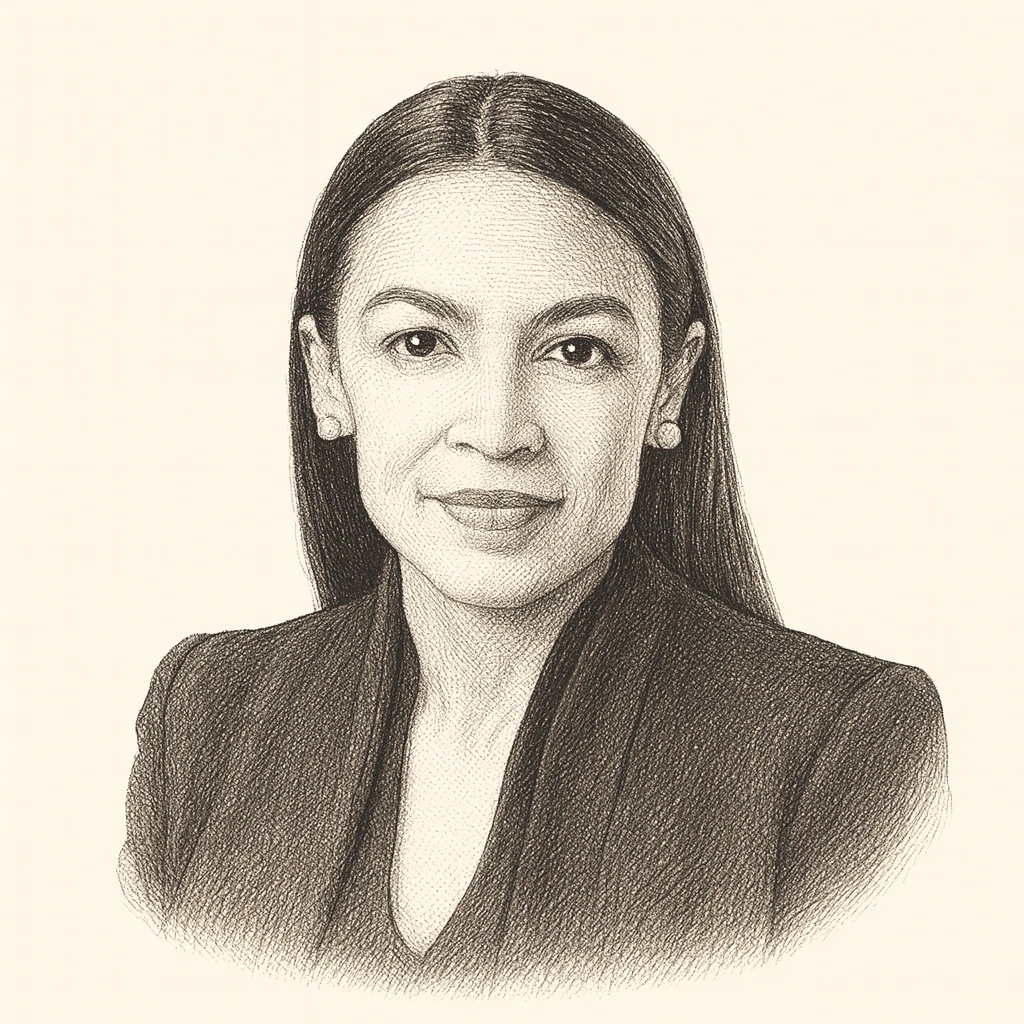
Alexandria Ocasio-Cortez, elected to the U.S. House of Representatives in 2018 after an insurgent Democratic primary victory over a long-serving incumbent, became one of the most prominent representatives of the American democratic-socialist revival. A member of the Democratic Socialists of America, she articulates a politics that fuses New Deal-era ambitions for active government with contemporary movements around climate, racial justice, and economic redistribution. Her thought is grounded in the conviction that concentrated wealth and corporate power distort democracy, and that the state should guarantee material security through programs such as universal health coverage, expanded labor rights, and a living wage.
Her most influential contribution to political discourse is the Green New Deal, a framework she championed that links decarbonization to a broad program of public investment, job creation, and social equity. The proposal reframed climate change not merely as an environmental problem but as an opportunity to restructure the economy along more egalitarian lines, and it shifted the boundaries of what mainstream Democrats treated as politically thinkable. In this she draws on a tradition of American progressivism and social democracy, arguing that markets alone cannot address collective challenges and that ambitious federal action is both morally necessary and historically precedented.
Ocasio-Cortez is also notable for her theory of political practice as much as her policy positions. She emphasizes grassroots organizing, small-donor fundraising, and direct communication with constituents, and she has used social media to bypass traditional gatekeepers and cultivate a mass political following. This approach reflects a belief that durable progressive change depends on mobilizing ordinary people rather than accommodating established donors and institutions. As a member of a cohort of younger left-wing legislators often described collectively in the press, she has helped normalize an explicitly socialist vocabulary within the Democratic Party while working, at times uneasily, within its coalition.
Her influence lies less in a systematic body of theory than in her role as a communicator and agenda-setter who brought once-marginal ideas into national debate. Supporters view her as revitalizing a democratic tradition of economic populism, while critics on both the right and the center argue that her proposals are fiscally or politically unrealistic. Either way, she has become a reference point for arguments about the future direction of the American left and the viability of democratic socialism in a two-party system.
Alexandria Ocasio-Cortez is associated with Democratic Socialist. See the archetype