
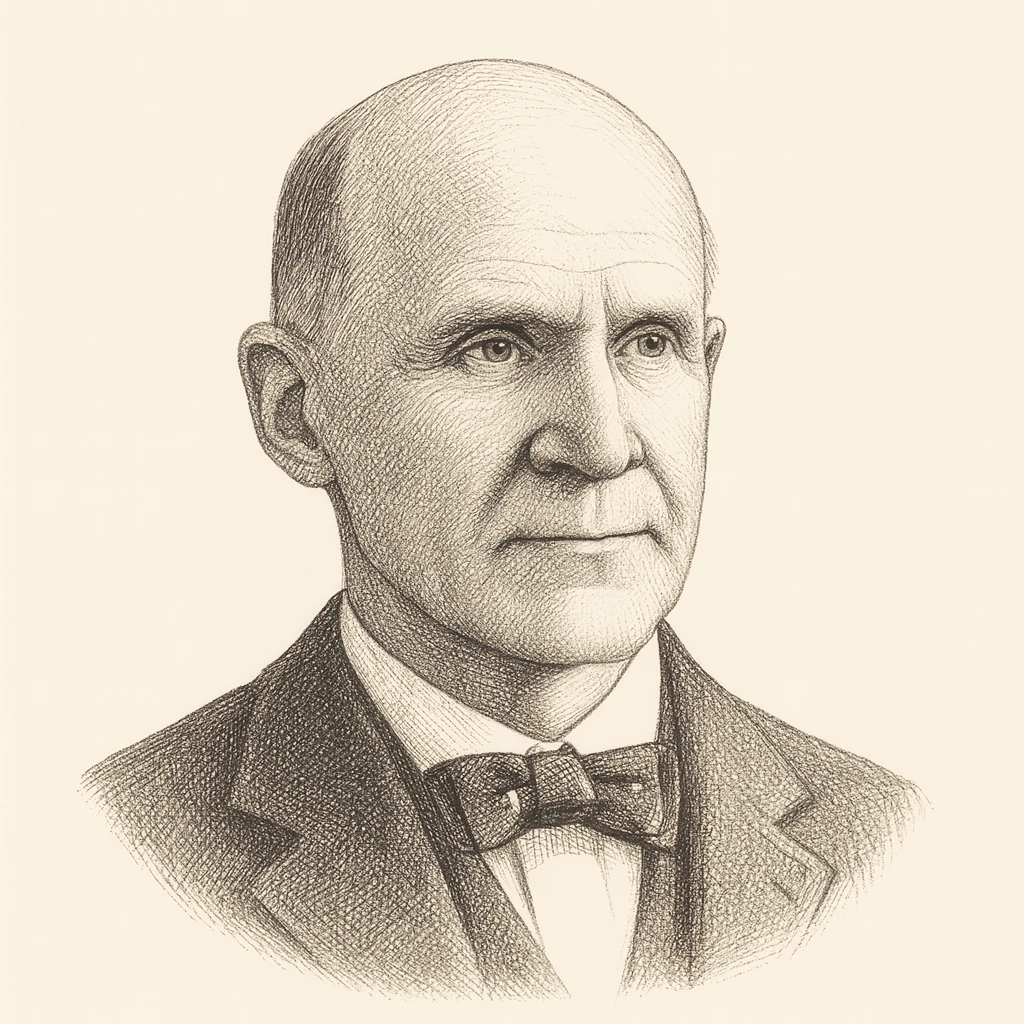
Eugene Victor Debs was the greatest American socialist, a labor leader whose moral passion and oratorical gifts made him the beloved champion of working people. Five times the Socialist Party's presidential candidate, Debs won nearly a million votes in 1920—while imprisoned for opposing World War I.
Debs began as a railroad worker and union organizer, rising through the craft brotherhoods before concluding that fragmented trade unions were too weak against consolidated capital. He founded the American Railway Union to unite railroad workers across trades into a single industrial union. The Pullman Strike of 1894, a sympathy boycott broken by federal injunction and troops, ended in his imprisonment—an experience that, together with the reading he did behind bars, converted him to socialism. 'While there is a lower class, I am in it, while there is a criminal element, I am of it, and while there is a soul in prison, I am not free.'
Debs's socialism was distinctly American—democratic, moralistic, rooted in Christianity and the Declaration of Independence rather than Marxist theory. He framed class struggle as a moral crusade for human brotherhood and dignity, appealing to the promise of equality in America's founding creed rather than to historical materialism. A founder of the Socialist Party of America and, in 1905, of the Industrial Workers of the World, he championed industrial unionism and the political organization of workers, while distancing himself from advocacy of sabotage and violence.
He opposed World War I as a capitalist war fought by workers for the benefit of the propertied, and his outspoken antiwar oratory led to his prosecution and imprisonment under the Espionage Act. His conviction was upheld by a unanimous Supreme Court, part of the wartime jurisprudence that narrowed free-speech protections. His 1920 campaign from prison cell #9653 remains American socialism's high-water mark; his sentence was later commuted, and he was released in 1921.
Debs died broken in health but unbroken in spirit, the conscience of the American left. His legacy shaped a durable strain of native-grown American radicalism—ethical, democratic, and anti-militarist—that later reformers, civil libertarians, and democratic socialists would claim as their own. Invoked across generations as a symbol of principled dissent, he stands as evidence that a socialism argued in the language of the Sermon on the Mount and the Declaration, rather than of Marx, could win a mass American hearing.
Eugene V. Debs is associated with Democratic Socialist. See the archetype