
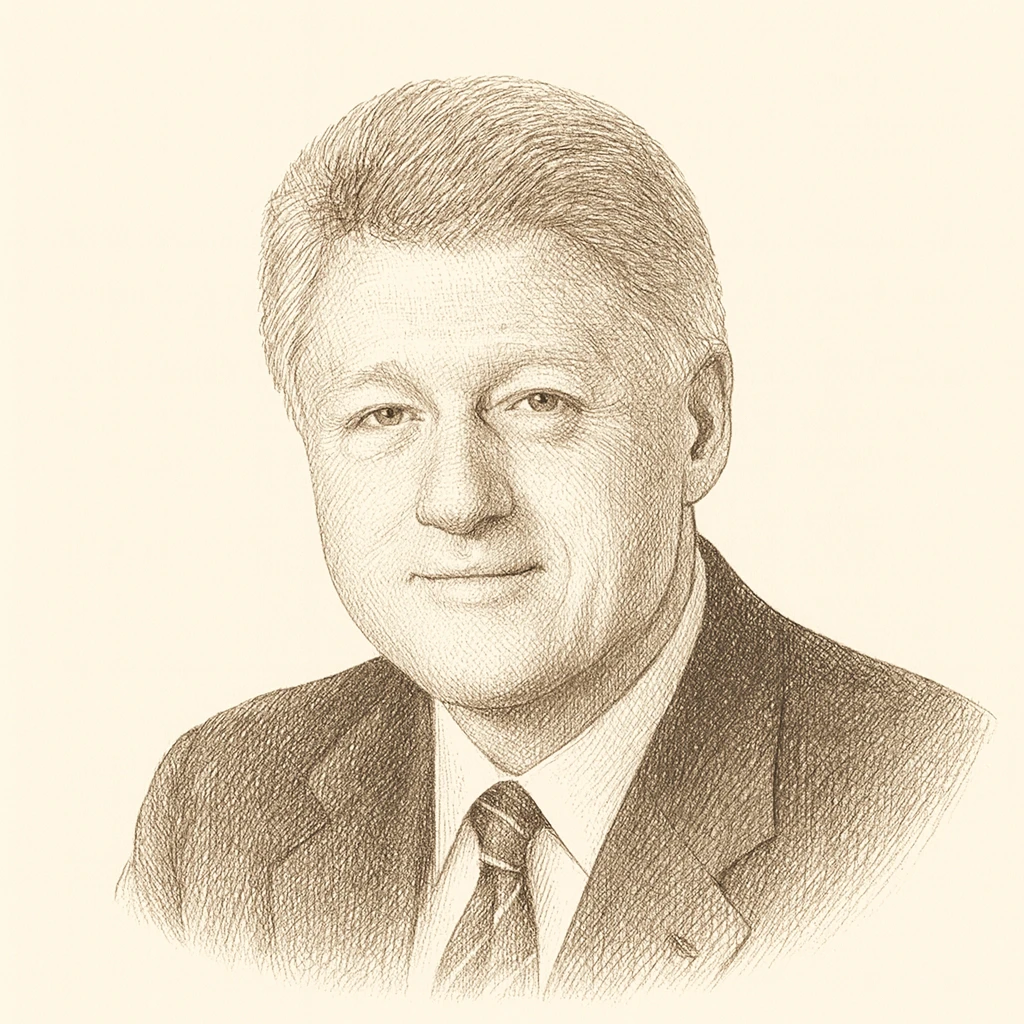
Bill Clinton, president of the United States from 1993 to 2001, is the emblematic figure of the American "New Democrat" movement, an effort to reposition a party many voters saw as fiscally profligate and culturally out of step. Emerging from the Democratic Leadership Council, he argued that the left could win and govern by shedding reflexive support for expansive government and embracing markets, personal responsibility, and economic growth as instruments of progressive ends. This synthesis, often called the "Third Way," cast politics not as a choice between state and market but as a search for pragmatic combinations of both.
Clinton's governing thought centered on what he framed as a rebalancing of rights and responsibilities. He championed fiscal discipline, pursuing deficit reduction and eventually budget surpluses, and accepted a role for free trade and financial deregulation as engines of prosperity. His declaration that "the era of big government is over" captured a deliberate accommodation with conservative critiques of the welfare state. The 1996 welfare reform he signed, imposing work requirements and time limits, became the signature and most contested expression of this outlook, praised by supporters as modernization and condemned by critics on the left as an abandonment of the poor.
The technique associated with Clinton—"triangulation"—treated ideological positioning itself as a craft: absorbing popular elements of the opposition's agenda to occupy a defensible center. Critics across the spectrum charged that this evacuated conviction in favor of poll-driven adaptation, while admirers saw a realistic path to majority coalitions in a conservative-leaning era. His record is genuinely contested. The 1994 crime bill and tough-on-crime posture, later widely criticized for fueling mass incarceration, and financial deregulation blamed by some for later instability, are read very differently depending on one's premises. His second term was consumed by the Monica Lewinsky affair: impeached by the House in 1998 on perjury and obstruction-of-justice charges, he was acquitted by the Senate in 1999 and finished his term with high approval.
Beyond his own presidency, Clinton's model shaped a generation of center-left leaders and remains a reference point in debates over whether the left should govern from the center or mobilize a more redistributive base. To his defenders he demonstrated that progressives could be trusted stewards of the economy; to detractors he ratified a rightward drift that hollowed out the party's commitments. Either way, his career defined the terms of an argument the American center-left is still having.
Bill Clinton is associated with Conservative Democrat. See the archetype