
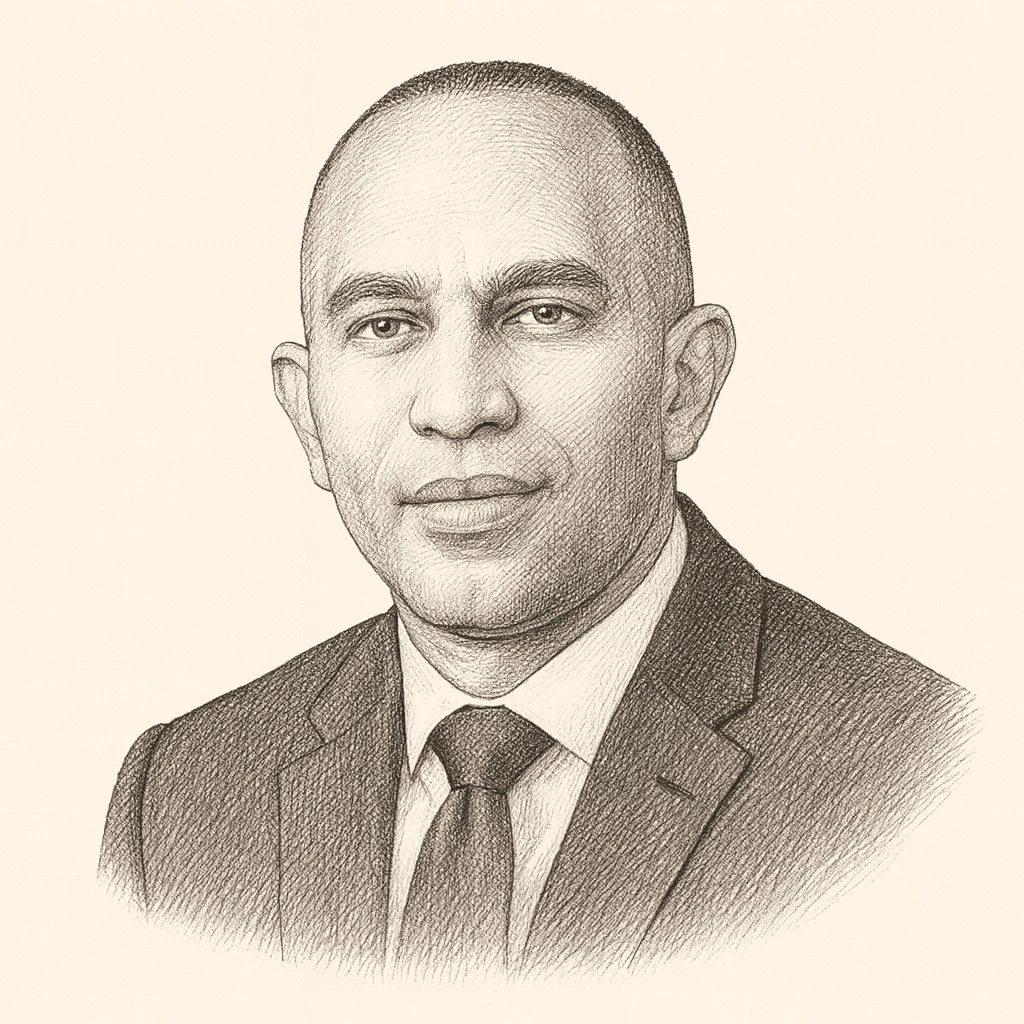
Hakeem Jeffries
Thinker

Hakeem Jeffries

1970– · American · politician

Hakeem Jeffries is a pragmatic, institutionalist liberal — the first Black American to lead a party in Congress — who bets that disciplined governing coalitions beat factional purity

Hakeem Jeffries, a New York representative from Brooklyn, rose through Democratic ranks to become House Democratic Leader in 2023, succeeding Nancy Pelosi and becoming the first Black American to lead a party caucus in Congress. Trained as a lawyer, he built a reputation as a disciplined communicator and a skilled internal coalition-builder before assuming leadership of the House minority. His political identity blends the traditions of the Congressional Black Caucus with a pragmatic, results-oriented liberalism that prioritizes what he frames as delivering tangible improvements in people's everyday lives.

Jeffries's political thought is characterized less by sweeping ideological manifestos than by an emphasis on governing capacity, party cohesion, and defense of democratic institutions. He has consistently positioned himself as a figure capable of bridging the Democratic Party's progressive and moderate wings, arguing that durable change comes through building broad, disciplined majorities rather than factional purity. This institutionalist instinct reflects a belief that the mechanics of coalition and legislative process are themselves a form of political principle, and that a governing party must balance ambition with electoral viability.

On substance, Jeffries has associated himself with priorities including criminal justice reform, voting rights, economic opportunity, and the protection of constitutional norms—themes that connect his work to a longer civil rights lineage while orienting it toward contemporary contests over democracy and the rule of law. He came to national prominence in part through his role as a House impeachment manager, an experience that sharpened his public arguments about accountability and constitutional limits on executive power. His rhetoric frequently invokes patriotism, pluralism, and the idea of an inclusive American story, framing the Democratic coalition as the custodian of democratic stability.

As a thinker within the party, Jeffries matters chiefly as a bridge figure and generational transition point: he represents the passing of leadership from the Pelosi era to a younger cohort while retaining an emphasis on unity, message discipline, and pragmatic incrementalism. His influence lies in modeling how a diverse, ideologically varied party can be held together around shared electoral and institutional goals, and in articulating a vision of governance that treats coalition maintenance and defense of democratic norms as central political commitments rather than mere tactics.

Hakeem Jeffries is associated with Moderate Liberal. See the archetype

Common questions

Is Hakeem Jeffries liberal or conservative?
Hakeem Jeffries is a pragmatic, institutionalist liberal — the first Black American to lead a party in Congress — who bets that disciplined governing coalitions beat factional purity. Left and right are one axis of the four mapped here, so the more precise answer is the archetype: Hakeem Jeffries is placed with Moderate Liberal, in the Centrist family.
What political tradition does Hakeem Jeffries belong to?
Hakeem Jeffries is mapped to Liberal Political Thought. The tradition of political analysis committed to individual liberty, constitutional government, and limited state power, while increasingly aware of the complexities of mass democratic society.
Which political archetype is closest to Hakeem Jeffries?
Moderate Liberal, in the Centrist family.
Positions on the recordReviewed Sep 2026

Where Hakeem Jeffries stands

Associated with the Moderate Liberal archetype, in the Centrist family. Its nearest types are Social Liberal and Establishment Progressive.

  1. Liberty

    Authority to Liberty

    His office calls him the lead Democratic sponsor of the 2018 First Step Act, which authorized funding to expand re-entry programming. On Section 702 surveillance he voted in January 2018 for the USA RIGHTS Act substitute and against reauthorization, then in April 2024 against requiring warrants to query Americans' communications and for renewal.

    Sources: Congressman Hakeem Jeffries, About (16 Mar 2026)U.S. Government Publishing Office (Congressional Record), Rapid DNA Act of 2017 (11 Jan 2018)U.S. Government Publishing Office, Public Law 115-118: FISA Amendments Reauthorization Act of 2017 (19 Jan 2018)U.S. Government Publishing Office (Congressional Record), Reforming Intelligence and Securing America Act (12 Apr 2024)

  2. Economy

    State to Market

    In July 2019 he voted for the Raise the Wage Act, which would have lifted the federal minimum wage in steps to $15 an hour. In January 2026 he led House Democrats, joined by 17 Republicans, in passing through the House a three-year extension of the lapsed Affordable Care Act tax credits.

    Sources: Office of the Clerk, U.S. House of Representatives, Roll Call 496 | Bill Number: H. R. 582 (18 Jul 2019)U.S. Government Publishing Office, H.R. 582 (EH) - Raise the Wage Act (18 Jul 2019)Democratic Leader Hakeem Jeffries, JOINT DEMOCRATIC LEADERSHIP STATEMENT ON PASSAGE OF THE AFFORDABLE CARE ACT TAX CREDIT EXTENSION (8 Jan 2026)Congressman Hakeem Jeffries, About (16 Mar 2026)

  3. Scope

    National to Global

    Before the April 2024 House vote on aid to Ukraine he described a choice between confronting Russian aggression and appeasement, and on April 20 he voted for the Ukraine security supplemental. In December 2019 he voted for the bill implementing the U.S.-Mexico-Canada Agreement.

    Sources: Democratic Leader Hakeem Jeffries, LEADER JEFFRIES: "THE TIME HAS COME FOR THE HOUSE OF REPRESENTATIVES TO ACT" (17 Apr 2024)Office of the Clerk, U.S. House of Representatives, Roll Call 151 | Bill Number: H. R. 8035 (20 Apr 2024)Office of the Clerk, U.S. House of Representatives, Roll Call 701 | Bill Number: H. R. 5430 (19 Dec 2019)

  4. Culture

    Traditional to Progressive

    He co-led the Respect for Marriage Act and voted for it in July and December 2022; his office said he helped draft its language protecting interracial couples. He voted for the Women's Health Protection Act in September 2021 and called the June 2022 ruling overturning Roe v. Wade an assault on freedom.

    Sources: Congressman Hakeem Jeffries, REP. JEFFRIES STATEMENT ON HOUSE PASSAGE OF BIPARTISAN RESPECT FOR MARRIAGE ACT (19 Jul 2022)Office of the Clerk, U.S. House of Representatives, Roll Call 513 | Bill Number: H. R. 8404 (8 Dec 2022)Office of the Clerk, U.S. House of Representatives, Roll Call 295 | Bill Number: H. R. 3755 (24 Sep 2021)Congressman Hakeem Jeffries, REP. JEFFRIES STATEMENT ON THE EXTREME SUPREME COURT DECISION TO OVERTURN ROE V. WADE (24 Jun 2022)

Summarized from Hakeem Jeffries's public statements and record, with a source for each position. The archetype is an editorial association, not a Scan result.

Traditions1
Archetypes1
Influences & connections3

A selection of notable, documented connections — not an exhaustive map.

Intellectual lineage

  • Barack Obama

    The president whose 2004 'one America' keynote and coalition-first pragmatism modeled the inclusive national story and disciplined, big-tent liberalism Jeffries adopted as House Democratic Leader.

  • Nancy Pelosi

    Jeffries's predecessor as House Democratic Leader, whose mastery of message discipline, vote-counting, and holding a narrow, fractious caucus together supplied the governing playbook he inherited in 2023.

  • Shirley Chisholm

    The Brooklyn congresswoman and first Black woman elected to Congress, whose 'unbought and unbossed' independence and coalition ambition made her the local political forebear Jeffries claims and invokes.

Discover your political archetype.

A four-minute assessment across four axes — no account required, no signup, no spam.

Take the Scan