
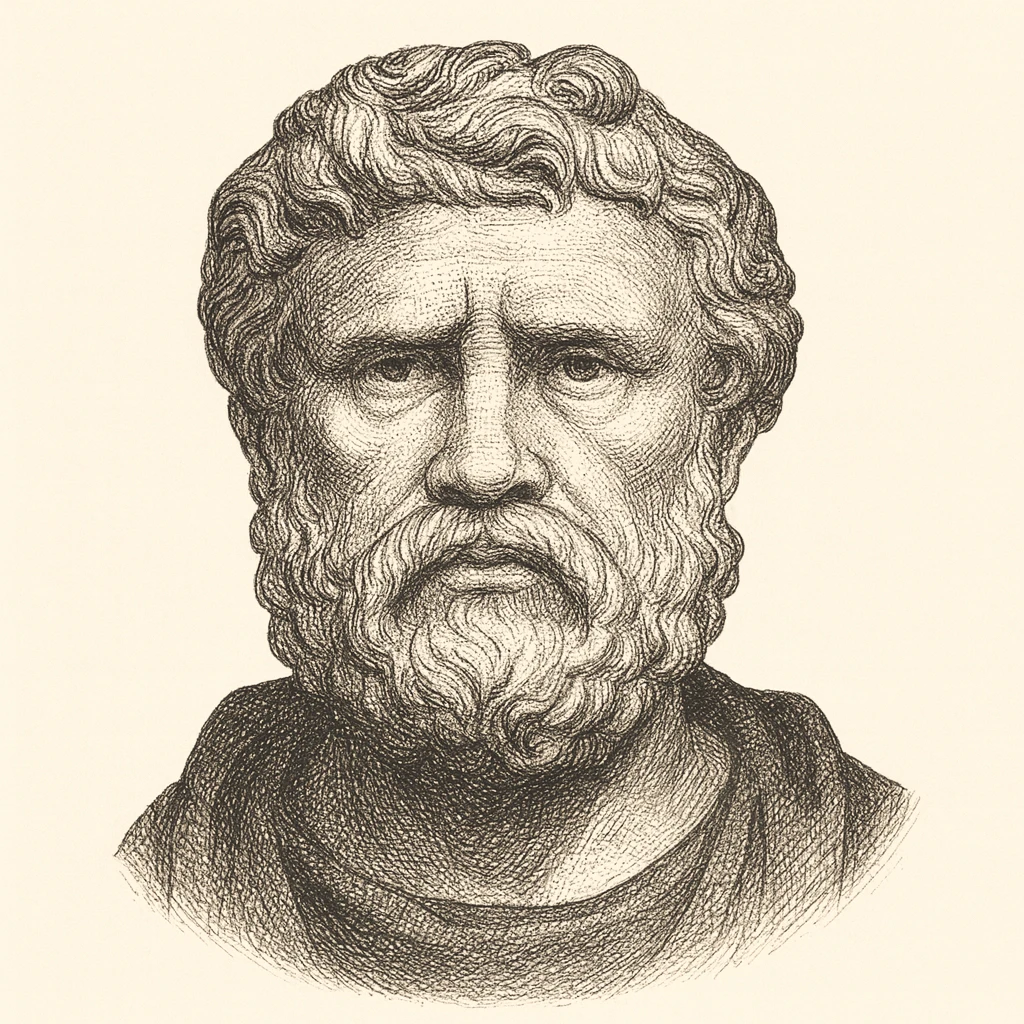
Xenophon was an Athenian gentleman who studied with Socrates, joined a Greek mercenary force fighting for a Persian claimant, and found himself elected to lead ten thousand men home across hostile country after their commanders were murdered. The Anabasis is his account of that march. He was later exiled from Athens, given an estate by Sparta, and spent his later years writing.
For most of European history he was read more than Thucydides. The reason is the Cyropaedia, a long semi-fictional account of the education and reign of Cyrus the Great, which is not history and does not pretend to be: it is an extended argument about what makes a ruler obeyed willingly. Cyrus succeeds not by force but by making himself the sort of person others want to follow — generous, visibly self-controlled, attentive to the interests of subordinates, and careful that rewards track merit. The book invented a genre. Every mirror for princes written between antiquity and the Renaissance stands downstream of it, and Machiavelli, who cites it, wrote The Prince partly as its refutation: his Cyrus is the one who deceives.
Xenophon's Socratic writings are the other half of his importance. The Memorabilia defends Socrates against the charges that killed him by presenting a figure very different from Plato's — practical, concerned with household management and military command as much as with definitions, and useful to his friends. Whether this is the historical Socrates or a domesticated one is an old dispute; what matters is that for centuries this was the Socrates people knew. The Oeconomicus, on the management of an estate, is the earliest sustained European text on what would later be called economics, and gives the word its root.
His revival in the twentieth century came from an unexpected direction. Leo Strauss read the Hiero, a dialogue in which a poet advises a tyrant on how to be less miserable, as an esoteric treatment of the relation between wisdom and power, and made Xenophon central to a whole school of political reading. The Cyropaedia's claim — that a ruler's authority rests on a manufactured impression of virtue — has looked less naive with every century.
Wondering where you land? Take the 4-minute assessment