
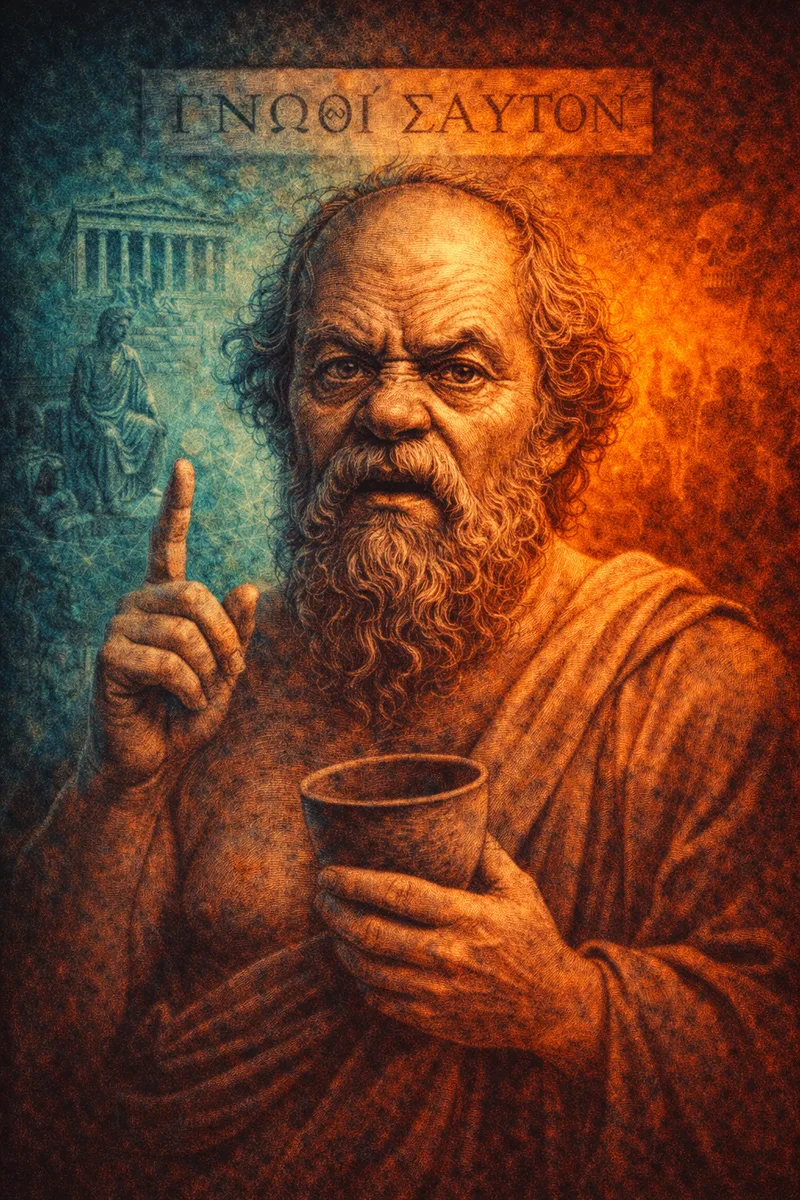
Socrates was the founding figure of Western philosophy, whose method of relentless questioning transformed how humans pursue truth and wisdom. An Athenian stonemason's son who served as a soldier, Socrates spent his life in the agora questioning politicians, poets, and craftsmen about virtue, justice, and knowledge—and demonstrating that they knew far less than they claimed.
Socrates wrote nothing; we know him through Plato's dialogues, Xenophon's memoirs, and Aristophanes' satire. The 'Socratic method' proceeds through questions that expose contradictions in the interlocutor's beliefs, leading to aporia (puzzlement) that opens the possibility of further inquiry. His line in Plato's Apology, 'I neither know nor think that I know,' expressed his epistemic humility. His inquiries also carried a moral claim: that virtue is a kind of knowledge, that no one does wrong willingly but through ignorance of the good, and that caring for one's soul matters more than wealth or reputation.
His questioning had political targets. He questioned the democratic practice of filling offices by lot, arguing, in Xenophon's account, that no one would choose a ship's pilot or a flute-player that way—an implicit challenge to the assumption that ordinary citizens are equally fit to decide public matters. This skepticism about democratic competence, and his association with figures like Alcibiades and Critias (a leader of the oligarchic Thirty Tyrants), formed part of the background to his prosecution. Yet he also defied those in power directly, reportedly refusing to join in the illegal mass trial of the generals after Arginusae and declining an order from the Thirty to help arrest an innocent man.
In 399 BC, Athens charged Socrates with corrupting the youth and impiety. He refused to flee, accepted the death sentence, and drank hemlock—becoming philosophy's first martyr. In the account of his conversation in prison, he reasoned that a citizen who has enjoyed the benefits of the laws owes them obedience, and that escaping would be a wrong repaid for a wrong; his choice to obey the law even when its verdict was, in his own view, unjust has been read ever since as a problem of civil obligation.
His courage before death and his commitment to the examined life have inspired philosophers from Plato to the present.
Wondering where you land? Take the 4-minute assessment