
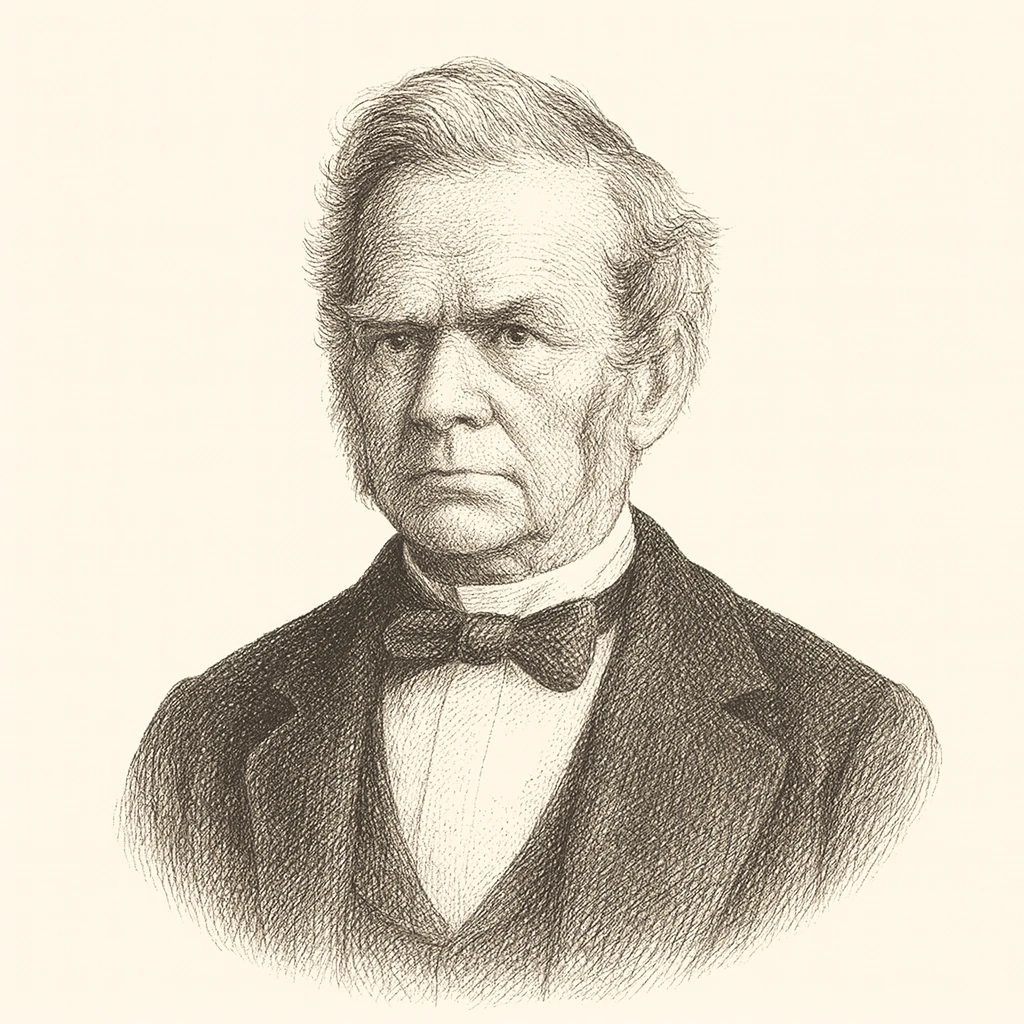
Josiah Warren was a Boston-born musician and inventor who joined Robert Owen's New Harmony community in Indiana in 1825 and watched it disintegrate within two years. He drew a conclusion opposite to the one Owen drew: the failure was not of execution but of principle, and communism had failed because it suppressed the individuality it depended on. What is needed is not the merging of interests but their disentanglement, so that each person bears the cost and keeps the result of his own actions.
He named the principle the sovereignty of the individual, and the phrase entered American radicalism through him. Each person is to be free to do as he pleases at his own cost, and the whole apparatus of collective decision is to be replaced wherever possible by individuated responsibility.
The economics is where he is most original. Warren held that price ought to be limited by cost, not by value — that charging what a thing is worth to the buyer rather than what it took to make is the mechanism by which some people live on others. In 1827 he opened the Cincinnati Time Store, selling goods at their wholesale cost plus a small markup, with his own labor in the transaction paid in labor notes promising an equivalent number of hours of his time. It ran successfully for three years, and it is the first practical experiment in labor-time currency anywhere.
He founded three communities on the principle — Equity, Utopia and Modern Times on Long Island — where land was sold at cost, no collective authority existed, and residents were left to arrange their affairs by contract. Modern Times survived nearly two decades and attracted enough eccentrics to embarrass him.
John Stuart Mill read about the sovereignty of the individual and cited the American experiments approvingly in On Liberty. Benjamin Tucker took the whole framework — cost the limit of price, individual sovereignty, mutual banking — and made it the basis of Liberty, the journal through which American individualist anarchism reached its fullest development.
Wondering where you land? Take the 4-minute assessment