
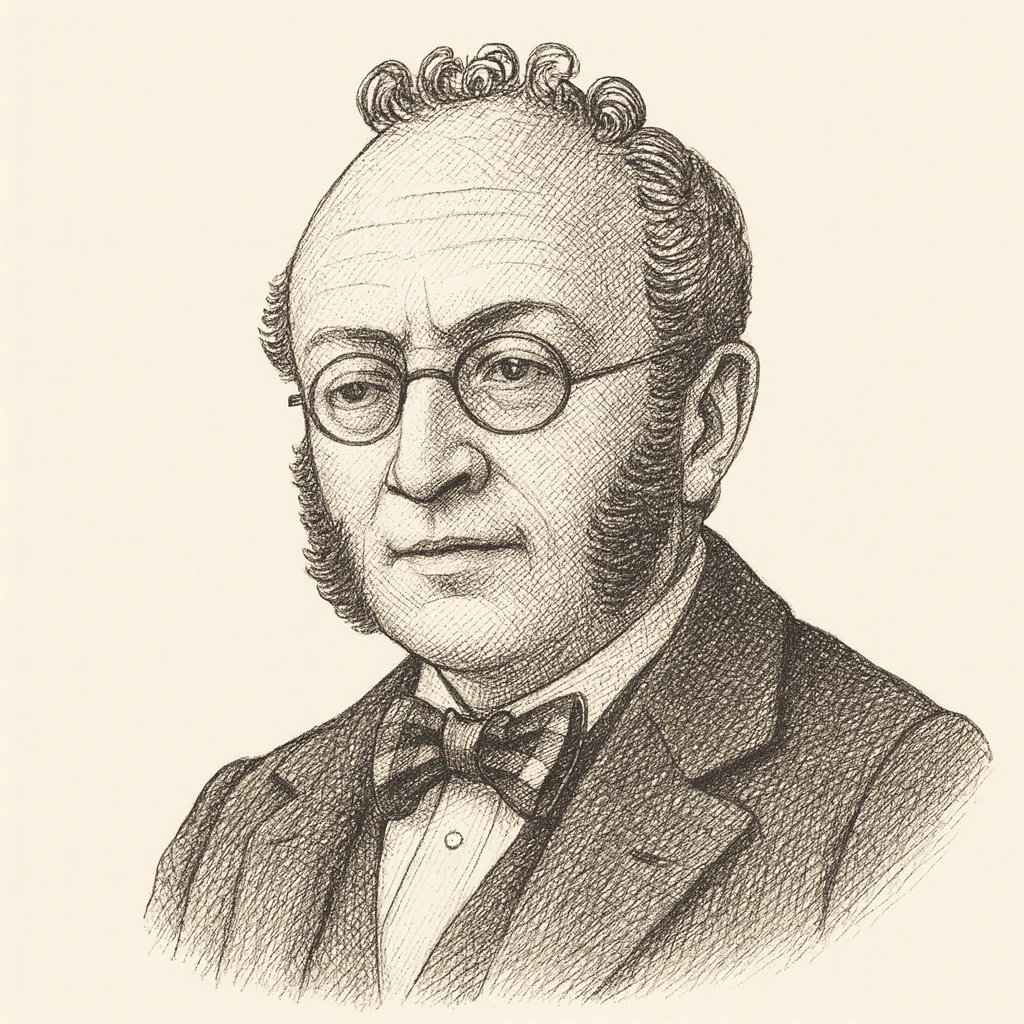
Max Stirner is one of the strangest and most influential figures in the 19th century radical tradition, a thinker who wrote one important book, was largely forgotten for decades, and then kept getting rediscovered by waves of later thinkers who found in him something they had not found in any other writer. Nietzsche read him, denied reading him, and then wrote philosophy that looks suspiciously like his. Early 20th century anarchist individualists treated him as a patron saint. Mid-20th century libertarians and anarcho-capitalists found his radical individualism useful. Postmodern theorists from the 1960s onward treated him as a proto-deconstructionist who had anticipated their own dissolution of essences and universal concepts. He remains one of the most subversive figures in the Western tradition because his work refuses to be assimilated to any of the political projects that have tried to claim him.
Stirner was born in 1806 in Bayreuth, Bavaria, and his real name was Johann Kaspar Schmidt — Stirner was a childhood nickname based on his high forehead. He studied at the University of Berlin, where he encountered Hegel and the circle of Young Hegelians, the radical group of intellectuals who had inherited Hegel's dialectical method and were using it to critique religion, the state, and bourgeois society. Stirner was part of the scene — he knew Bruno Bauer, Arnold Ruge, and the young Karl Marx — but he was always an outsider within it. He spent most of his working life as a teacher at a girls' school in Berlin, a respectable middle-class career that gave no hint of the intellectual radicalism he was developing in private.
In 1844 he published The Ego and Its Own (Der Einzige und sein Eigentum), the single book that would make his reputation. The book was a sustained assault on every abstract concept that humans use to organize their lives: God, humanity, the state, morality, rights, the good, truth, even the category of "humanity" itself. All of these, Stirner argued, were "spooks" — ghostly abstractions that people had allowed to dominate them, sacrificing their actual individual existence to empty concepts that had no reality apart from the individuals who believed in them. When Christians served God, they were sacrificing themselves to an abstraction. When Enlightenment humanists served humanity, they were sacrificing themselves to a different but equally empty abstraction. When socialists served the proletariat, they were doing the same thing. The revolution Stirner was calling for was not political but existential: each individual had to reclaim their own particular existence from all the spooks that had been feeding on it.
The alternative Stirner proposed was what he called "egoism," but it is easy to misunderstand what he meant. He was not arguing for selfish behavior in any ordinary sense, and he was not defending capitalism or any political program. He was arguing for a radical honesty about the fact that each person is an unrepeatable particular existence, not a specimen of any general category, and that authentic life requires treating one's own concrete self-interest as the ultimate reference point rather than deferring to abstract moral, religious, or political authorities. His "Union of Egoists" was a voluntary association of individuals who pursued their own interests while recognizing that mutual cooperation often served those interests — a framework that looks remarkably like what later anarcho-individualists and some libertarians would develop in much more systematic form.
The Ego and Its Own had an immediate effect that its reviewers did not anticipate. It provoked Marx into writing The German Ideology (1845), a massive unpublished critique of Stirner and other Young Hegelians that occupied Marx for nearly a year. Roughly three hundred pages of The German Ideology are a sustained attack on Stirner, which is itself evidence of how seriously Marx took him. But by the time The German Ideology was eventually published nearly a century later, Stirner had been mostly forgotten in the German philosophical tradition.
Stirner himself collapsed into obscurity quickly. He lost his teaching job, his marriage failed, his attempts at journalism and business ventures went nowhere, and he died in 1856 in Berlin, poor and nearly forgotten, from an infected insect bite. His reputation would not be meaningfully revived until the 1890s, when a generation of German individualist anarchists and proto-Nietzschean philosophers rediscovered him. Nietzsche himself almost certainly read Stirner, though he denied it, and the parallels between Nietzsche's critique of Christian morality and Stirner's critique of abstract concepts are unmistakable. From the 1890s onward, Stirner has remained one of the small number of foundational texts for every subsequent radical individualist tradition — anarcho-individualism, post-left anarchism, certain strands of libertarianism, and contemporary anti-authoritarian philosophy all keep returning to him.
Max Stirner is associated with Independent Localist. See the archetype