
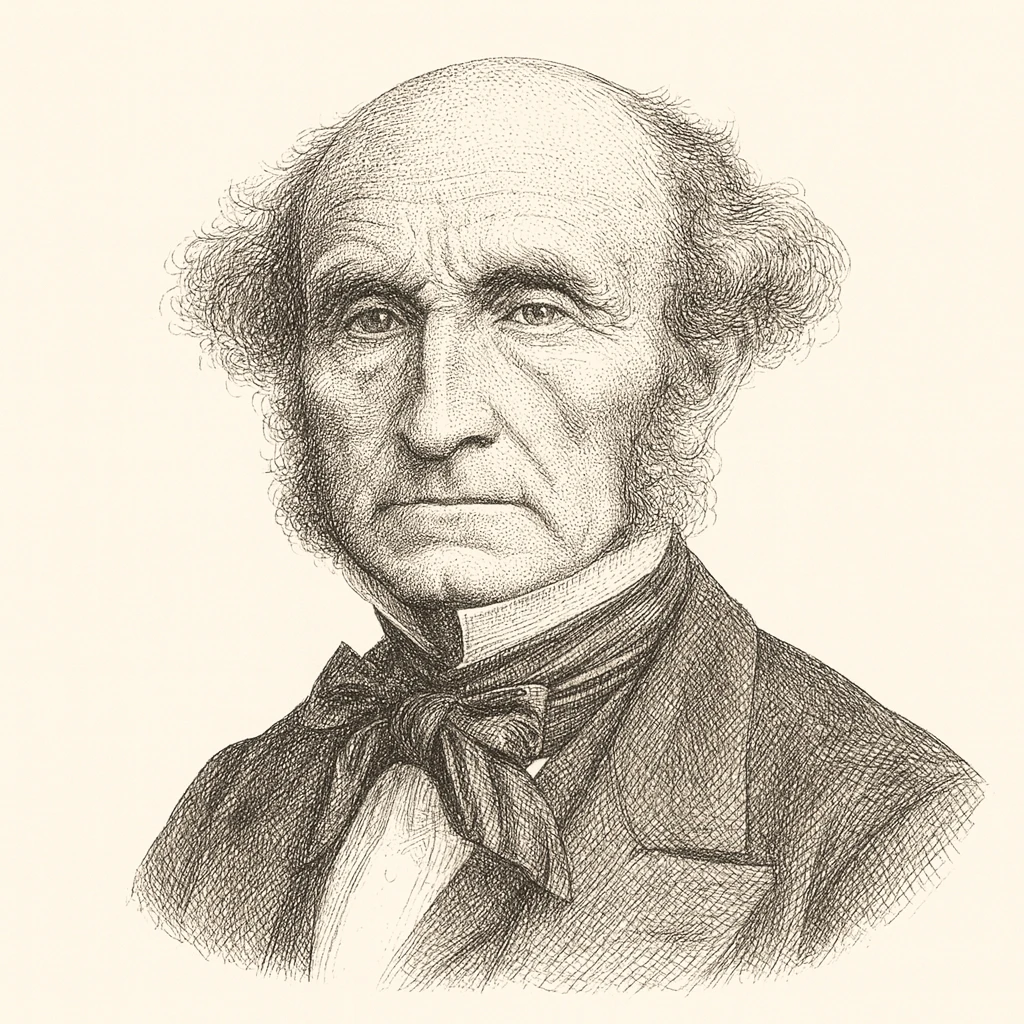
John Stuart Mill spent the first twenty years of his life being engineered. His father James Mill, a stern Scottish utilitarian and disciple of Jeremy Bentham, had decided before young John was born that the boy would become the perfect philosophical heir to the utilitarian movement. Mill learned Greek at three. Latin at eight. By the time he was a teenager he had read most of the philosophical canon his father deemed important and absorbed the Benthamite worldview as naturally as breathing.
Then, at twenty, the engineering broke down. Mill suffered what he later called a "mental crisis" — a slow, terrifying recognition that even if every utilitarian goal he had been raised to pursue came true, he would feel nothing. The cold calculus of pleasure and pain that his father had given him as a complete philosophy of life had no room for the things that actually made life feel worth living. He found his way out partly through reading Wordsworth's poetry, which gave him permission to feel things that Bentham's framework couldn't account for. He spent the rest of his career trying to rebuild liberalism on warmer foundations.
The result was a body of work that no purist of any school has ever been entirely happy with. Mill's On Liberty (1859) gave the modern world its sharpest defense of free speech and personal autonomy — the "harm principle," which holds that the only legitimate reason to restrict an individual's freedom is to prevent harm to others, became one of the foundational arguments of liberal political theory. But Mill couldn't stop there. His Principles of Political Economy (1848) argued that markets were generally the best system for organizing production but that the distribution of wealth was a human choice that society could and should adjust through policy. His Subjection of Women (1869) made him one of the first major male philosophers to argue for full legal and political equality of the sexes — a position so radical at the time that it cost him friendships and political support.
Mill served briefly in Parliament, where he proposed (unsuccessfully) extending the vote to women decades before the suffragist movement made it a mainstream cause. He spent his last years in Avignon, France, near the grave of Harriet Taylor — his intellectual partner and eventual wife, whose influence on his thinking he insisted was more profound than any other person's, and whose contributions historians still debate the full extent of. He died there in 1873.
What Mill bequeathed to the contemporary world is harder to summarize than what almost any other philosopher gave us, because he tried to do too many things. He wanted markets without cruelty. He wanted utilitarianism with a soul. He wanted freedom that included the freedom to flourish, not just the freedom to be left alone. Every contemporary tradition that descends from him — and there are many — has had to pick which Mill they want to inherit.
John Stuart Mill is associated with Civil Libertarian. See the archetype